UC HEALTH LINE: Trial Studies New Way to Deliver Parkinson's Medication

CINCINNATIMost medications for Parkinsons disease are taken orally, at certain times of the day. But doctors at UC Health University Hospital are participating in a clinical trial that significantly changes the Parkinsons drug-delivery model.
Parkinsons disease is a chronic, degenerative neurological disorder in which certain dopamine-producing cells in a region of the brain begin to die. When these cells die, neurons in the brain fire erratically, leaving patients less able to direct or control their movements.
Abbott's Levodopa-Carbidopa Intestinal Gel treatment system (referred to as Duodopa in Europe, where it is commercially available) feeds levodopa (the precursor of dopamine) into the upper intestine via a small tube inserted directly into the first part of the small bowel, or duodenum. The medication is suspended as a stable gel from a cassette worn outside the body. The programmable pump allows the patient or physician to adjust the delivery of medication.
The system is in a phase 3 clinical trial, the final step of testing before study results are submitted to the Food and Drug Administration (FDA) to obtain a New Drug Application. Phase 3 trials are multi-center trials on large patient groups.
"With the way we administer most other Parkinsons medications, the stimulation to dopamine receptors is given, then taken away, in multiple cycles throughout the day, says UC Health neurologist Alberto Espay, MD, a member of the UC Neuroscience Institute at University Hospital. "With this system, were basically bathing the patient in dopamine at all times, at a more physiologic rate, eliminating the artificial variability of stimulation that is otherwise inflicted upon the brain.
If found to be safe and effective and approved by the FDA, the system may offer the greatest potential for patients with advanced stage Parkinsons disease where oral treatments are no longer effective. With Parkinsons, Espay says, there is a wearing-off phenomenon as the disease progresses and intervals between doses need to become progressively shorter to minimize the re-emergence of Parkinsons symptoms.
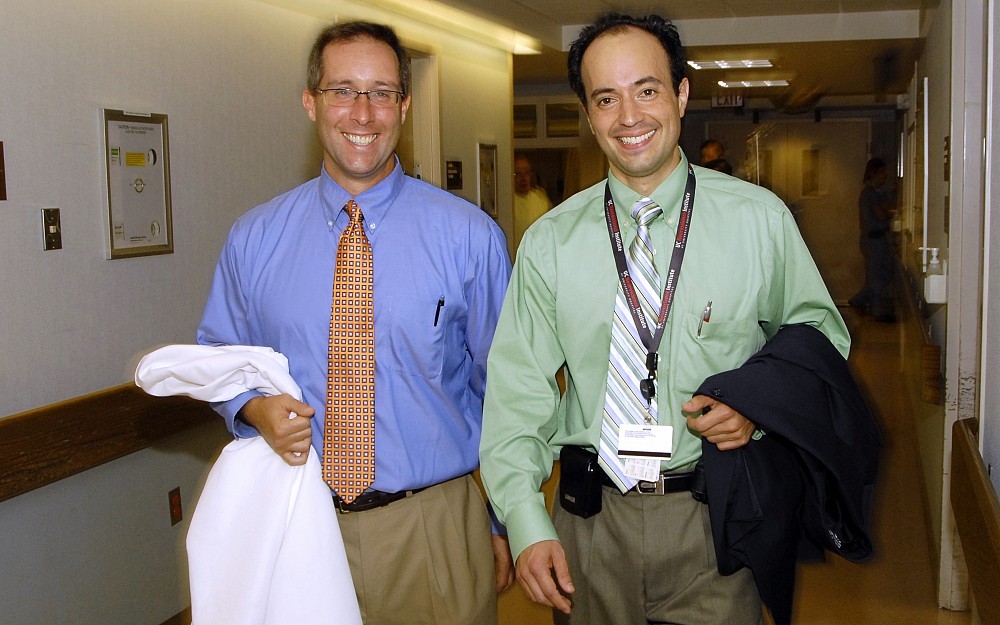
Espay works in cooperation with UC Health physician Nathan Schmulewitz, MD, who performs the tube insertion procedure at University Hospital. Patients typically are hospitalized for about a week for testing before the procedure and recuperate in the hospital afterward.
Don Truesdale, 46, of Maineville, underwent the procedure at University Hospital in March 2009. He wears the cassette 16 hours a day, taking it off to sleep at night.
"The whole experience at University Hospital was top-notch, he says. "Everyone from the physical therapy assistants all the way up was tremendous.
Tags
Related Stories
Cancer Center plays key role in lab research, clinical trials for new pancreatic cancer drug
September 1, 2026

WLWT and WCPO highlighted the contributions of University of Cincinnati Cancer Center researchers that helped lead to the recent FDA approval of daraxonrasib, a new treatment for pancreatic cancer.
Cancer Center physician receives $150,000 New Investigator Research Grant to study treatment-resistant leukemia
September 1, 2026
The University of Cincinnati Cancer Center’s Sarah Skuli, MD, PhD, received a two‑year, $150,000 Leukemia Research Foundation New Investigator Grant to study TP53‑mutated leukemia, a treatment‑resistant subtype with very poor outcomes.
Heavy social media use linked to depression
August 31, 2026

U.S. News and World Report, Yahoo! News, MSN, USA Today and other national media highlight a new study by the University of Cincinnati and Northwestern University that found a correlation between heavy social media use and depression in adults.