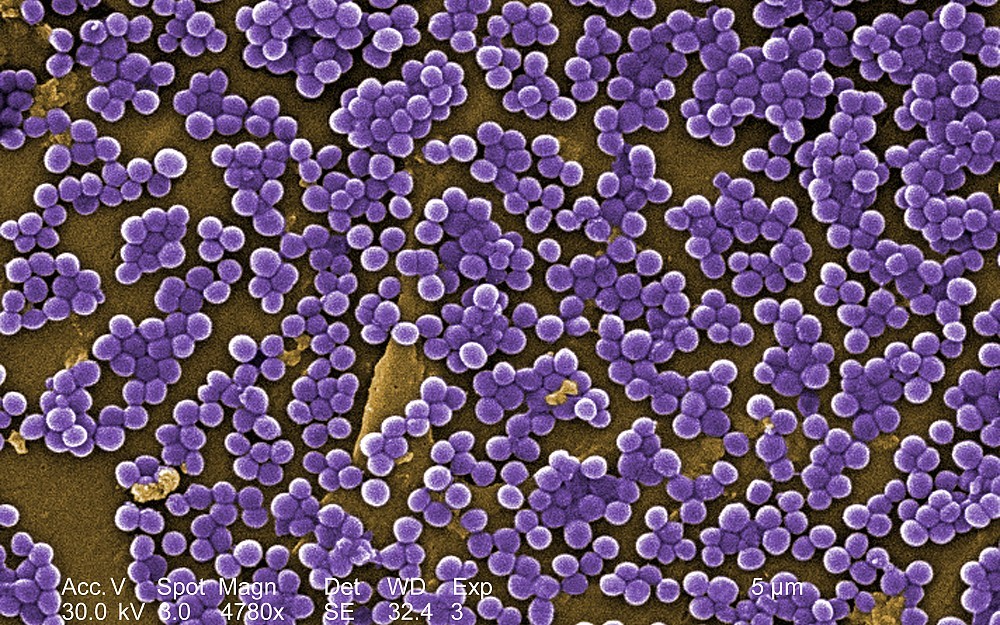
UC HEALTH LINE: MRSA Becoming More Common Outside of the Hospital

CINCINNATIIt used to be known as the bacteria you contracted after being admitted to the hospital.
But now, experts are saying methicillin-resistant Staphylococcus aureus (MRSA) may be more prevalent in your stores, gym and even your home than in the halls and walls of your local infirmary.
World MRSA Day 2010 is Oct. 1, and Francine Kidd, infection control practitioner at UC Health University Hospital, says people should be cautious of this bacterial skin infection that is highly resistant to some antibiotics.
"MRSA is a condition that was thought to be predominately acquired among hospital populations, where patients with invasive devices and weakened immune systems were at greater risk of infection than the general public, she says. "However, the situation has flipped, and now were seeing more people coming into the hospital with MRSA than leaving with it.
Kidd says compromised skin surfaces, contact with those infected and inadequate personal hygiene are just a few ways someone can develop MRSA.
"MRSA is a skin organism, she explains. "It cant hurt you unless you get a break in your skin. Then, it can get in and start an infection. It is seen a lot in contact sportslike footballbecause people slam into each other and can easily break their skin, which is all MRSA needs to set up an infection. Hospital infections are seen more in the bloodstream, sputum (mucus) and other deep organs. Outside of the hospital, MRSA is seen mostly as a skin abscess.
She says prevention is much betterand easierthan a cure.
"Cleanliness and extra precaution should be in the forefront of everyones mindswhether youre going to the grocery or running on the treadmill at your local gym, she says.
Kidd says the first line of defense is the easiest.
"Wash your hands, she says. "MRSA is usually transmitted by everyday touching. Use soapy water and friction for at least 20 seconds. Use of a hand sanitizer is protective, especially when you're not near a sink. In fact, alcohol hand sanitizers can be better than washing because they kill germs. When you wash, you loosen the germs from your skin and rinse them down the drain.
In addition, Kidd says cover open scrapes or blisters, and if you are involved with contact sports, make sure to shower and wash after participating.
"Disinfect gym equipment before and after use, and bring your own towels and flip flops, she says. "Dont share.
"MRSA is not a new condition, and weve been hearing a lot about its effects recently, she continues. "Just because we dont hear about it every day doesnt mean it isnt out there. Do your best to protect yourself by being mindful of your health habits and the habits of others.

Abscess caused by methicillin-resistant Staphylococcus aureus bacteria (MRSA)
Tags
Related Stories
Cancer Center plays key role in lab research, clinical trials for new pancreatic cancer drug
September 1, 2026

WLWT and WCPO highlighted the contributions of University of Cincinnati Cancer Center researchers that helped lead to the recent FDA approval of daraxonrasib, a new treatment for pancreatic cancer.
Cancer Center physician receives $150,000 New Investigator Research Grant to study treatment-resistant leukemia
September 1, 2026
The University of Cincinnati Cancer Center’s Sarah Skuli, MD, PhD, received a two‑year, $150,000 Leukemia Research Foundation New Investigator Grant to study TP53‑mutated leukemia, a treatment‑resistant subtype with very poor outcomes.
Heavy social media use linked to depression
August 31, 2026

U.S. News and World Report, Yahoo! News, MSN, USA Today and other national media highlight a new study by the University of Cincinnati and Northwestern University that found a correlation between heavy social media use and depression in adults.