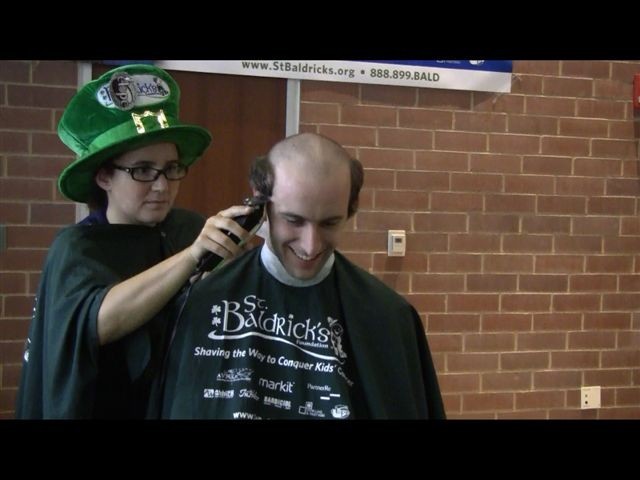
UC's Future Physicians Raise Over $13K by Going Bald for Pediatric Cancer Patients

CINCINNATIThe goal was to raise $11,000 for pediatric cancer researchand isnt it just like University of Cincinnati students to overachieve!
"Were nearing $14,000 and hope to have a few more thousand come in before May, UC College of Medicine second-year student Jamie Lovell said of exceeding their goal at the head-shaving event on St. Baldricks Day, March 18.
Approximately 20 medical students and one faculty member, Edmund Choi, PhD, had their heads shaved to show solidarity for the cause named for a fusion of "St. Patricks Day and "bald.
The St. Baldricks Foundation coordinates worldwide head-shaving events that raise money for childhood cancer research. According to the foundation, since 2005 it has funded over $56.9 million in childhood cancer research. In 2010, volunteers helped raise more than $22.2 million by hosting more than 800 events and shaving more than 38,200 heads.
This is the second year the event has been organized by UC medical students who belong to the pediatric club and the oncology cluband Laura Wexler, MD, senior associate dean of student affairs, seems to have added the title of chief barber to her credentials.
"This kind of charitable support is a very meaningful experience for the students, says Wexler.
Related Stories
Cancer Center plays key role in lab research, clinical trials for new pancreatic cancer drug
September 1, 2026

WLWT and WCPO highlighted the contributions of University of Cincinnati Cancer Center researchers that helped lead to the recent FDA approval of daraxonrasib, a new treatment for pancreatic cancer.
Cancer Center physician receives $150,000 New Investigator Research Grant to study treatment-resistant leukemia
September 1, 2026
The University of Cincinnati Cancer Center’s Sarah Skuli, MD, PhD, received a two‑year, $150,000 Leukemia Research Foundation New Investigator Grant to study TP53‑mutated leukemia, a treatment‑resistant subtype with very poor outcomes.
Heavy social media use linked to depression
August 31, 2026

U.S. News and World Report, Yahoo! News, MSN, USA Today and other national media highlight a new study by the University of Cincinnati and Northwestern University that found a correlation between heavy social media use and depression in adults.