Study Examines Use of Blood Pressure Medicine to Change Markers for Heart Disease

CINCINNATIA new clinical trial is examining possible benefits of a Federal Drug Administration-approved drug for high blood pressure, not frequently used in the U.S., in patients with heart disease.
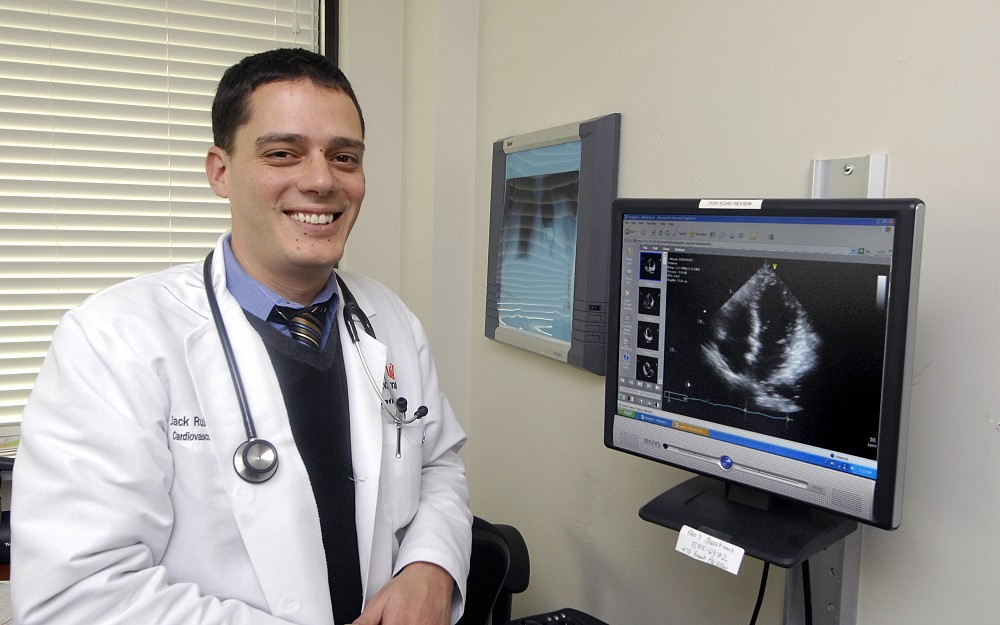
The study, led by UC Health cardiologist Jack Rubinstein, MD, is aimed at finding the impact of nebivolol on cardiac muscle function.
Nebivolol is part of a family of drugs known as beta blockers but also has a nitric oxide-mediated response in the body, important in cell signaling. It is used in treatment of hypertension. In Europe, it has been effective in treating congestive heart failure.
"The medical community has become increasingly aware that diseases such as hypertension and heart failure progress from preclinical appearance to obvious pathologic changes over long periods of time, Rubinstein says. "Recent advances in echocardiographic imaging are now permitting physicians and researchers to identify early changes in heart function and potentially modify underlying disease processes before more obvious and less reversible abnormalities occur.
"Recently, we used echocardiographic technology to identify minor changes in heart function associated with statin therapy that were not identified with traditional techniques. In other studies, nebivolol has been shown to have blood pressure lowering effects similar to other beta blockers with added effects, such as the improvement of blood flow, which could be beneficial for those at risk for heart disease.
The study will be a six-month, open-label trial comparing the effects of nebivolol in mildly hypertensive participants aged 20 to 60 years, who will be placed on 5 milligrams of the medication daily.
If their blood pressure stays greater than 150/90 (normal), then the dosage will increase to 10 milligrams.
"As long as blood pressure stays at safe levels, participants will be given stress, or treadmill, tests, at the beginning of the trial, at two weeks, and then at the three- and six-month markers, Rubinstein says. "Blood pressure measurements as well as testing for overall well-being will be measured at each visit as well.
Cardiologists will then correlate their findings with echocardiographic readings digitally recorded at intervals throughout the study. An echocardiogram is an ultrasound that helps experts visualize and examine the heart.
"We believe that the added benefits with the use of nebivolol could improve outcomes by preventing not only hypertension but by preventing the onset of heart disease, Rubinstein says. "The preliminary information should prompt further studies in all stages of hypertension and heart failure as these markers may function as clinical cues that are easy to obtain, follow and potentially modify during the course of treatment.
This investigator-initiated study is funded by Forrest Laboratories. Rubinstein cites no conflict of interest.
Tags
Related Stories
Cancer Center plays key role in lab research, clinical trials for new pancreatic cancer drug
September 1, 2026

WLWT and WCPO highlighted the contributions of University of Cincinnati Cancer Center researchers that helped lead to the recent FDA approval of daraxonrasib, a new treatment for pancreatic cancer.
Cancer Center physician receives $150,000 New Investigator Research Grant to study treatment-resistant leukemia
September 1, 2026
The University of Cincinnati Cancer Center’s Sarah Skuli, MD, PhD, received a two‑year, $150,000 Leukemia Research Foundation New Investigator Grant to study TP53‑mutated leukemia, a treatment‑resistant subtype with very poor outcomes.
Heavy social media use linked to depression
August 31, 2026

U.S. News and World Report, Yahoo! News, MSN, USA Today and other national media highlight a new study by the University of Cincinnati and Northwestern University that found a correlation between heavy social media use and depression in adults.