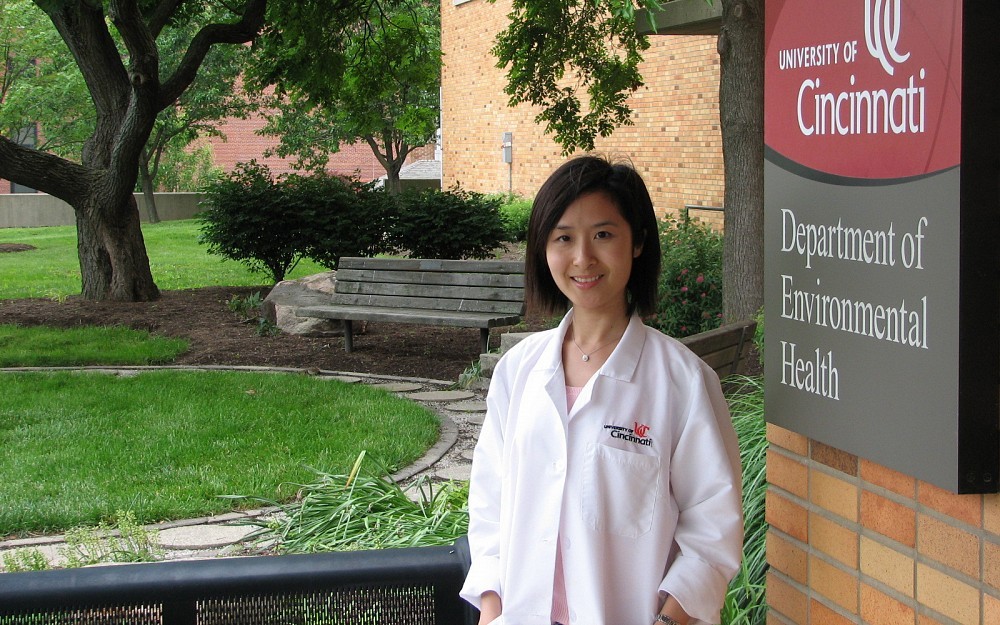
Focus on Science With Hung-ming Lam, PhD

Focus On highlights faculty, staff, students and researchers at the UC Academic Health Center. To suggest someone to be featured, please email uchealthnews@uc.edu.
Hung-ming Lam, PhD, is a research associate in environmental health who focuses on estrogen receptor and prostate cancer.
How long have you been at UC?
"I joined UC in February 2007. I started out working as a postdoc in the lab of our environmental health chair, Shuk mei Ho, PhD. I received my undergraduate and postdoctoral degrees from the Chinese University of Hong Kong. I joined this lab after completing my PhD study on cardiovascular diseases."
What is the focus of your research?
"Our work focuses on estrogen receptor and prostate cancer."
What got you interested in this topic originally?
"G protein-coupled receptor 30 (GPR30) is a recently identified estrogen receptor, apart from classical estrogen receptor-alpha and -beta. We are the first group to identify the growth inhibitory role of this estrogen receptor in prostate cancer. There is no curative treatment for advanced hormone refractory prostate cancer. Chemotherapy poses major side effects, immensely reducing the quality of life of patients. We are testing if GPR30 is a good target for this end-stage prostate cancer or not.
"We established a castration-resistant prostate cancer xenograft model recapitulating the two stages of human prostate cancer: Hormone-sensitive stage and hormone-refractory stage. We found that a specific agonist for GPR30, G-1, can halt the growth of castration-resistant (hormone-refractory) prostate tumors by inducing massive tumor cell death, whereas G-1 has no effect on an intact animal without castration. The result suggested that castration (or androgen-ablation therapy in contemporary medicine) somehow primed the prostate tumor for the later cell kill by G-1 (activation of GPR30). Mostly importantly, G-1 exerts undetectable toxicity to the mouse."
Science is a slow, methodical process. What keeps you motivated?
"I am curious about everything. As I grew up, I kept asking, 'Why?' I love new discoveries and team-science. I still remember during the SARS outbreak in 2003. I had to stop all my experiments and join the team to sequence SARS genome. We had to compete with time and work in two-shifts. Then, I was chosen to present the work in Hong Kong and China. For a first-year PhD student, it was very exciting, and I was fortunate to work with brilliant people in the lab throughout the competitions. To me, exploring science is driven by unlimited curiosity, fueled by collaboration and persistence and finally rewarded by answers and recognition. I'm glad that my motivation is supported by good mentors, collaborators, my family and friends."
Any exciting new research projects on the horizon?
"We are now actively looking into the mechanism triggering the massive cell death by G-1 and how castration predisposes a favorable environment for G-1 action. The current finding can perfectly fit in the therapeutic window: After castration/hormone-ablation therapy, when prostate cancer relapses, G-1 can be applied to patients to halt tumor growth before patients go into the end-stage chemotherapy, which has tremendous side effects."
When you are not in the lab, what are your hobbies?
"I did dancing and Taekwondo in Hong Kong, and I enjoyed hanging out with friends. When I moved to the U.S., I became fascinated with traveling to explore more of this country."
You have been recognized frequently for your work. Tell us about your recent awards.
"This year, I was the recipient of the Outstanding Abstract Award from the Endocrine Society for exploring GPR30 as a potential therapeutic target for advanced prostate cancer. In 2010, I was a finalist and winner of the ENDO 10 presidential poster competition and received a travel award. I was a finalist and winner of the ENDO 09 presidential poster competition as well."

Kettering Laboratory
Tags
Related Stories
On-site training in Speech & Hearing Clinic sets UC’s programs apart
August 27, 2026
At the University of Cincinnati’s Speech & Hearing Clinic, Doctor of Audiology and Speech-Language Pathology graduate students gain real-world experience while providing free speech and hearing services to the community.
Funding expands UC research into weight gain side effects of bipolar medication
August 26, 2026
University of Cincinnati researchers have been approved for funding by the Patient-Centered Outcomes Research Institute (PCORI) to expand the implementation of healthy lifestyle interventions and metformin prescription to help manage weight gain in overweight or obese youth taking second-generation antipsychotic medications.
One in four NFL players had CTE at death
August 25, 2026

Forbes cites research on concussions and football helmets by the University of Cincinnati in a report that found one in four NFL players had brain damage at death.