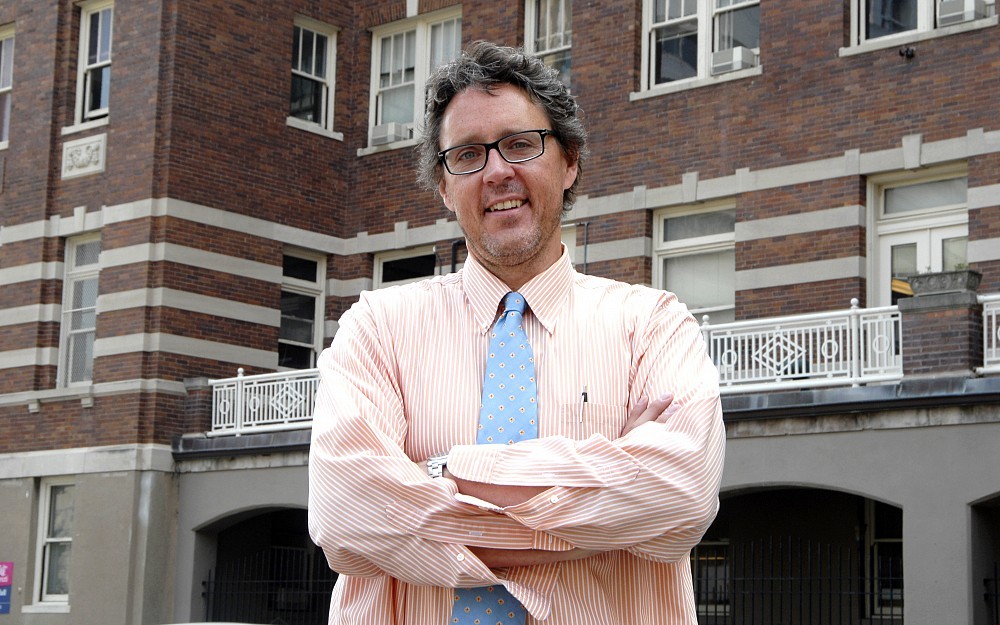
Psychiatry Resident Has Profitable 'Millionaire' Appearance

As a psychiatrist, Peirce Johnston, MD, says he wont be tormented the rest of his life by thoughts of Beethovens Symphony No. 5, the topic of the question that ended his run on "Who Wants to Be a Millionaire.
In fact, Johnston says, "I love Beethoven. And when I hear Beethovens 5th, Ill smile.
Johnston, a UC College of Medicine alumnus and fourth-year resident in the department of psychiatry and behavioral neuroscience, was a $38,600 winner on the nationally syndicated TV game show that aired May 24. Hosted by Meredith Viera, the show was taped at ABC studios in New York.
Johnston successfully fielded eight questions having to do with topics including music, movies, explorers and nuts but was stumped by the $100,000 question, which gave him the names of first three notes of Beethovens Fifth Symphony (all are G-naturals) and challenged him to identify the fourth.
"I think if I had to pick a question to walk away from, it would be a question like that because Ive never studied music and I had no guilt about not knowing it, Johnston says. (Its a question plenty of trained musicians would have struggled with under the circumstances; the answer was E-flat.)
Johnston chose to walk away at that point, as an incorrect answer would have cost him $13,000 by sending him back down to the $25,000 level. (He used his three "lifelines by "jumping two questionsincluding one about the Osterizer blender that he knew but "talked myself out ofand getting help from the audience on a third.)
Johnston has a background that makes him perfectly suited for game show success. Before starting medical school at age 35, he was an English professor who taught at Miami University, the University of Massachusetts Amherst and UC, specializing in creative writing and 19th- and 20th-century fiction.
"What I do in psychiatry is really just an extension of what I did in English, Johnston points out.
"I loved teaching, but I was always sorry to see the students go at the end of the semester. In psychiatry, I can help a patient express himself or herself about something even more vital than in their writing, and for a much longer durationperhaps for a lifetime.
Johnston appeared calm and relaxed on the show, and has nothing but good things to say about the overall experience. He auditioned last fall at Newport on the Levee after first passing an online test. The audition consisted of more testing plus an interview with show personnel.
"I thought I had failed, he says, "but two weeks later I got a phone call and a postcard inviting me on the show.
Johnston and his wife, Melissa, went to New York for the taping. (Expenses were not paid, but contestants were guaranteed $1,000.) Their two daughters, 8 and 4, stayed home and did not know how he did until they actually saw the show. Show rules prohibited Johnston from giving away the results or talking about the content of the questions before the air date.
"It was a good experience, and fun, Johnston says. "I was thinking before the show, if I won $30,000 or so Id be pretty happynot because of the money, but because it would mean I did pretty well. And as it turned out, thats about how much I won.
Related Stories
On-site training in Speech & Hearing Clinic sets UC’s programs apart
August 27, 2026
At the University of Cincinnati’s Speech & Hearing Clinic, Doctor of Audiology and Speech-Language Pathology graduate students gain real-world experience while providing free speech and hearing services to the community.
Designing with cancer patients' needs in focus
August 27, 2026
Kristina Shin is designing garments that prioritize the comfort, function and confidence of breast cancer patients, addressing a need often overlooked by traditional fashion.
UC, NKU renew longstanding partnership supporting Army ROTC cadets
August 26, 2026
The University of Cincinnati Army ROTC and Northern Kentucky University (NKU) have renewed a longstanding partnership that supports students preparing to become Army officers and leaders in their communities. The universities formalized the renewed agreement during a signing event Aug. 11 at NKU.