Air Pollution Study Still Recruiting Participants, Receives Scientific Boost With Lab-in-Chip Sensor

Environmental health research should be done with a community, not simply on a community.

That’s the idea behind the current CARES (Communities Actively Researching Exposure Study) project, led by Erin Haynes, DrPH, of UC’s environmental health department. Now over two years into recruitment, the research team has about 250 study participants and expects to achieve full enrollment by the beginning of 2012. 

"We’ve had great success so far, and it’s because the community is involved in addressing their health concerns and seeking answers,” says Haynes, who is co-principal investigator of CARES with Marietta, Ohio, resident Caroline Beidler. 

The study is a partnership between UC, Marietta College and the community that looks at air pollution and its effects on childhood health—particularly related to the heavy metal manganese—in southeastern Ohio communities. 

Manganese is a metal used widely in the production of steel, aluminum alloys, batteries and fertilizers. It is also added to unleaded gasoline to reduce engine knocking during combustion. 

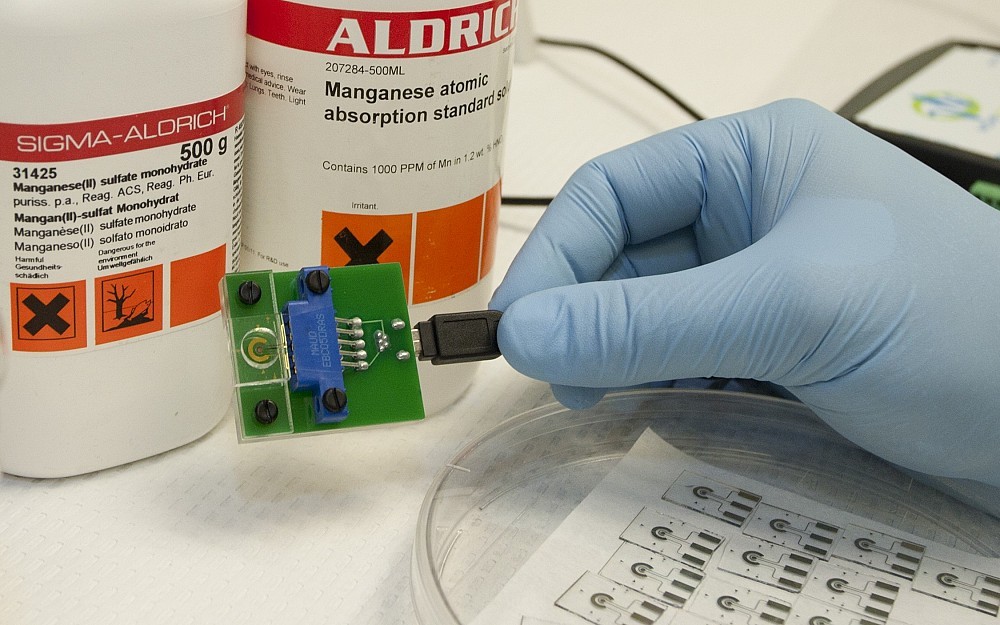
In a complementary effort, UC engineering associate professor Ian Papautsky and chemistry professor William Heineman have been developing a lab-on-a-chip sensor for measuring heavy metals. Haynes has partnered with them to develop the first lab-in-a-chip sensor that enables researchers to quickly measure manganese in humans with just a few drops of blood. The new sensor is expected to have low production costs and is disposable, but made with more eco-friendly components. 

"The sensor’s working electrode is made of bismuth thin film as opposed to the more commonly used mercury, which can be harmful to both humans and the environment,” says Papautsky. "It is also child-friendly because, unlike traditional blood tests for manganese, only a few drops of blood will be necessary to get an accurate measurement.” 

For Haynes, this sensor will be a critical tool for collecting data without causing unnecessary burden to study participants.

"We have to process our current samples in batches of 50, so study participants typically have to wait several months before we can give them their test results,” says Haynes. "The manganese sensor will provide results in just a few minutes and we can share them with our study participants the same day. This will ease a lot of anxiety for individual study participants as well as accelerate our data collection process.” 

The sensor is expected to be ready for initial field testing in 2012.  Before it is used in the CARES study, it will be tested for safety and effectiveness in existing human blood samples. 

CARES is still recruiting children ages 7 to 9 who live in Washington, Wood and Guernsey counties for the study. For more information on eligibility, visit the CARES website

Marietta resident Caroline Beidler (left) and Erin Haynes, DrPH, are researching potentially dangerous metals polluting the Marietta area.

Marietta resident Caroline Beidler (left) and Erin Haynes, DrPH, are researching potentially dangerous metals polluting the Marietta area.

Erin Haynes, DrPH

Erin Haynes, DrPH

Tags

Related Stories

1

UC students organize free health clinic in community

July 13, 2026

The University of Cincinnati student chapter of Remote Area Medical held its annual free health clinic July 11-12 at St. Xavier High School. Medical, dental and vision care was offered to adults and children, with no income requirements or insurance needed.

2

Is speech-to-text AI really reliable?

July 10, 2026

UC researcher Nelly Elsayed’s study in the International Journal of Medical Informatics reveals key risks in clinical speech-to-text AI and shows why human review is essential.

3

Hoxworth Blood Center CEO advocates on Capitol Hill during National Blood Advocacy Week

July 9, 2026

Hoxworth Blood Center, University of Cincinnati, has announced that David Oh, MD, director and chief executive officer, joined blood center leaders, patient advocates and partner organizations in Washington, D.C., in June as part of Blood Advocacy Week, a national initiative led by America’s Blood Centers to strengthen the nation’s blood supply.
