Nuclear Medicine Test Could Pinpoint Parkinson s Disease Earlier

CINCINNATIEnabling earlier diagnosis and treatment of Parkinsons disease is the goal of a nuclear medicine test now being offered at UC Health University Hospital.
The test uses a unique imaging agentknown as DaTscan, the first and only radiopharmaceutical approved by the Food and Drug Administration to help physicians evaluate patients with tremors and other warning signs of Parkinsons disease. The chronic and progressive movement disorder has no known cure. The team expects to scan its first patient in early September.
Developed by GE Healthcare, DaTscan works by combining a drug compound labeled with a commonly used radioactive tracer which is injected into the patients bloodstream. It then travels to the central nervous system and is absorbed by specific cells in the brain that transmit dopamine.
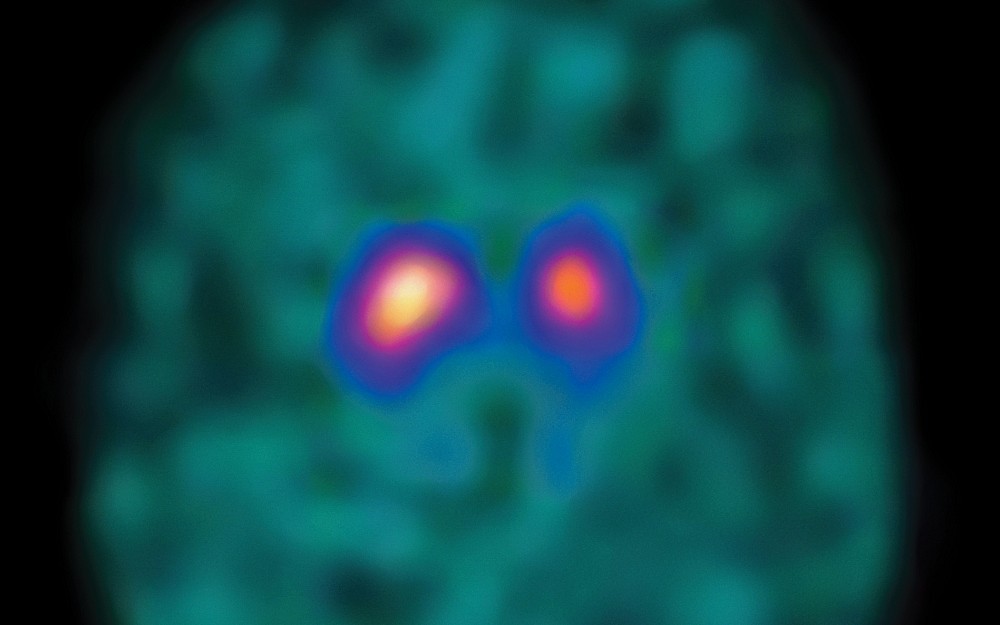
Nuclear medicine physicians then use a SPECT (single photon emission computed tomography) camera to capture 3D images that show nerve function and dopamine receptor activity in the upper midbrain. Dopamine is a chemical involved in generating and controlling movements and other central nervous system functions. When dopamine is deficient, movements become impaired as is the case in Parkinson's disease.
"We know that symptoms of Parkinsons are caused by loss of nerve cells in the substantia nigra, a region in the upper midbrain. Loss of these cells causes a depletion of dopamine at a higher level in the brain called the striatum, explains Mariano Fernandez-Ulloa, MD, director of nuclear medicine at University Hospital and professor at the UC College of Medicine. "By scanning the brain using DaTscan we can assess the degree of loss of dopamine function in the striatum, which is typically observed in patients with Parkinsons disease. This diagnostic tool complements other important clinical assessment performed by the neurologist.
SPECT images are analyzed as a series of "slices and then fused with other brain imaging tests (magnetic resonance imaging, computed tomography) to create a detailed visual map of nerve function in the brain.
Alberto Espay, MD, says studies indicate that DaTscan can greatly assist in the diagnosis of patients with Parkinson's disease at early stages or with atypical presentations, and for whom diagnostic uncertainty exists.
"Determining the nature of tremors and other movement abnormalities in parkinsonian conditions is at the mercy of a physicians judgment. In many instances, a firm diagnosis of Parkinson's disease is difficult to reach because it can present in so many different ways, explains Espay, a UC Health neurologist with the UC Neuroscience Institutes Gardner Center for Parkinsons Disease and Movement Disorders. Espay is also an associate professor at the UC College of Medicine. "Studies indicate that DaTscan can greatly assist in the diagnosis of patients with Parkinson's disease at early stages or with atypical presentations, and for whom diagnostic uncertainty exists.
"We hope this tool will enhance our ability to distinguish Parkinsons disease from other causes of motor abnormalities that may look like it. It may also prove important for earlier diagnosis, especially as we prepare to examine pharmacological treatments that may slow down the disease,adds Fredy Revilla, MD, associate professor at the College of Medicine and director of the Gardner Center.
According to the National Institute of Neurologic Disorders and Stroke, more than 1 million people are believed to suffer from Parkinsons disease and 50,000 are diagnosed annually. Common symptoms of the disease include tremors, slow movement or the inability to move, rigid limbs, a shuffling gait and stooped posture.
For more information on the UC Health movement disorder specialists, visit ucphysicians.com. More information on the Gardner Center is available at ucgardnercenter.com.
University Hospital accredited by the American College of Radiology (ACR) for all types of diagnostic imaging, including nuclear medicinean honor UC Health holds exclusively in the Cincinnati area. University Hospital and the physicians affiliated with the Gardner Center have no financial interest in GE Healthcare.

A DaTscan image, showing normal dopamine activity in the brain. Nira Ben-Jonathan has found that a receptor in dopamine is linked to breast cancer.

Mariano Fernandez-Ulloa, MD, is a professor of radiology.

Fredy J. Revilla, MD, associate professor of neurology at the UC College of Medicine
Related Stories
Cancer Center plays key role in lab research, clinical trials for new pancreatic cancer drug
September 1, 2026

WLWT and WCPO highlighted the contributions of University of Cincinnati Cancer Center researchers that helped lead to the recent FDA approval of daraxonrasib, a new treatment for pancreatic cancer.
Cancer Center physician receives $150,000 New Investigator Research Grant to study treatment-resistant leukemia
September 1, 2026
The University of Cincinnati Cancer Center’s Sarah Skuli, MD, PhD, received a two‑year, $150,000 Leukemia Research Foundation New Investigator Grant to study TP53‑mutated leukemia, a treatment‑resistant subtype with very poor outcomes.
Heavy social media use linked to depression
August 31, 2026

U.S. News and World Report, Yahoo! News, MSN, USA Today and other national media highlight a new study by the University of Cincinnati and Northwestern University that found a correlation between heavy social media use and depression in adults.