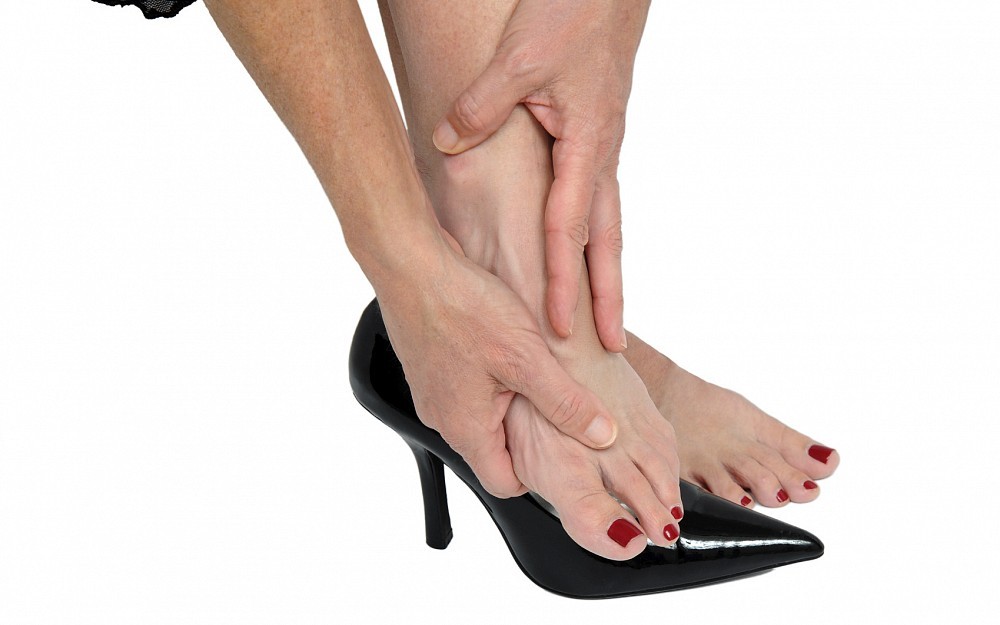
HEALTH LINE: Wearing Heels Could Lead to Arthritis Later in Life

CINCINNATIBeauty is pain: Weve heard women say thatjoking or notfor decades.
This mantra helps you get through those agonizing last few miles on the treadmill or jazzes you up when going to the salon for an eyebrow wax or tweeze.
But some of the pain associated with societys image of beauty could truly be harmful for health, says one UC Health primary care physician, and it doesnt have to be as extremeor as expensiveas surgery or injections.
"There are all sorts of products on the market that are truly unnecessary, but we are told we need these things to fit into society, says Shyamala Jagtap, MD, who sees patients in the UC Health Physicians Office in West Chester, citing teeth whitener as an example and a new deodorant that is supposed to stop underarm hair growth in women. "These are not harmful, but they are not vital to our health. In some cases, what makes us fit in could not only mean pain now, but also health problems down the road.
Specifically, Jagtap relates this to a fashion staple in most womens closets: High heels.
A recent poll by the Society of Chiropodists and Podiatrists found that 25 percent of women who wear high heels are more likely to get arthritis.
"When you stand, the forces of gravity supporting your body go along your spine, then split into two along your pelvic bones to your hipbones, downward into your thigh bones, then down your leg bones to your heel, and then along the outer margin of your feet. The forces then spread throughout the rest of the foot, to your toes and finally to your big toe, Jagtap explains. "If you change that alignment, causing weight to be borne on your toes instead of your heels, throwing your whole weight bearing system off and changing the line of gravity, it can affect your joints negatively, eventually leading to arthritis in your knees, ankles and back.
She adds that more immediate problems could arise before the aches and pains of arthritis begin.
"Feet, like ones ears and nose, keep growing throughout a lifetime, Jagtap says. "In most womens shoes, high heels in particular, the front of the shoe comes to a point at the center, causing the bigger toeour longest toeto get pushed towards the middle of the shoe, causing bunions.
Jagtap adds that cramming your feet into the small and narrow shoe box of high heels can lead to hammer toe, in which the end of the toe is bent downward. High heels can also lead to Achilles tendonitis and additional back problems.
In addition to purchasing shoes with a large enough shoe box to allow toes to align side-by-side, Jagtap suggests:
· Buy shoes at the end of the day. Feet swell throughout the day, and to avoid shoes that pinch, its best to buy when your feet are at their largest.
· Measure the right and left feet separately and buy shoes to fit the larger one, providing padding for the smaller one.
· Leave a little room in the shoe box, enough to slip an extra finger.
· Buyshoes with good arch and heel support.
· If you do buy heels, make sure they are no higher than an inch to an inch and a half.
· Walk around in new shoes to make sure they fit correctly; shoes should have a slight give when you lift the foot, and the back of the foot should not feel tight.
"If you really want to wear the most fashion-forward stilettos, you can carry something more comfortable and foot-friendly to change into, says Jagtap. "The older you get, the more you should think about comfort shoes, and you should always think about getting shoes that fit well. Its OK to be fashionable, but we must keep our health in mind and try to decide which is more important or determine a way to be both trendy and healthful.
Tags
Related Stories
Cancer Center plays key role in lab research, clinical trials for new pancreatic cancer drug
September 1, 2026

WLWT and WCPO highlighted the contributions of University of Cincinnati Cancer Center researchers that helped lead to the recent FDA approval of daraxonrasib, a new treatment for pancreatic cancer.
Cancer Center physician receives $150,000 New Investigator Research Grant to study treatment-resistant leukemia
September 1, 2026
The University of Cincinnati Cancer Center’s Sarah Skuli, MD, PhD, received a two‑year, $150,000 Leukemia Research Foundation New Investigator Grant to study TP53‑mutated leukemia, a treatment‑resistant subtype with very poor outcomes.
Heavy social media use linked to depression
August 31, 2026

U.S. News and World Report, Yahoo! News, MSN, USA Today and other national media highlight a new study by the University of Cincinnati and Northwestern University that found a correlation between heavy social media use and depression in adults.