Finding May Lead to Treatments for Obesity, Type 2 Diabetes

CINCINNATIActivating a specialized type of fat, known as brown adipose tissue, may help combat obesity as well as result in better glucose control for type 2 diabetes, according to new research conducted by scientists at the UC Metabolic Diseases Institute.
The current UC study suggests that activating brown adipose tissue through targeted inhibition of the cannabinoid receptor 1, also known as CB1, could effectively reduce body weight and blood glucose by increasing calorie burning in brown adipose tissue.
Silvana Obici, MD, and her UC-based team report these findings online ahead of print Oct. 10, 2011, in Diabetologia, the journal of the European Association for the Study of Diabetes.
CB1 receptor antagonists were previously used in human weight loss drugs offered in Europe but were taken off the market due to significant neurologic side effects like depression.
"CB1 antagonists still hold promise for fighting obesity and diabetesthe challenge is finding one that does not engage the receptors in areas of the brain that control mood and still maintains its enormous calorie-burning properties, explains Obici, senior author of the UC study. "We have shown that the powerful effects of CB1 antagonists on brown adipose tissue are mediated by the sympathetic nervous system. With further study, this could lead to a more effective and safer drug strategy for glucose regulation and weight loss.
Obici is now conducting further studies to determine the specific location of the CB1 receptor in the sympathetic nervous system that activates the calorie-burning, glucose-consuming properties of brown adipose tissue.
"Our findings suggest that the capacity of brown adipose tissue to burn calories and consume glucose is impaired in obesity and type 2 diabetes. If we could find an effective and safe way to reactivate the brown adipose tissues calorie-burning properties, this could represent a breakthrough in the search of more effective drugs against obesity and diabetes, Obici adds.
Funding support for this research comes from the National Institutes of Health, American Diabetes Association and Ethicon Endo-Surgery. Researchers involved in this study have no personal financial interests in Ethicon Endo-Surgery.

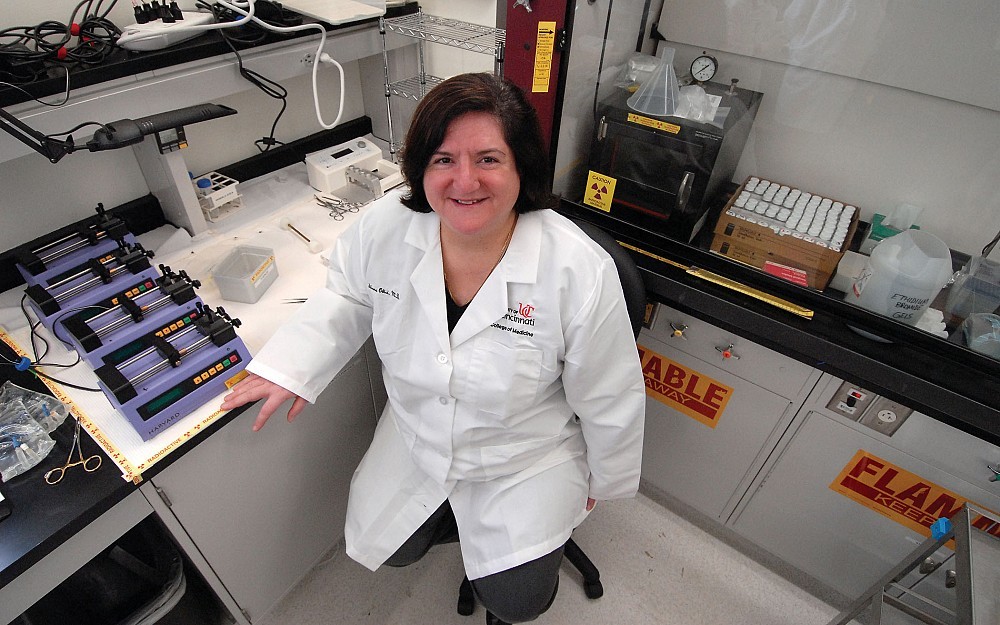
Silvana Obici, MD
Tags
Related Stories
Cancer Center plays key role in lab research, clinical trials for new pancreatic cancer drug
September 1, 2026

WLWT and WCPO highlighted the contributions of University of Cincinnati Cancer Center researchers that helped lead to the recent FDA approval of daraxonrasib, a new treatment for pancreatic cancer.
Cancer Center physician receives $150,000 New Investigator Research Grant to study treatment-resistant leukemia
September 1, 2026
The University of Cincinnati Cancer Center’s Sarah Skuli, MD, PhD, received a two‑year, $150,000 Leukemia Research Foundation New Investigator Grant to study TP53‑mutated leukemia, a treatment‑resistant subtype with very poor outcomes.
Heavy social media use linked to depression
August 31, 2026

U.S. News and World Report, Yahoo! News, MSN, USA Today and other national media highlight a new study by the University of Cincinnati and Northwestern University that found a correlation between heavy social media use and depression in adults.