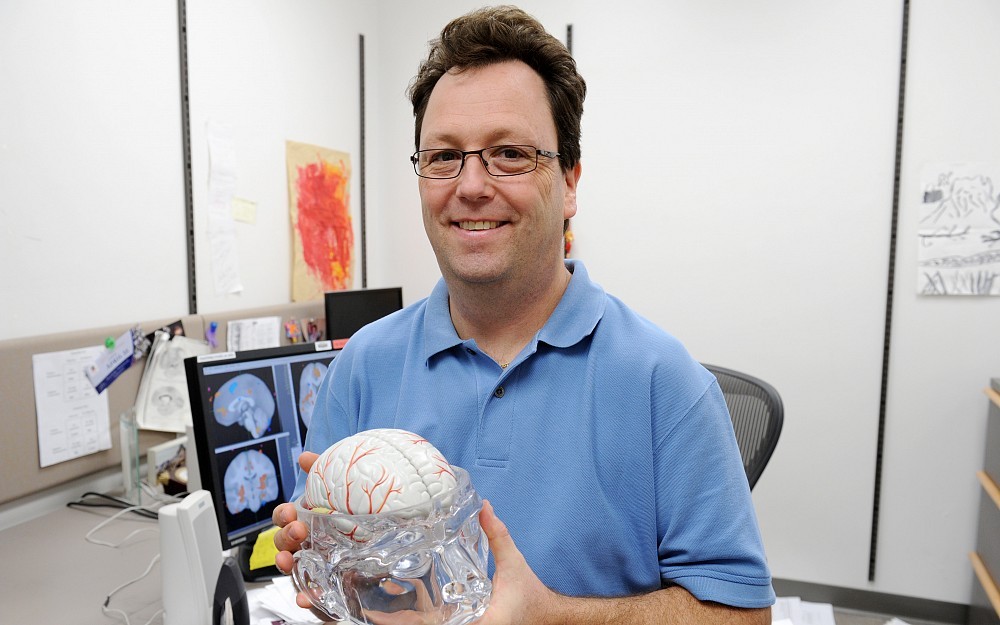
Focus on Research With James Eliassen, PhD

After studying in the West (Stanford University and the University of California, Davis) and East (Dartmouth College and Brown University), James Eliassen, PhD, settled in the Midwest as a research assistant professor at UC in the department of psychiatry and behavioral neuroscience. He is based at the College of Medicines Center for Imaging Research, where he is associate director. He also holds a secondary appointment as an assistant professor of psychology and is associate director of the Neuroscience Graduate Program.
Why did you come to UC and what brought you here?
"I came to UC in 2003 to pursue research about how the human brain learns simple associations. This research has implications for addiction, which some theories describe as an "associative learning disorder. Aside from the research opportunities and collegial atmosphere, one of the main draws for me was the then new Center for Imaging Research, which houses a state-of-the-art 4 Tesla MRI system. This research-dedicated MRI "brain camera can be used to take pictures of the active human brain while people play simple video or other 'games.'"
Share a bit about your current research focus.
"I am interested in how brain activity changes with learning and how addiction alters the normal behavior of the brain. I have been researching that question using functional MRI, event-related potential EEG and behavior. We study recreational users of MDMA ("ecstasy) and marijuana as well as healthy people. We find that past drug use alters brain activity during associative learning, which supports theories of addiction as an associative learning disorder. We also find that during learning, peoples brains respond differently to positive and negative performance feedback. Peoples brain respond more efficiently to positive feedback, and later performance is faster. With negative feedback there is a larger response and later performance is slower."
What implications might your research have on treatment?
"We are investigating two current implications of this research. First, we want to know if the differences that we see in brain activity for positive and negative feedback arise because we are activating two different learning circuits, one for reward-based learning and another for punishment-avoidance learning. In insects and mollusks, separate dopamine and norepinephrine circuits control reward and punishment-avoidance learning. If this is also true in humans, it could explain why addictions are so difficult to treat. Current treatments attempt to reduce the rewarding or intoxicating aspects of drug abuse. But if people continue addictions because they are avoiding the unpleasant side effects of withdrawal symptoms, a totally different set of brain regions may be involved that are not targeted by current treatments.
"The second, more recent implication of this work is whether learning through positive or negative feedback has implications for education. We are working to understand if brain imaging can be used to better understand different educational approaches. For instance, if brain activity and behavior are more efficient after positive feedback, does it help to use more positive feedback in instructional settings? Alternatively, if negative feedback is less efficient, could it provide longer-lasting learning because it engages more brain activity initially?"
Tell us a bit about yourself. Any hobbies?
"I do some amateur astronomy from my back yard. I visit the Cincinnati Observatory Center whenever possible, which is a UC-supported facility, by the way. I play music with friends occasionally, string bass and drums. I also spend time coaching my kids soccer and basketball teams."
Related Stories
Heavy social media use linked to depression
August 31, 2026

U.S. News and World Report, Yahoo! News, MSN, USA Today and other national media highlight a new study by the University of Cincinnati and Northwestern University that found a correlation between heavy social media use and depression in adults.
On-site training in Speech & Hearing Clinic sets UC’s programs apart
August 27, 2026
At the University of Cincinnati’s Speech & Hearing Clinic, Doctor of Audiology and Speech-Language Pathology graduate students gain real-world experience while providing free speech and hearing services to the community.
Designing with cancer patients' needs in focus
August 27, 2026
Kristina Shin is designing garments that prioritize the comfort, function and confidence of breast cancer patients, addressing a need often overlooked by traditional fashion.