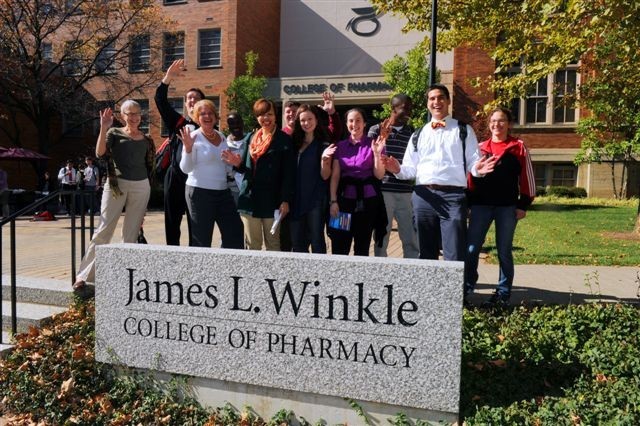
James L. Winkle College of Pharmacy Individualizes Student Plans for Semester Conversion

By this time next year, faculty, staff and students at 13 of UC's colleges and one of its degree-granting units will have several months of semester conversion under their belts, with hopefully few hiccups. At the UC Academic Health Center (AHC), three collegesnursing, pharmacy and allied health scienceswill undergo the conversion, along with some of the graduate programs at the College of Medicine. All are working hard to ensure that their policies and procedures are updated to align with UCs new semester schematic (more details of which can be found at www.uc.edu/conversion).
This month, were asking faculty and administrators at these colleges to give us some insight into what the conversion means to existing and potential students there.
Below, Bill Fant, PharmD, the colleges associate dean of academic affairs, discusses how the conversion process will affect the college.
For more information on semester conversion, see the student guide at www.uc.edu/content/dam/uc/conversion/docs/faqs/guide.pdf.
How are you anticipating the semester conversation affecting your college?
"The College of Pharmacy re-invented the Professional Curriculum leading to the Doctor of Pharmacy Degree. We have incorporated new accreditation standards into our curricular plans. We have developed transition plans for students who will be caught in the conversion from quarters to semesters. We have also developed individual advising plans for all of our students. These plans are dynamic and published for individual student on our private website. Plans of study will continue to be updated for any student who is not successful in completing a course on their original plan. We have created new curriculum and courses for our MS/PhD programs. We are working on individual advising plans for these students."
Have you made any changes in anticipation of it?
"We have added, modified and deleted courses in both professional and graduate programs. We have made the necessary scheduling adjustments and have balanced workloads to avoid duplicate teaching whenever possible. Students have access to their plans of study and individual advising plans through our private web portal pages."
What should students/staff/faculty know about the conversion?
"This year we are refining course outlines and assigning student learning outcomes to all courses. Several transitional courses will be offered to provide a bridge between the old and the new curricula. Students completing their fourth year practice experiences will have one less month to complete their assignments."
To read more about how the conversion will affect the College of Allied Health Sciences, click here.
To read more about how the conversion will affect the College of Nursing, click here.
Related Stories
Cancer Center plays key role in lab research, clinical trials for new pancreatic cancer drug
September 1, 2026

WLWT and WCPO highlighted the contributions of University of Cincinnati Cancer Center researchers that helped lead to the recent FDA approval of daraxonrasib, a new treatment for pancreatic cancer.
Cancer Center physician receives $150,000 New Investigator Research Grant to study treatment-resistant leukemia
September 1, 2026
The University of Cincinnati Cancer Center’s Sarah Skuli, MD, PhD, received a two‑year, $150,000 Leukemia Research Foundation New Investigator Grant to study TP53‑mutated leukemia, a treatment‑resistant subtype with very poor outcomes.
Heavy social media use linked to depression
August 31, 2026

U.S. News and World Report, Yahoo! News, MSN, USA Today and other national media highlight a new study by the University of Cincinnati and Northwestern University that found a correlation between heavy social media use and depression in adults.