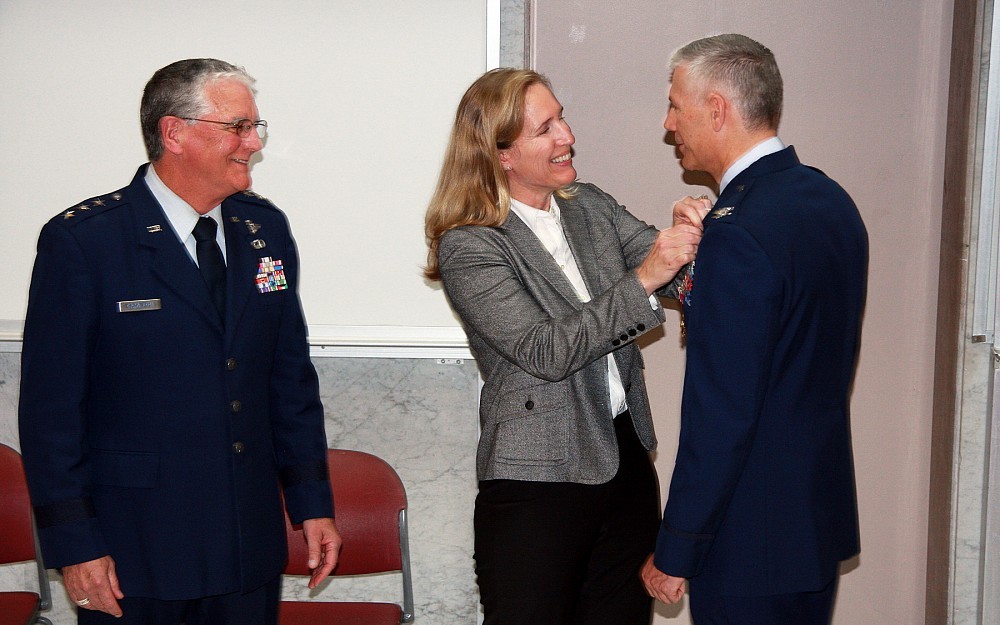
After 26+ Years, Dorlac Retires from Air Force

In a ceremony filled with family, friends and colleagues from UCs Department of Surgery, UC Health University Hospital and the United States Air Force, UC trauma surgeon Col. Warren Dorlac, MD, retired from the Air Force after 26 1/2 years of service Tuesday, Nov. 8, 2011.
Dorlac is the director of the Center for Sustainment of Trauma and Readiness Skills (C-STARS) at University Hospital and a volunteer associate professor of surgery. He will assume the role of associate professor of surgery and will volunteer with the C-STARS program.
In the ceremony, presided over by Lt. Gen. Paul K. Carlton Jr., USAF, Retired Air Force Surgeon General, Dorlac was recognized for his service to improve trauma care in the U.S. and internationally.
Carlton recalled his first meeting with Dorlac in 1992 at Wilford Hall Medical Center in San Antoniowhen Carlton was "the old guy taking trauma call and Dorlac was a third-year resident.
Since then, Carlton said, he has seen Dorlac and his wife, UC Health critical care and pulmonary physician Gina Dorlac, MD, improve the delivery and knowledge of trauma care in the military.
"As we stand here, Im honestly a bit sad because Warren and Gina are taking off the uniform for real, said Carlton, "but Im also happy, because the changes theyve made have been so significant. And it wont stop, because the university setting provides the atmosphere for us to continue to push the envelope and figure out how to save the next series of wartime injuries.
Dorlac has spent most of his military and medical career working alongside his wife, who retired from the Air Force in 2009 after 20 years of service. From 2004 to 2007, they worked at Landstuhl Regional Medical Center in Germany, where Warren Dorlac served as chief of trauma and critical care and then trauma medical director.
Carlton said the Dorlacs saved countless patients during their time heading Landstuhloften overseeing "remarkably painful stories that resulted in remarkably successful outcomes.
The Dorlacs also worked together as the first medical exchange officers to the Chilean Air Force, where they developed a Chilean Combat Casualty Care Course, now in its ninth year.
At UC, Warren Dorlac has served since 2007 as director of the C-STARS program, one of three centers in the country conducting pre-deployment training of Air Force medical personnel. Under his leadership, C-STARS expanded its teaching cadre, the number of Critical Care Air Transport Teams trained annually and research projects in aeromedical evacuation.
In 2009, he deployed as the Central Commands Joint Theater Trauma System Director, overseeing trauma care in both Iraq and Afghanistan. He currently serves as the trauma consultant to the Air Force Surgeon General.
At the retirement event, Dorlac was awarded the Legion of Merit medal and a letter of appreciation from President Barack Obama.
Dorlac credited the partnerships he and his wife made in the Air Force and abroad and Air Force leadership for much of his success, telling the crowd that, "without all of you, none of this would have been possible.
Tags
Related Stories
Cancer Center plays key role in lab research, clinical trials for new pancreatic cancer drug
September 1, 2026

WLWT and WCPO highlighted the contributions of University of Cincinnati Cancer Center researchers that helped lead to the recent FDA approval of daraxonrasib, a new treatment for pancreatic cancer.
Cancer Center physician receives $150,000 New Investigator Research Grant to study treatment-resistant leukemia
September 1, 2026
The University of Cincinnati Cancer Center’s Sarah Skuli, MD, PhD, received a two‑year, $150,000 Leukemia Research Foundation New Investigator Grant to study TP53‑mutated leukemia, a treatment‑resistant subtype with very poor outcomes.
Heavy social media use linked to depression
August 31, 2026

U.S. News and World Report, Yahoo! News, MSN, USA Today and other national media highlight a new study by the University of Cincinnati and Northwestern University that found a correlation between heavy social media use and depression in adults.