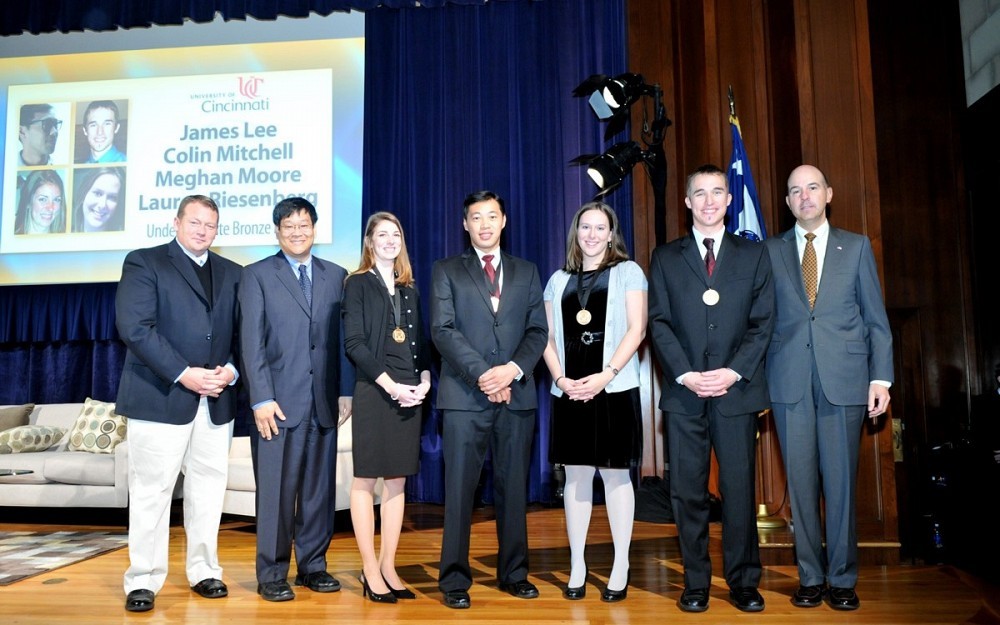
Medical Device Design Team Receives Bronze Award in Inventors Competition

Four UC alumni received the 2011 Collegiate Inventors Competition's
Bronze Award this month for
their invention for pediatric ICU patients.
James Lee, Colin Mitchell, Lauren Riesenberg and Meghan Moore developed their device as part of their senior project in the department of biomedical engineerings Medical Device Innovation and Entrepreneurship Program (MDIEP).
They presented
the BLINX device to science and intellectual property experts, as well as inductees to the National Inventors Hall of Fame, as part of the competition,
which recognizes discoveries and patentable innovations from undergraduates and graduate students across the country. Mitchell, Riesenberg and Moore majored in biomedical engineering at the College of Engineering and Applied Sciences. Lee graduated from the industrial design program at the College of Design, Art, Architecture and Planning.
The device is a fitted mask and bonnet with integrated electronics designed to induce blinking and prevent corneal damage in comatose patients in pediatric intensive care units.
The team worked with William Motley, MD, an ophthalmologist at Cincinnati Childrens Hospital Medical Center and UC assistant professor of clinical ophthalmology, to develop BLINX. Motley often gives consultations on comatose pediatric ICU patients who require neuromuscular blocking drugs to allow for mechanical respiration.
"The blocking drugs also paralyze the muscles around the eyes, says Moore. "For many of those patients, their eyes dont close all the way, leading to corneal dryness, potential corneal abrasion or even vision loss.
The teams device uses topical electrical stimulation to stimulate the muscle around the eyes, inducing a normal blink to hydrate the eye and prevent corneal damage before it starts. BLINX is designed to provide a cycle of blinking for 10 minutes, producing a blink every six seconds, followed by a rest cycle of 30 minutes, for as long as patients need it.
Moore says the team was "excited and honored to participate in the competition.
"We submitted our project for the competition in the spring quarter, but since weve graduated, weve all moved on with our lives, she says. "This competition allows us to come full circle with our project and stay in touch as a team. Theres huge potential for this device.
Introduced by the National Inventors Hall of Fame in 1990, the Collegiate Inventors Competition annually rewards individuals or teams for innovative work and scientific achievement.

The BLINX device is designed as a fitted mask and bonnet with integrated electronics designed to induce blinking.

UC students James Lee, Colin Mitchell, Lauren Riesenberg and Meghan Moore developed their BLINX device as part of their senior project in the department of biomedical engineering s Medical Device Innovation and Entrepreneurship Program.

This future version of BLINX would be made of wireless stimulators attached to the patient's face.
Related Stories
Cancer Center plays key role in lab research, clinical trials for new pancreatic cancer drug
September 1, 2026

WLWT and WCPO highlighted the contributions of University of Cincinnati Cancer Center researchers that helped lead to the recent FDA approval of daraxonrasib, a new treatment for pancreatic cancer.
Cancer Center physician receives $150,000 New Investigator Research Grant to study treatment-resistant leukemia
September 1, 2026
The University of Cincinnati Cancer Center’s Sarah Skuli, MD, PhD, received a two‑year, $150,000 Leukemia Research Foundation New Investigator Grant to study TP53‑mutated leukemia, a treatment‑resistant subtype with very poor outcomes.
Engineering professor named KEEN Fellow
August 31, 2026
Dhuree Seth, assistant professor educator in the Department of Aerospace Engineering, is one of 30 engineering faculty members nationwide who were named 2026 KEEN Engineering Unleashed Fellows. The University of Cincinnati College of Engineering and Applied Science has been a partner of the Kern Entrepreneurial Engineering Network (KEEN) since 2024. Seth has been part of KEEN since she was a PhD student more than 10 years ago.