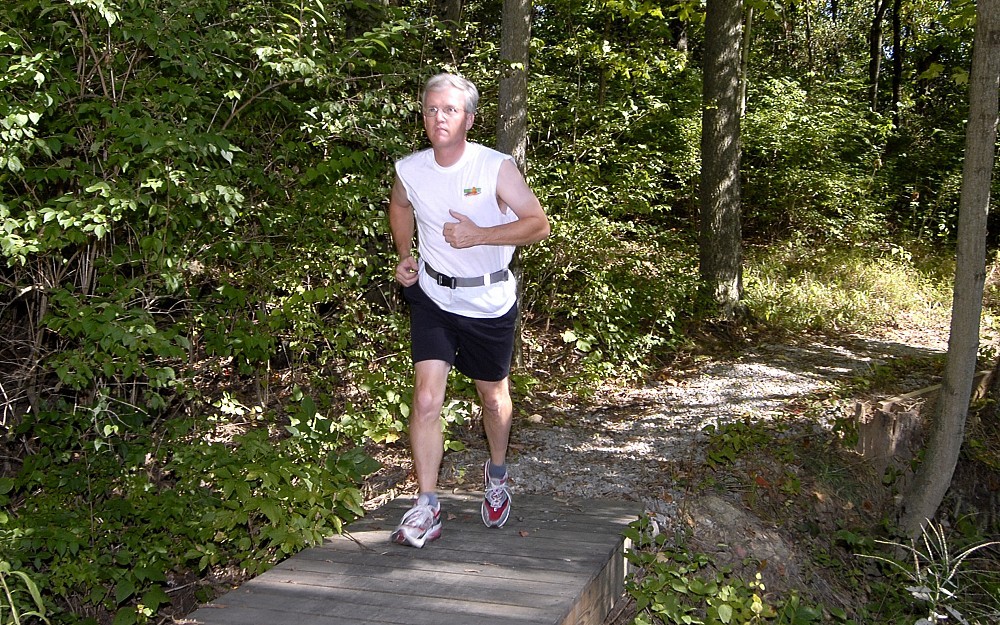
UC HEALTH LINE: Don't Let Footing Go Afoul at Turkey Day Race

CINCINNATINext week, on Thursday, Nov. 24, thousands of people of all ages will turn out to participate in Cincinnatis 102nd annual Thanksgiving Day Race. Some will be elite athletes, some will be first-timers and others will fall somewhere in betweenand invariably some will experience foot and ankle injuries.
In preparation for the 10-kilometer (6.2-mile) race, and with an eye toward prevention, UC Healths Ryan Finnan, MD, orthopedic surgeon and foot and ankle specialist, says simple precautions can help participants stay the course and walk away without limping.
The most common injury to the foot and ankle from a race such as this, Finnan says, is an Achilles tendon rupture, which occurs in the back of the ankle and "will feel like someone kicked you in the back of the leg.
The Achilles tendon is a strong fibrous cord connecting the muscles in the back of your calf to your heel bone. There are several ways it can rupture, including overstretching and trauma.
"This is a road race and there are going to be curbs and potholes to avoid, says Finnan.
For many the race is also a social event, where conversation takes ones eyes off the course, so its vital to watch the road ahead, he advises.
As for overstretching, it can be difficult to judge how much stretching is enough. Inexperienced participants might overstretch the foot and ankle because they incorrectly think it should "hurt to be stretched. And then there are the elite runners who might under-stretch because they arent taking this race quite as seriously as other competitions or arrive late, leaving little time to warm up.
"Its likely going to be cold on the day of the race, Finnan notes, "and foot and ankle muscles, like all muscles, will take longer to warm up than in the weeks before when elite runners have been training in higher temperatures.
The key, he says, is to follow the American Academy of Orthopedic Surgeons (AAOS) guidelines, which instruct: Begin stretches slowly and carefully until reaching a point of muscle tension. Hold each stretch for 10 to 20 seconds, and then slowly and carefully release it. Inhale before each stretch and exhale as you release. Do each stretch only once. Never stretch to the point of pain, always maintain control, and never bounce on a muscle that is fully stretched.
The highest instance of foot and ankle injuries at the Thanksgiving Day Race, Finnan says, will likely be among the "weekend warrior typesin particular those in the middle age category who dont train for the race and then hit the ground running, so to speak.
"Races and marathons are a set-up for overuse injuries, he says. "Many people think they can still exercise just like they did in high school or college.
Other tips he offers are not to wear new shoes for the first time on race dayregardless of your expertiseand to avoid cotton socks. "A good synthetic sock that fits appropriately in your shoe is the right choice, he says
Finnan advises all participants not to run or walk on an already injured ankle, and should one experience any noticeable strain or popping for the first time, to get off of the injured foot and practice the RICE protocol also endorsed by the AAOS:
Rest: Take a break from the activity that caused the injury. Your doctor may recommend that you use crutches to avoid putting weight on your leg.
Ice: Use cold packs for 20 minutes at a time, several times a day. Do not apply ice directly to the skin.
Compression: To prevent additional swelling and blood loss, wear an elastic compression bandage
Elevation: To reduce swelling, recline when you rest, and put your leg up higher than your heart.
If the injury doesnt improve with avoidance of the activity after a short period of time, or if the symptoms reoccur with use, then its time to see a foot and ankle specialist.
Tags
Related Stories
Cancer Center plays key role in lab research, clinical trials for new pancreatic cancer drug
September 1, 2026

WLWT and WCPO highlighted the contributions of University of Cincinnati Cancer Center researchers that helped lead to the recent FDA approval of daraxonrasib, a new treatment for pancreatic cancer.
Cancer Center physician receives $150,000 New Investigator Research Grant to study treatment-resistant leukemia
September 1, 2026
The University of Cincinnati Cancer Center’s Sarah Skuli, MD, PhD, received a two‑year, $150,000 Leukemia Research Foundation New Investigator Grant to study TP53‑mutated leukemia, a treatment‑resistant subtype with very poor outcomes.
Heavy social media use linked to depression
August 31, 2026

U.S. News and World Report, Yahoo! News, MSN, USA Today and other national media highlight a new study by the University of Cincinnati and Northwestern University that found a correlation between heavy social media use and depression in adults.