Brain Tsunamis Are Clue to Helping Victims of Major Head Injuries

CINCINNATITreating "brain tsunamis or "killer waves could stop many victims of major head injury from suffering additional brain damage, a study published in Lancet Neurology has found.
Researchers at Kings College Hospital and Kings College London (both part of Kings Health Partners Academic Health Science Centre), in collaboration with the department of neurosurgery at the University of Cincinnati (UC) College of Medicine and the UC Neuroscience Institute, found that of 103 patients undergoing neurosurgery following major head trauma, 58 experienced a phenomenon called cortical spreading depolarizations, or "brain tsunamis.
For decades, scientists have investigated this phenomenon. The newly published study supports the original clinical evidence that brain tsunamis are common in patients with major brain injuries, and now showsfor the first timethat they contribute to worse outcomes in these patients. Longer-term, it is hoped the results of this study will be used to help guide how brain injuries are treated and managed, leading to better outcomes for patients.
The study was published online Nov. 3, 2011, and in print Nov. 14.
The majority of patients were treated at Kings College Hospital in London. Nine were treated at UC Health University Hospital by a treatment team that included Mayfield Clinic specialists.
Patients were enrolled at seven centers internationally, including the University of Miami, University of Pittsburgh, Virginia Commonwealth University and the German centers Charité University Medicine (Berlin) and University Hospital Heidelberg. The collaborating scientists and clinicians are members of COSBID (Co-Operative Studies of Brain Injury Depolarizations: www.cosbid.org).
The study was funded largely by a four-year $1.96 million grant awarded through the U.S. Department of Defenses Psychological Health and Traumatic Brain Injury (PH/TBI) Research Program (formerly known as the Post Traumatic Stress Disorder/TBI Research Program). The topic of spreading depolarizations is of keen interest to the U.S. military because head injuries have emerged as the signature wound of the wars in Iraq and Afghanistan.
Anthony Strong, emeritus professor of neurosurgery (in the department of clinical neuroscience in the Institute of Psychiatry, a school of Kings College London) and a former neurosurgeon at Kings College Hospital who has led the study in the UK from the same hospital, says the results were promising:
"This is an exciting area of research, which is attracting a lot of interest and collaboration internationally. This study provides real, concrete evidence that brain tsunamis can cause further damage to the brain in the few days after a major injury. This is significant, because they have a direct link to poor recovery in patients. Of course, the end goal is to take the results of this study and, longer term, develop new treatments for this type of injury. This potentially may mean finding a way of blocking these killer waves as they are happening.
Principal investigator Jed Hartings, PhD, research assistant professor in the department of neurosurgery at UC and director of clinical monitoring for the Mayfield Clinic, emphasizes the historical nature of the findings.
"Spreading depolarizations were first discovered in animals almost 60 years ago and for a long time were thought to not occur in the human brain, he says. "We didn't begin studying them in patients until recently, partly because we didn't know how. Now we know that depolarizations occur abundantly and are important to patient outcomes. This is the question we set out to answer when we started COSBID.
He adds that "our ability to monitor and understand what happens in the brain after a severe injury hasn't advanced significantly in decades. The brain is like a black box, but the process of spreading depolarizations now gives us a window into that box. Being able to treat patients based on specific cellular brain events that we can measure and monitor would be a great advance."
Hartings Cincinnati co-investigator was Lori Shutter, MD, professor of neurosurgery and neurology at UC, director of neurocritical care at the UC Neuroscience Institute and a neurointensivist with the Mayfield Clinic.
When a brain injury occurs, nerve cells in the brain (which act like batteries by storing electrical and chemical energy) malfunction and effectively short-circuit. Because all nerve cells in the brain are connected, this depolarization causes all the neighboring cells to short-circuit as well; this subsequent leakage of precious electrical charge moves like a tsunami through the brain, with the potential to cause additional permanent tissue damage.
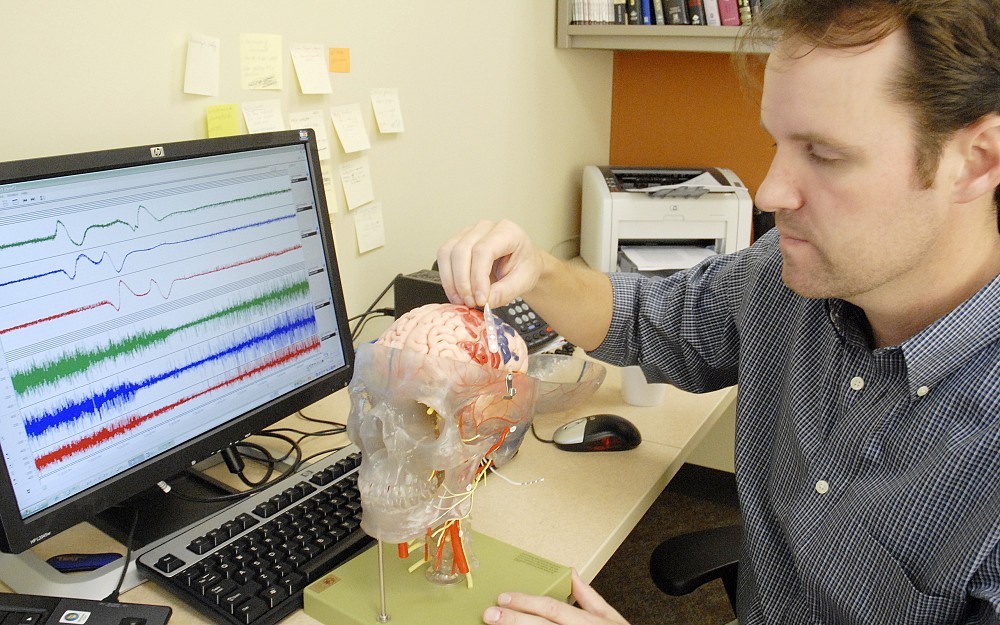
To measure the depolarizations, researchers placed a linear strip of electrodes on the surface of the brain, near the injured area, during neurosurgery. Only patients who required brain surgery to treat their injuries were enrolled in the study. Kings College Hospital and UC Health University Hospital are major trauma centers and regularly treat patients who are suitable candidates for the trial.
Related Stories
Cancer Center plays key role in lab research, clinical trials for new pancreatic cancer drug
September 1, 2026

WLWT and WCPO highlighted the contributions of University of Cincinnati Cancer Center researchers that helped lead to the recent FDA approval of daraxonrasib, a new treatment for pancreatic cancer.
Cancer Center physician receives $150,000 New Investigator Research Grant to study treatment-resistant leukemia
September 1, 2026
The University of Cincinnati Cancer Center’s Sarah Skuli, MD, PhD, received a two‑year, $150,000 Leukemia Research Foundation New Investigator Grant to study TP53‑mutated leukemia, a treatment‑resistant subtype with very poor outcomes.
Heavy social media use linked to depression
August 31, 2026

U.S. News and World Report, Yahoo! News, MSN, USA Today and other national media highlight a new study by the University of Cincinnati and Northwestern University that found a correlation between heavy social media use and depression in adults.