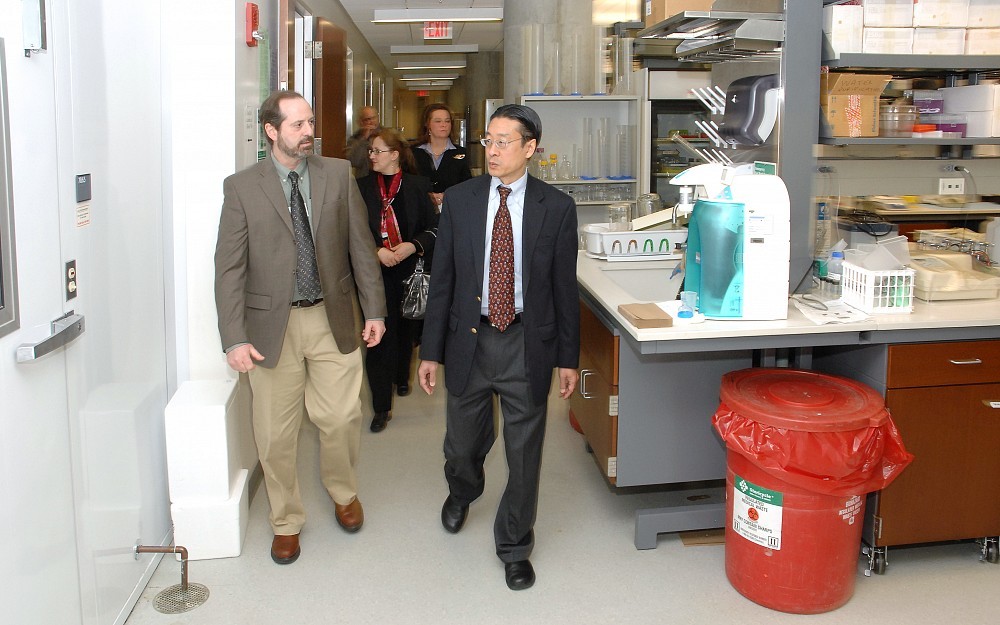
Neuroscientist Choi Spends Busy Day on Medical Campus

For a talk billed as "Future of Neuroscience Research, Dennis Choi, MD, PhD, covered a lot of groundincluding the Rolling Stones, vomiting ferrets and autistic mice. But it was all just the beginning of a busy day for the esteemed neuroscientist as he visited the medical campus on Thursday, Jan. 19.
Choi, executive vice president of the Simons Foundation, toured labs, met with key leadership, attended research presentations and talked with as many individuals as he could during a day packed with activities. (The activities continued the next day, as he visited educators and researchers on UCs West Campus.)
The Simons Foundation is a New York City-based private foundation whose single largest initiative has been in autism research. Before joining the foundation, Choi served as vice president for academic health affairs at Emory University in Atlanta, where he was a colleague of Santa Ono, PhD, now senior vice president for academic affairs and provost at UC.
Choi began the day with his talk in a Medical Sciences Building lecture hall and drew laughter from the sizable crowd when he said, "I have to say up front that I dont have a clue about the future of neuroscience research. But he did show that he knows plenty about drug developmentand while he may not be able to predict the future of medical research, he has some firm ideas about how things should go in an environment where the cost to industry of launching a new drug was $1.78 billion as of 2004.
"What is of particular concern to many people in this room, including myself, he said, "is that neuroscience has taken it on the chin
Several major companies have closed their neuroscience efforts.
"This is actually a crisis. I think if society is allowed to stop developing therapeutics for neurosystem diseases, that is a very ominous step for the future of mankind.
While the companies decisions are market-driven, Choi said, "Societys interests at some point have to be factored in along with the shareholders.
Choi said the problem was solvable by changing some of the rules applicable to drug development, such as those pertaining to patent expiration, and he went on to call for "increasing the bandwidth of the screening effort for new drugs.
The current model for drug development is a linear model, he said, with the National Institutes of Health and foundations funding basic research at academic institutions and discoveries being passed to industry to develop drugs and test them in clinical trials.
"That bandwidth is maxed out, Choi said. "So my fear is that our current pace, were leaving all kinds of good ideas on the table. More of the good ideas need to be tested, at an early stage.
Foundations can play a larger role, he said, instead of "sitting passively in the background and saying, Well just wait and fund peoples studies. More are stepping forward into more pro-active roles, with in-house discovery programs and development of clinical trials networks.
Tags
Related Stories
Cancer Center plays key role in lab research, clinical trials for new pancreatic cancer drug
September 1, 2026

WLWT and WCPO highlighted the contributions of University of Cincinnati Cancer Center researchers that helped lead to the recent FDA approval of daraxonrasib, a new treatment for pancreatic cancer.
Cancer Center physician receives $150,000 New Investigator Research Grant to study treatment-resistant leukemia
September 1, 2026
The University of Cincinnati Cancer Center’s Sarah Skuli, MD, PhD, received a two‑year, $150,000 Leukemia Research Foundation New Investigator Grant to study TP53‑mutated leukemia, a treatment‑resistant subtype with very poor outcomes.
Heavy social media use linked to depression
August 31, 2026

U.S. News and World Report, Yahoo! News, MSN, USA Today and other national media highlight a new study by the University of Cincinnati and Northwestern University that found a correlation between heavy social media use and depression in adults.