New Deep Brain Stimulation Device Shows Promising Results

CINCINNATIA multi-site study of a new deep brain stimulation device for people with Parkinsons disease has found the device to provide benefits to patients, potentially paving the way for unprecedented competition in the area of neurostimulation technology.
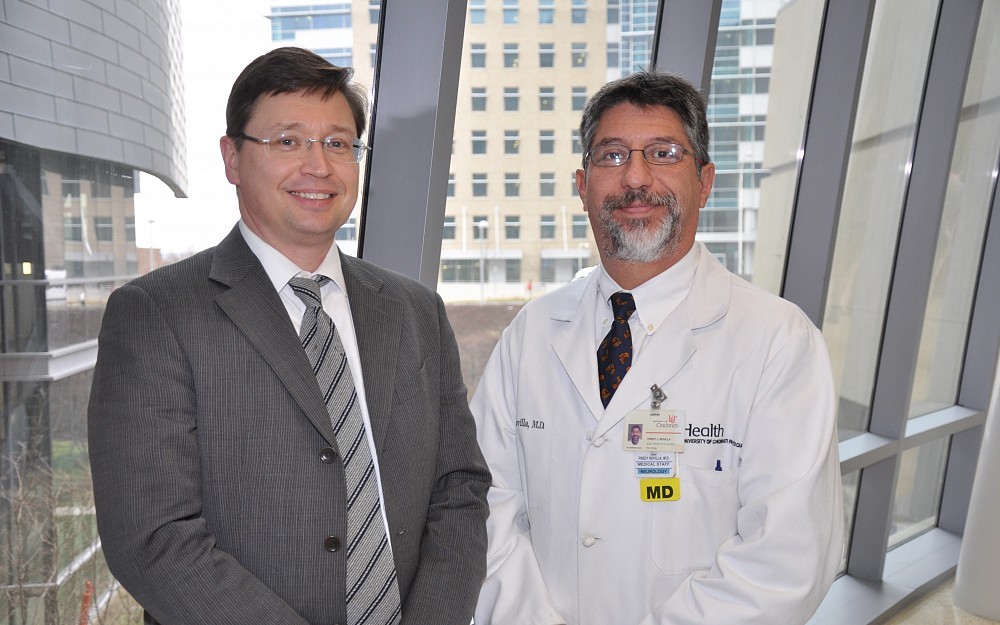
The study, whose co-authors included George Mandybur, MD, an associate professor of neurosurgery at the University of Cincinnati (UC) College of Medicine and Mayfield Clinic neurosurgeon, and Fredy Revilla, MD, an associate professor of neurology and UC Health neurologist, was published Jan. 11, 2012, in the online edition of Lancet Neurology. Mandybur and Revilla are members of the James J. and Joan A. Gardner Center for Parkinsons Disease and Movement Disorders at the UC Neuroscience Institute, a specialty center within UC Health.
Principal investigator of the study was Michael Okun, MD, a neurologist and co-director of the Center for Movement Disorders and Neurorestoration at the University of Florida College of Medicine.
Deep brain stimulation (DBS) devices stimulate the subthalamic nucleus deep within the brain. Deep brain stimulation surgery has been shown to reduce symptoms of Parkinsons and to improve quality of life.
The Lancet Neurology study examined the new Libra and LibraXP devices, which are manufactured by St. Jude Medical and which provide a constant, fixed-dose current. Medtronic, Inc., the only manufacturer with a DBS device currently approved by the U.S. Food and Drug Administration (FDA), recently added a controlled-current option to its longstanding voltage-controlled stimulator.
Participants in the randomized, controlled trial whose stimulators were turned on shortly after surgery experienced an increase of four hours of "on time (with minimal symptoms), three months into the study. These benefits were significantly greater2.5 more hours of "on timethan those experienced by participants in the control group, whose stimulators were not turned on until the three-month mark.
Mandybur, who implanted the devices in 12 study participants at UC Health University Hospital, said the constant-current device compares favorably with the voltage-controlled device currently in widespread use.
"This is the first study to look at constant-current effectiveness in Parkinsons disease, Mandybur says. "The new device appeared to be every bit as effective as the voltage-controlled device, but we wont know for sure until there is a head-to-head comparison in future clinical trials. The devices are not identical.
"With further study," Revilla says, "we may be able to establish clearly the differences and similarities of these two technologies."
The St. Jude Neuromodulation Division, which funded the study, has applied for and is awaiting approval from the U.S. Food and Drug Administration for the Libra and LibraXP neurostimulators, which are currently available in Europe, Latin America and Australia.
The study results likely signal the imminent arrival of a competitor into a market currently filled only by Medtronic. "It will stir competition and it will light fires under people to develop new technology, Mandybur says. "The same thing happened in the area of spinal cord stimulators.
Researchers theorize that constant-current stimulation might provide more accurate control of the spread of the electrical field than voltage-controlled stimulation. "But fundamental differences are unlikely, writes Jens Volkmann, MD, of University Hospital of Würzburg, Germany, in an accompanying editorial in Lancet Neurology.
Parkinsons disease, which afflicts more than 1 million Americans, is a degenerative neurological disorder involving the death of dopamine-producing nerve cells deep within the brain. There is no cure for Parkinsons at this time, and scientists do not yet know how to halt its progression. Recent studies have shown that neurostimulation may slow the progression of the disease.
Candidates for deep brain stimulation are those who respond well to dopamine but over time have developed intolerable side-effects (mainly dyskinesias) and short duration of benefit.
"When a person with Parkinson's develops wide motor fluctuations, requiring frequent doses of medications, along with intolerable side effects, it is time for DBS surgery, Revilla says. "But it is still a requirement that the patient experience some benefit from the medications, even if it is short-lived.
Revilla praised the 15 institutions whose close collaboration resulted in a study "that we expect will allow us to have alternative options for programming deep brain stimulation in patients who dont respond well to conventional medical treatments.
The Gardner Center team enrolled 12 patients, the second-highest number of any of the participating centers. (The highest enrollment was 13.)
Mandybur has received honoraria from Medtronic, Inc. Revilla is a consultant for Lundbeck, Inc.
Related Stories
Heavy social media use linked to depression
August 31, 2026

U.S. News and World Report, Yahoo! News, MSN, USA Today and other national media highlight a new study by the University of Cincinnati and Northwestern University that found a correlation between heavy social media use and depression in adults.
On-site training in Speech & Hearing Clinic sets UC’s programs apart
August 27, 2026
At the University of Cincinnati’s Speech & Hearing Clinic, Doctor of Audiology and Speech-Language Pathology graduate students gain real-world experience while providing free speech and hearing services to the community.
Designing with cancer patients' needs in focus
August 27, 2026
Kristina Shin is designing garments that prioritize the comfort, function and confidence of breast cancer patients, addressing a need often overlooked by traditional fashion.