UC HEALTH LINE: Surgical Weight Loss Without Stomach Cutting or Banding Now Available

CINCINNATIWhen a long-term commitment to healthy eating and exercise doesnt get people to their weight loss goals, surgical weight loss offers an alternative option to achieve better health.
Many people are turned off by surgical weight loss, however, because it involves somewhat radical surgery: either removing a portion of the stomach or implanting a permanent adjustable gastric band to limit food intake.
Now Greater Cincinnati patients have access to a newer surgical weight loss procedure known as GPS, gastric plication surgery. The technique reduces the size of the stomach without cutting or removing any of the patients stomach.
Brad Watkins, MD, a UC Health bariatric/general surgeon and assistant professor at the College of Medicine, is the only surgeon in the Greater Cincinnati area offering GPS.
"This procedure simply reduces the stomach size with stitches, like hemming or tailoring a dress: The fabric (stomach) is still there; it is just smaller, explains Watkins, who leads the UC Health Weight Loss Center in West Chester. "Patients also dont need post-op blood work or band port adjustments, so it is more convenient.
UC Health was one of the first health systems to perform the procedure and remains one of just a few centers in the United States actively offering it to patients as an option. Watkins has performed more than 50 GPS cases, which represents more experience than any other surgeon in the United States currently. The procedure is currently considered investigational in the U.S. as surgeon-scientists gather long-term clinical data. Two- and three-year data out of Brazil and Iran, respectively, exists in the medical literature.
"The surgery offered all the advantages and none of the disadvantages, says a recent patient who asked to remain anonymous. She had the GPS procedure in October 2010. Since then, she has lost 60 pounds and no longer has type-2 diabetes. "This was a less radical surgical approach at reduced costs that gave me the ability to eat healthful, but hard to digest, foods.
Weight Loss Seminars
The UC Health Weight Loss Center offers free informational sessions regularly. Sessions are scheduled on the following days at UC Health West Chester Hospital, 7700 University Court, Plaza Conference Room Level A, at 7 p.m.
2012 Upcoming Sessions
- January 19
- February 2
- February 14
- March 1
- March 13
For more information, call 513-939-2263 or register online at cincyweightloss.com. To learn more about the UC Health bariatric and general surgery team, visit ucphysicians.com.
The UC Health Weight Loss Center is certified American Society for Metabolic and Bariatric Surgery as a Bariatric Surgery Center of Excellence for safe, high-quality surgical care.

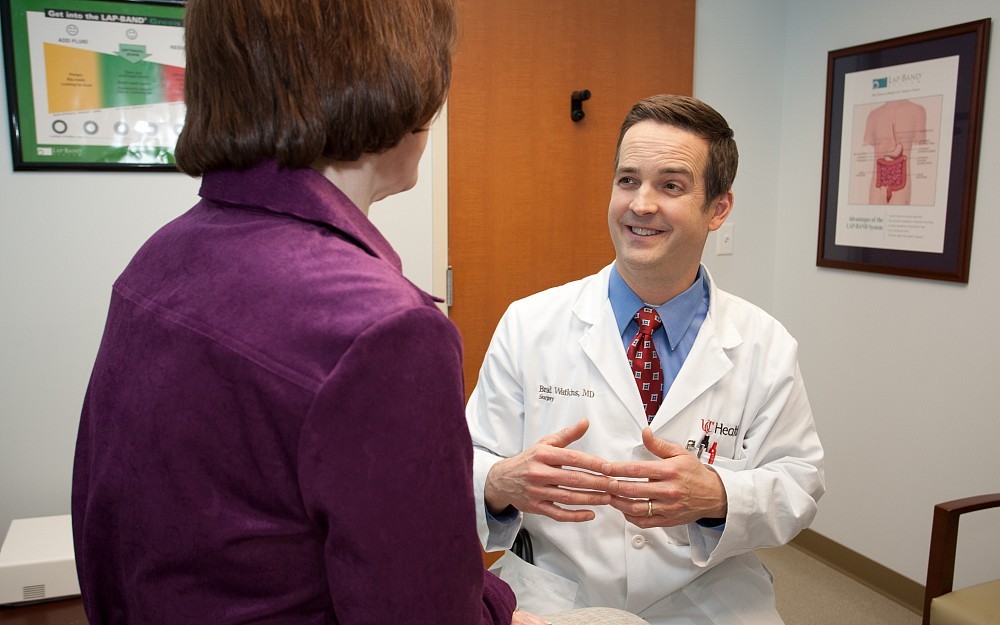
Brad Watkins, MD, discusses gastric banding with a patient.

Brad Watkins, MD, is a UC Health surgeon and assistant professor at UC.
Related Stories
Cancer Center plays key role in lab research, clinical trials for new pancreatic cancer drug
September 1, 2026

WLWT and WCPO highlighted the contributions of University of Cincinnati Cancer Center researchers that helped lead to the recent FDA approval of daraxonrasib, a new treatment for pancreatic cancer.
Cancer Center physician receives $150,000 New Investigator Research Grant to study treatment-resistant leukemia
September 1, 2026
The University of Cincinnati Cancer Center’s Sarah Skuli, MD, PhD, received a two‑year, $150,000 Leukemia Research Foundation New Investigator Grant to study TP53‑mutated leukemia, a treatment‑resistant subtype with very poor outcomes.
Heavy social media use linked to depression
August 31, 2026

U.S. News and World Report, Yahoo! News, MSN, USA Today and other national media highlight a new study by the University of Cincinnati and Northwestern University that found a correlation between heavy social media use and depression in adults.