Clinical Trial Examines Benefits of, Mechanisms Behind Ultrafiltration for Heart Failure

CINCINNATIUniversity of Cincinnati cardiologists are conducting a one-of-a-kind clinical trial to determine if a dialysis-like procedure could be deemed the new standard of care for patients suffering from extensive fluid retention caused by heart failure.
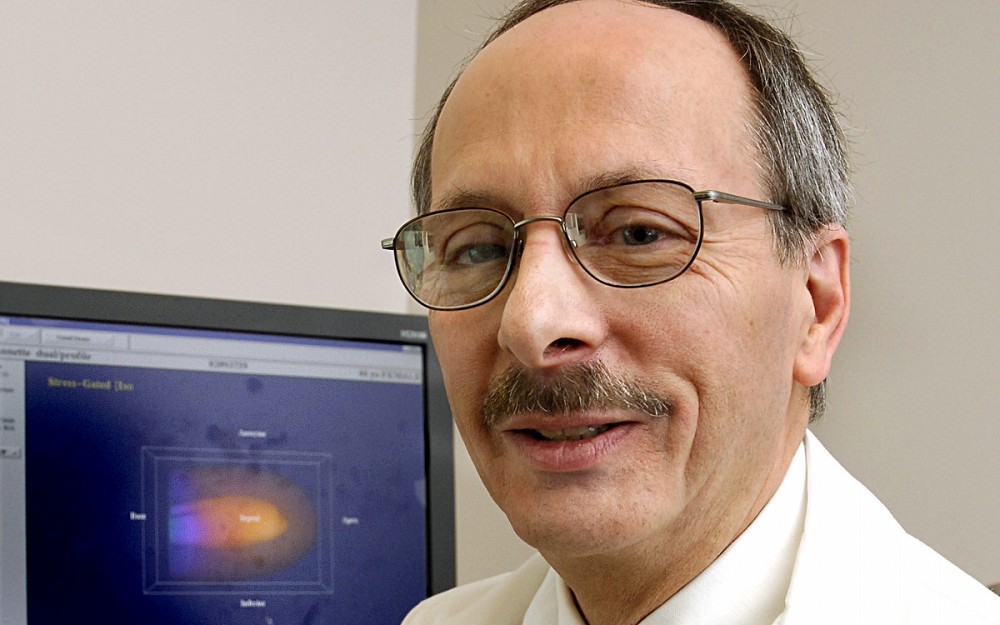
Myron Gerson, MD, a professor in the division of cardiovascular diseases at UC and a UC Health physician, says the trial will compare ultrafiltration with intravenous diuretic drugs to see which is more beneficial to heart failure patients who are experiencing fluid retention. This investigator-initiated study is being conducted exclusively at UC Health University Hospital.
"There are two accepted treatments for removing fluid from heart failure patients: diuretic treatment and ultrafiltration, which uses a dialysis-like machine to remove excess fluid through an IV, Gerson says. "The main advantage of ultrafiltration is that large volumes of excess fluid can be removed more rapidly than with diuretics, and this usually results in a shorter stay in the hospital.
"This trial is being conducted to better understand why it is possible to remove such a large amount of fluid so rapidly using ultrafiltration. In patients who have kidney failure, standard dialysis has been found to reduce blood flow to the heart muscle. If this was also occurring with ultrafiltration, we would not expect patients with heart failure to have large amounts of fluid removed without further impairing function of the heart.
Gerson says that for this reason, researchers will be measuring the blood flow to the heart muscle with ammonia-guided positron emission testing (PET) before and after treatment with either diuretics or ultrafiltration.
Ammonia-PET scanning allows physicians to measure "absolute blood flow, a precise calculation of the blood volume within the heart muscle per unit of time and muscle mass. The measurement can help pinpoint specific areas of compromised blood flow.
"In addition, we are measuring the effects of these heart failure treatments on the pumping function of the heart and heart size, adds Gerson. "We plan to study 30 patients over the next two years.
He says researchers hope to discover why ultrafiltration works so well, which adds to the evidence of its benefit and could eventually lead to it becoming the standard of care for heart failure patients who are retaining a large amount of fluid.
"We hope that this will give us more insight into why ultrafiltration improves outcomes for patients so that we can provide the best possible care to those with this life-threatening illness, he says.
Tags
Related Stories
Cancer Center plays key role in lab research, clinical trials for new pancreatic cancer drug
September 1, 2026

WLWT and WCPO highlighted the contributions of University of Cincinnati Cancer Center researchers that helped lead to the recent FDA approval of daraxonrasib, a new treatment for pancreatic cancer.
Cancer Center physician receives $150,000 New Investigator Research Grant to study treatment-resistant leukemia
September 1, 2026
The University of Cincinnati Cancer Center’s Sarah Skuli, MD, PhD, received a two‑year, $150,000 Leukemia Research Foundation New Investigator Grant to study TP53‑mutated leukemia, a treatment‑resistant subtype with very poor outcomes.
Heavy social media use linked to depression
August 31, 2026

U.S. News and World Report, Yahoo! News, MSN, USA Today and other national media highlight a new study by the University of Cincinnati and Northwestern University that found a correlation between heavy social media use and depression in adults.