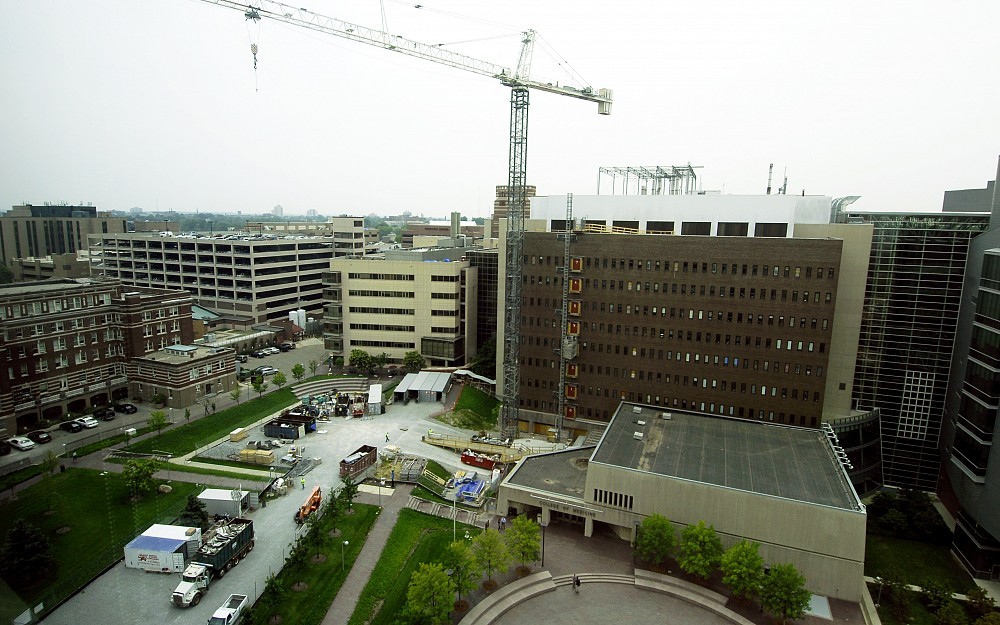
MSB Rehab Project on Schedule With Ambitious Final Phase Approaching

Work on the Medical Sciences Building (MSB) rehabilitation project is on schedule and moving toward its largest phase since Phase Is construction of the CARE/Crawley Building: Phase IV, which involves the entire south side of the MSB.
Phase III, rehabilitation work in the MSBs northwest quadrant, is currently under way following completion and move-in for Phase II, the northeast quadrant, in December 2011. (The northwest quadrant faces Eden Avenue and Albert Sabin Way; the northeast quadrant faces the Cardiovascular Research Center and Albert Sabin Way.) Phase III work is scheduled for completion Nov. 30, 2012, with move-in scheduled for December 2012 to May 2013.
The four-phase rehabilitation project began in July 2004 with groundbreaking for the architecturally striking CARE/Crawley Building. But unlike Phase I, Phases II-IV focus almost entirely on infrastructure improvements to the 37-year-old MSB, says Dennis Funke, interim associate director of project management in the office of planning, design and construction. The only cosmetic changes involve renovation of perimeter offices and some restrooms located near classroom areas.
"This is mainly a mechanical, electrical and plumbing, upgradeits to bring the life of the building back, Funke says. "Were also doing code compliance for fire protection and installing new fume hoods.
"So most of the work is from the ceiling line up, and its not really visible when people go back into the rehabilitated spaces.
Lejla Zejnilovic, a planner in the office of planning design and construction, says move-out for Phase IV will begin in December 2012 and continue through May 2013. Rehabilitation work is scheduled to begin June 1, 2013. Levels 3-7 are affected in the west half of the Phase IV area; levels E-7 are affected in the east half. Work is scheduled for completion in December 2014, with move-in scheduled for 2015.
"This is a very large phase of the project, and we are working on accommodating everyone who will need to move in order for work to begin, says Zejnilovic, who has already begun contacting and meeting with some of the 25 affected departments within the Phase IV area. "Because the space involved is so large, not everyone will be able to stay in the MSB, and were looking at other buildings for people to move into.
Some of those buildings, she says, could include CARE/Crawley, the Cardiovascular Research Center, the Vontz Center for Molecular Studies and possibly UCs Reading Campus. Bus/shuttle transportation to the Reading Campus is being investigated.
For now, Zejnilovic says, planners are verifying existing space and personnel in Phase IV, meeting with department representatives and preparing drawings that will show options for where the departments can go while work is under way. Departments are being asked to designate a "departmental move coordinator to serve as a liaison with planners.
Zejnilovic says occupants of affected areas of Phase IV can help by communicating their needs to planners and move coordinators as soon as possible. In addition, she says, now is a good time for departments to look at their furniture and equipment inventories and reduce them if possible before the actual move.
The Campus Services (Old Sears) Building on Reading Road, where many departments currently store excess furniture, equipment and files, is functionally and operationally obsolete and will no longer be available for storage.
Tags
Related Stories
On-site training in Speech & Hearing Clinic sets UC’s programs apart
August 27, 2026
At the University of Cincinnati’s Speech & Hearing Clinic, Doctor of Audiology and Speech-Language Pathology graduate students gain real-world experience while providing free speech and hearing services to the community.
Funding expands UC research into weight gain side effects of bipolar medication
August 26, 2026
University of Cincinnati researchers have been approved for funding by the Patient-Centered Outcomes Research Institute (PCORI) to expand the implementation of healthy lifestyle interventions and metformin prescription to help manage weight gain in overweight or obese youth taking second-generation antipsychotic medications.
One in four NFL players had CTE at death
August 25, 2026

Forbes cites research on concussions and football helmets by the University of Cincinnati in a report that found one in four NFL players had brain damage at death.