Telestroke Technology Speeds Care, Expertise

When it comes to stroke, seconds count. And with the help of telestroke technology, UC Health neurologists and emergency physicians will be able to save precious time while still providing state-of-the-art care.
The UC Neuroscience Institute and UC Health University Hospital are launching a major initiative to bring the expertise of the UC Stroke Team to partner hospitals in Greater Cincinnati through telestroke, the use of telemedicine specifically for stroke care.
"The UC Neuroscience Institute and University Hospital believe that the launch of this technology will save lives and reduce the devastating impact of stroke on patients that have access to it, says Opeolu Adeoye, MD, assistant professor of emergency medicine and neurosurgery at the University of Cincinnati (UC) and director of the Telestroke Program at University Hospital.
The UC Stroke Team, founded in 1987, is a group of UC physicians and health professionals dedicated to providing rapid diagnosis and treatment of stroke patients. The Stroke Team serves as a community resource to all Greater Cincinnati hospitals, while managing the stroke treatment program at University Hospital.
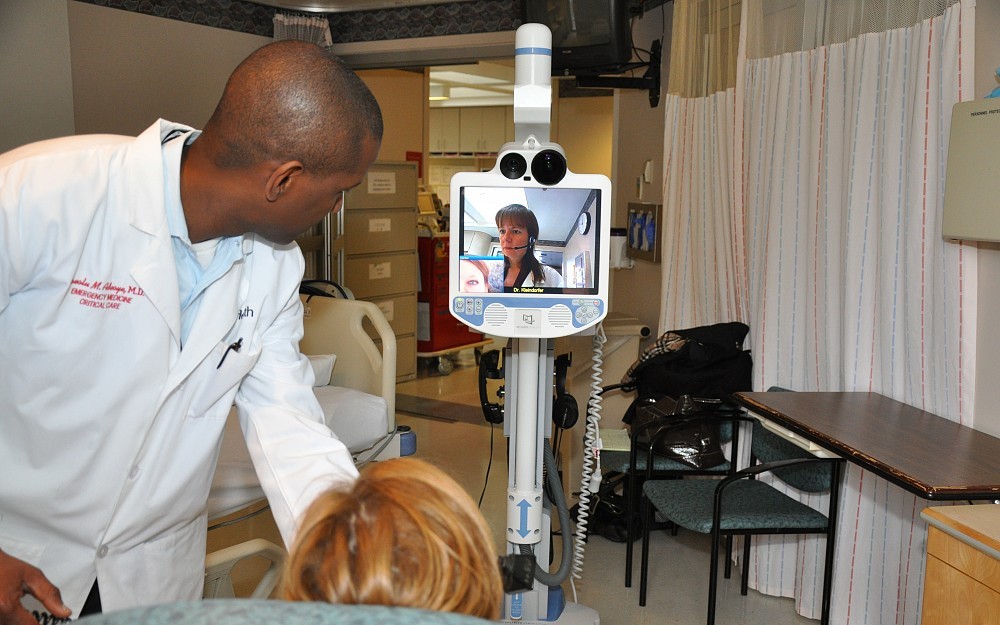
Telestroke robots have already been placed in University Hospitals emergency department and neuroscience intensive care unit and are expected to go live in the coming weeks. A third unit is bound for UC Health West Chester Hospitals emergency department, and a fourth is planned for UC Healths first official telestroke partner, Dearborn County Hospital in Indiana.
These robots, in addition to two-way video and audio capability, can transmit a patients medical data to the off-site physician, who can manipulate the robot to interact with the patient, referring physicians, nurses and family members.
Telestroke networks have been successfully launched in other parts of the country and have demonstrated positive results, including reduced time to treating acute strokes and allowing patients to stay closer to home at partner hospitals while still receiving state-of-the-art care.
University Hospital has committed funding to the launch of this telestroke program as part of its mission-based effort to bring world-class stroke care to the region. This project will bring the following benefits to partner hospitals and their patients:
Provide 24/7 consultation with UC Stroke Team physicians.
Enable the sharing of clinical protocols.
Provide access to University of Cincinnati clinical trials.
Facilitate transfer for emergent cases requiring intervention.
Facilitate care close to home for patients who do not absolutely need to be transferred.
Enable partner hospitals to pursue Primary Stroke Center designation.
"This is an important advance for us and, more importantly, our patients, says Adeoye. "This will allow them to stay closer to home at partner hospitals while still receiving the most advanced care available.
Tags
Related Stories
On-site training in Speech & Hearing Clinic sets UC’s programs apart
August 27, 2026
At the University of Cincinnati’s Speech & Hearing Clinic, Doctor of Audiology and Speech-Language Pathology graduate students gain real-world experience while providing free speech and hearing services to the community.
Funding expands UC research into weight gain side effects of bipolar medication
August 26, 2026
University of Cincinnati researchers have been approved for funding by the Patient-Centered Outcomes Research Institute (PCORI) to expand the implementation of healthy lifestyle interventions and metformin prescription to help manage weight gain in overweight or obese youth taking second-generation antipsychotic medications.
One in four NFL players had CTE at death
August 25, 2026

Forbes cites research on concussions and football helmets by the University of Cincinnati in a report that found one in four NFL players had brain damage at death.