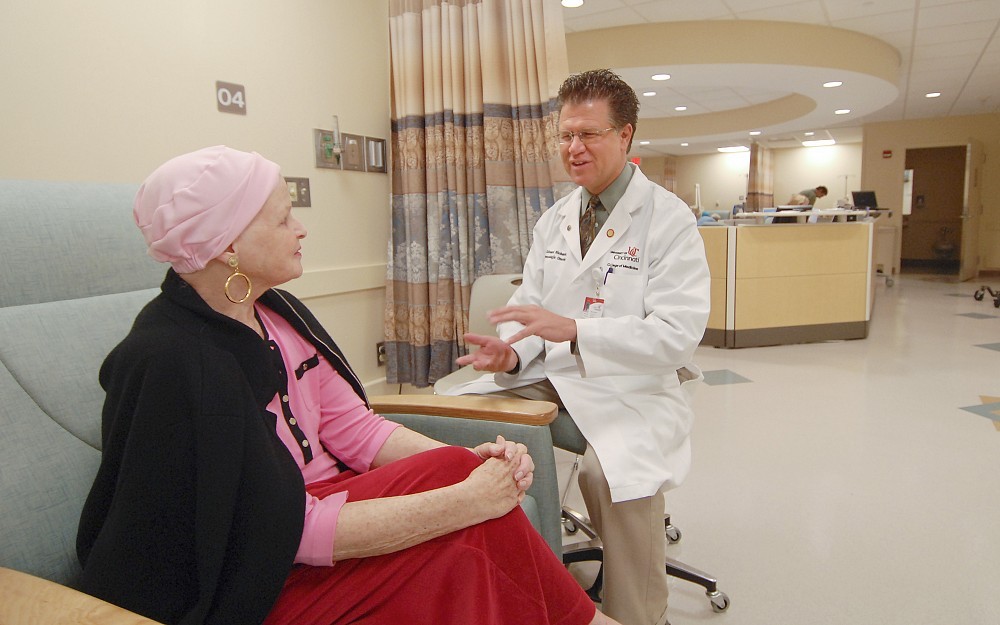
UC HEALTH LINE: Experimental Vaccine Aimed at Improving Ovarian Cancer Survival Rates

CINCINNATIAn experimental vaccine study currently under way at the UC Cancer Institute aims to prevent ovarian cancer recurrence by triggering the bodys natural defense system.
Offered exclusively through UC Health in the Greater Cincinnati area, this phase-2 clinical trial is open to women who have undergone treatment for ovarian, fallopian tube or peritoneal cancer and are currently in remission (cancer-free).
Sponsored by the National Cancer Institutes (NCI) Gynecologic Oncology Group, this is the first large-scale study in ovarian cancer to test a live vaccine that stimulates the body to produce substances to protect it. About 200 patients are expected to participate from across the United States. NCI estimates nearly 22,000 women were diagnosed with ovarian cancer and nearly 15,500 women died from the disease in 2011.
"The odds that a woman with ovarian cancer will relapse is almost 100 percent, so anything we can do to reduce that risk and prolong survival is critically important, says W. Edward Richards, MD, a UC Health gynecologic oncologist/surgeon and gynecologic oncology division director at the University of Cincinnati College of Medicine.
Patients enrolled to this experimental vaccine trial will be given a series of vaccinations over the course of two years.
Given as an injection under the skin, the ovarian cancer-specific vaccine introduces antigens found in many cancer cellsparticularly in the ovaries, fallopian tubes and peritoneal cavitythat will then circulate throughout the body and serve as cellular targets the immune system could then recognize as abnormal and destroy.
"Cancer is insidious partially because the bodys natural defense system doesnt recognize the cancer cells as abnormal, allowing the cancer to go unchecked by the bodys defense system, explains Richards, who serves as principal investigator of the Cincinnati arm of the study. "This specific ovarian cancer vaccine was designed to help the immune system recognize the cancer cells as abnormalwhich it currently does not.
Researchers believe that if the immune system is stimulated to respondvia a medication or vaccineto recognize these cancer cells as abnormal, it might help reduce the risk for cancer recurrence.
Patients interested in participating in the study should call 513-584-5044 to request a screening appointment at the UC Health outpatient location in Clifton or West Chester. To learn more about the trial, visit cancer.gov.
UC Health Gynecology Oncology is currently recruiting participants for numerous clinical trials looking at new treatment options for gynecologic cancers. This includes diseases that involve the cervix, ovaries, uterus, and vulva. Richards and his colleagues Heather Pulaski, MD, and Thomas Reid, MD, specialize in minimally invasive gynecologic surgery procedures, including robotic surgery.
» The UC Cancer Institute is part of the Cincinnati Cancer Center, a joint cancer program involving the UC College of Medicine, Cincinnati Childrens Hospital Medical Center and UC Health. The collaborative initiative brings together interdisciplinary research teams of caring scientists and health professionals to research and develop new cures, while providing a continuum of care for children, adults and families with cancer.
Related Stories
Cancer Center plays key role in lab research, clinical trials for new pancreatic cancer drug
September 1, 2026

WLWT and WCPO highlighted the contributions of University of Cincinnati Cancer Center researchers that helped lead to the recent FDA approval of daraxonrasib, a new treatment for pancreatic cancer.
Cancer Center physician receives $150,000 New Investigator Research Grant to study treatment-resistant leukemia
September 1, 2026
The University of Cincinnati Cancer Center’s Sarah Skuli, MD, PhD, received a two‑year, $150,000 Leukemia Research Foundation New Investigator Grant to study TP53‑mutated leukemia, a treatment‑resistant subtype with very poor outcomes.
Heavy social media use linked to depression
August 31, 2026

U.S. News and World Report, Yahoo! News, MSN, USA Today and other national media highlight a new study by the University of Cincinnati and Northwestern University that found a correlation between heavy social media use and depression in adults.