Research Partnership Links UC and Aquarium to Study Hearing, Health of Animals

In a new research partnership, UC scientists will work with biologists at the Newport Aquarium to study the hearing, vocalization and environment of several animals in the aquariums exhibits.
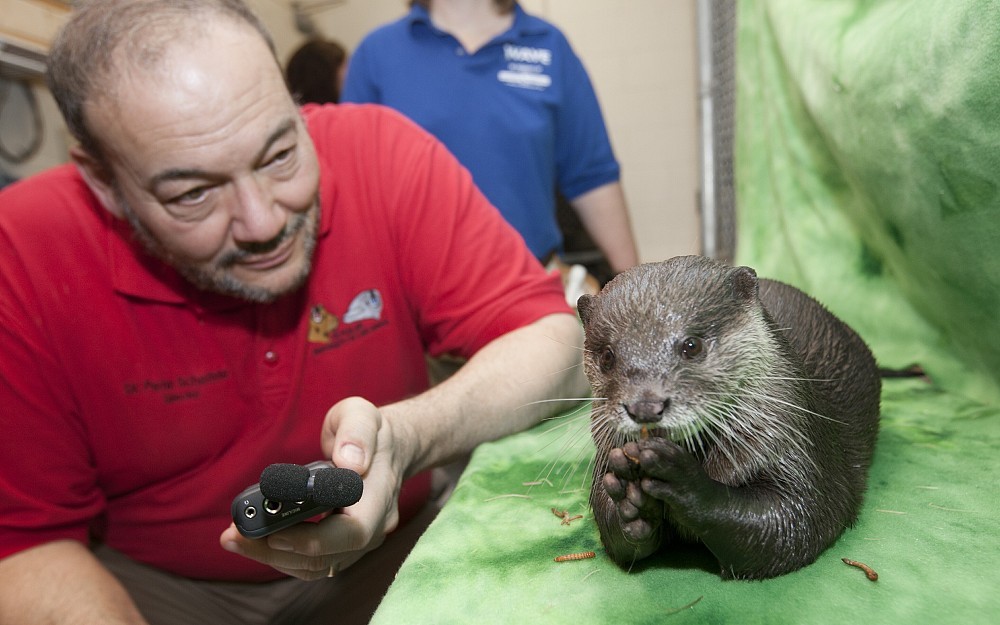
Led by communication sciences and disorders assistant professor Pete Scheifele, MDr, PhD, researchers at the Facility for Education and Testing of Canine Hearing and Lab Animal Bioacoustics, or FETCHLAB, are spending this spring visiting Greater Cincinnatis Newport Aquarium to study animals as varied as otters, sea horses and shark rays.
First among their projects is to understand how and why the aquariums Asian small-clawed otters vocalize.
"Otters are gregarious, social creatures with larynxes similar to humansbut we dont know exactly how many different vocalizations they can produce and how they do it, says Scheifele. "If we can record and categorize their calls, the handlers can understand just what the otters are expressing. This is especially important to know for when the otters are under stress.
Working with aquarium biologists, trainers and veterinary staff, Scheifele has observed and recorded the otters while handlers train them to accept ultrasound wands on their throat. Later, the team will use ultrasounds to study the otters larynxes during vocalizations.
Theyve already observed two vocalizations: the first, a distress call, was made by the male otter Gyan when the female Malena was taken to a different room for an exam. When the brother and sister were reunited, the team heard happy chattering between the pair.
Biologist Michelle Fry says she hears differences in Malina and Gyans calls, but the research can pinpoint the exact details of the vocalizations.
"I may hear five different calls, but the computer could distinguish 10 separate ones based on the frequencies, she says. "Once we learn how many there are, we can learn how to interpret them to have a healthier animal.
Next, Scheifele will work with biologist Scott Brehob and veterinarian Peter Hill to conduct the first-ever hearing exam on the aquariums female shark ray, Sweet Pea.
Sweet Pea was the first shark ray to be exhibited in the hemisphere, and together with male Scooter, is part of the worlds first shark ray breeding program, launched by the aquarium in 2007.
Little is known about the rare and vulnerable shark rays breeding habits, but Brehob says he believes Scooter is showing early breeding behavior around Sweet Pea.
Hell work with Scheifele to take sound recordings of the shark tank and its pumps, to better understand what Sweet Pea and Scooter can hear and how the environment may be affecting them.
FETCHLAB will also take sound readings of the sea horse environment to understand how environmental sound affects breeding of the delicate sea horses. By adding to their knowledge of these species hearing and environment, researchers believe the project could eventually improve captive breeding programs for rare, endangered animals.
"The entire idea of aquatic breeding programs is fairly new, says Brehob. "Were learning every day. Taking care of these animals is an evolving process.
Tags
Related Stories
Cancer Center plays key role in lab research, clinical trials for new pancreatic cancer drug
September 1, 2026

WLWT and WCPO highlighted the contributions of University of Cincinnati Cancer Center researchers that helped lead to the recent FDA approval of daraxonrasib, a new treatment for pancreatic cancer.
Cancer Center physician receives $150,000 New Investigator Research Grant to study treatment-resistant leukemia
September 1, 2026
The University of Cincinnati Cancer Center’s Sarah Skuli, MD, PhD, received a two‑year, $150,000 Leukemia Research Foundation New Investigator Grant to study TP53‑mutated leukemia, a treatment‑resistant subtype with very poor outcomes.
Heavy social media use linked to depression
August 31, 2026

U.S. News and World Report, Yahoo! News, MSN, USA Today and other national media highlight a new study by the University of Cincinnati and Northwestern University that found a correlation between heavy social media use and depression in adults.