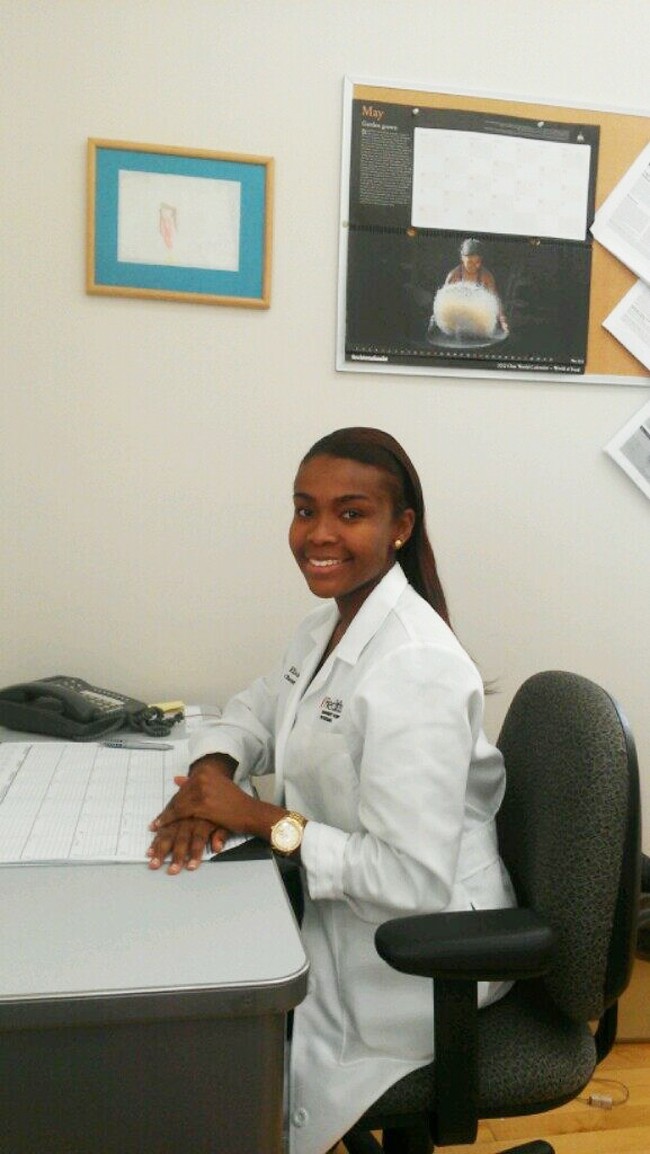
Focus on Staff With College of Nursing Alumna Ebony Hill

UC Health employee Ebony Hill, a 2011 graduate of the University of Cincinnati College of Nursing's nurse practitioner program, works as a certified nurse practitioner (CNP) at the Elm Street Health Clinica collaborative among an arm of the department of OB-GYNs division of community women's health, the Cincinnati Health Department (CHD) and UC Health. In Hills capacity, she provides basic obstetric and gynecological care to women of Greater Cincinnati. She cites her greatest professional accomplishment as seeing women of all walks of life being provided quality care at UC Health, but is specifically proud of the care provided for women with hardships.
Says Hill: "The vast majority of the patients I see of are of low economic conditions and my 'takeaway' message is that they are receiving quality care in spite of their socioeconomic and life circumstances."
When did you come to UC?
I started my UCP employment in January of 2012.
What is your educational background?
"I received my BSN in nursing from Berea College in Berea, Kentucky, and my masters in science in Nursing (11) from the University of Cincinnati College of Nursing, with emphasis in women's health.
What are your daily duties like?
"At Elm Street Health Clinic my daily duties as a CNP are to see OB-GYN patients. I like to fully equip my patients with knowledge and a full understanding of how to improve or maintain their health. In conjunction with registered nurses and nurse clinicians we educate on nutrition, exercise and the importance of prenatal care. In Hamilton County, our infant mortality rate is double compared to the nation's; realizing this shocking statistic we are actively advocating the importance of safe sleep to our mothers. We educate on ways to reduce the risk of SIDS (sudden infant death syndrome) and other contributing factors that could decrease the percentage of infant mortality. The Elm Street Health Center, along with other CHD clinics is currently participating in a state funded grant through the Ohio Department of Health with the use of Title X funding to provide various contraception at little to no cost to the women of Hamilton County.
How do you convey to people how important it is to specialize in women's health?
Being that I am a woman myself, I find it immensely fulfilling to know that I am empowering someone's mom, sister, aunt, wife or friend by positively impacting their attitude toward their mental and physical well-being. Women's health focuses on the woman as a whole; it looks beyond the relevance of childbirth and is structured to give the autonomy that women deserve. It is imperative that the women I provide care for feel significant; I tend to continue to make good health care for women not a status of privilege, but a right.
What do you do outside of work, as a hobby or with family?
I consider myself to be family and friend oriented. Im active in my church, and totally addicted to Zumba. When I am not working out, I am a believer in personal time for meditation and reflection.
Tags
Related Stories
Cancer Center plays key role in lab research, clinical trials for new pancreatic cancer drug
September 1, 2026

WLWT and WCPO highlighted the contributions of University of Cincinnati Cancer Center researchers that helped lead to the recent FDA approval of daraxonrasib, a new treatment for pancreatic cancer.
Cancer Center physician receives $150,000 New Investigator Research Grant to study treatment-resistant leukemia
September 1, 2026
The University of Cincinnati Cancer Center’s Sarah Skuli, MD, PhD, received a two‑year, $150,000 Leukemia Research Foundation New Investigator Grant to study TP53‑mutated leukemia, a treatment‑resistant subtype with very poor outcomes.
Heavy social media use linked to depression
August 31, 2026

U.S. News and World Report, Yahoo! News, MSN, USA Today and other national media highlight a new study by the University of Cincinnati and Northwestern University that found a correlation between heavy social media use and depression in adults.