Pilot Research Funding Opportunities Expand for Cancer

CINCINNATIA community-based fundraising effort has yielded a new pilot grant program at the Cincinnati Cancer Center for a historically underfunded research area: pancreatic cancer.
The Give Hope/BSI Engineering pilot research program will provide start-up research funding to a scientist affiliated with the UC Cancer Institute and studies pancreatic cancer, a devastating disease that affects more than 43,000 people each year and has a five-year survival rate of less than five percent.
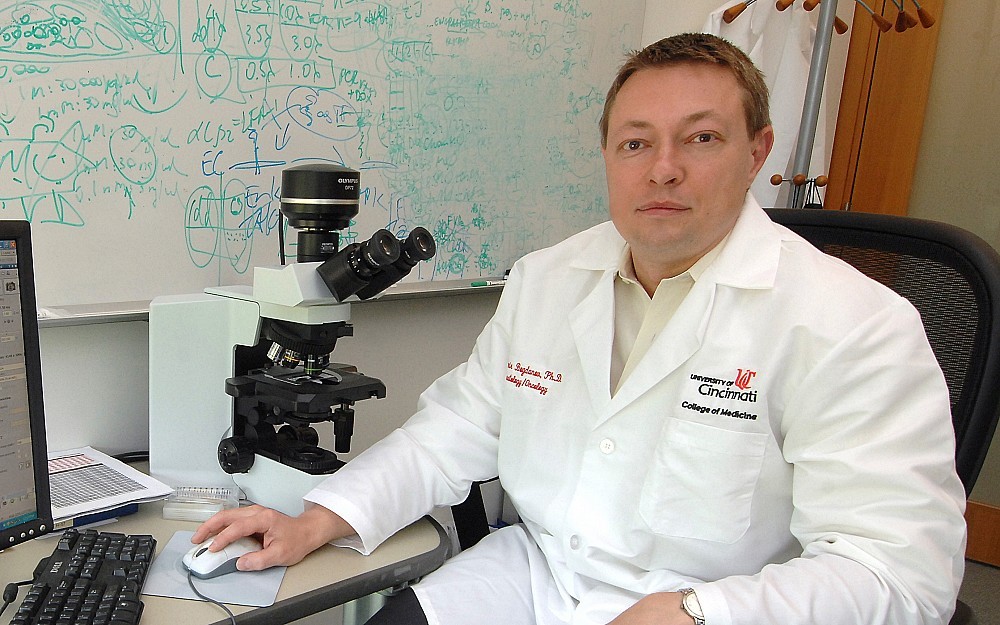
Vladimir Bogdanov, PhD, a researcher and assistant professor in the UC College of Medicine Department of Internal Medicines Division of Hematology/Oncology, received the programs first grant of $21,000 to look at a novel potential biomarker and therapeutic target for pancreatic ductal adenocarcinoma (PDAC).
The start-up funding will help Bogdanov delve into the specific role of a molecule he discovered, known as "alternatively spliced tissue factor (asTF), in PDAC. Preliminary data suggests that asTFa protein that promotes vessel growth and recruitment of pro-inflammatory white cellsis highly expressed in PDAC but not in normal pancreas. Bogdanovs project will study this molecule in PDAC tissue and blood samples, as well as pre-clinical animal models to determine whether asTF holds promise, in part, as a new circulating biomarker.
The Critical Role of Pilot Research Funding
Securing resources to gather the necessary preliminary data to justify a full-fledged research project is one of the biggest hurdles of modern research. Resources are limited and the "big player funders like the National Cancer Institutea part of the National Institutes of Healthare more likely to invest in the projects most likely to succeed in moving beyond the lab bench to clinical practice. In order to gather the data to prove that a research idea has merit, though, scientists must have sufficient staff and equipment.
Get Involved
Pilot grant programs at the Cincinnati Cancer Center offer researchers a financial boost that is critical to get an idea off the ground and eventually lead to larger grants. The Ride Cincinnati Marlene Harris Pilot Grants Program, established in 2007, has raised nearly $1 million for breast cancer research at the Cincinnati Cancer Center. The organizations annual cycling event occurs June 10, 2012. To register, visit ridecincinnati.org.
Related Stories
Cancer Center plays key role in lab research, clinical trials for new pancreatic cancer drug
September 1, 2026

WLWT and WCPO highlighted the contributions of University of Cincinnati Cancer Center researchers that helped lead to the recent FDA approval of daraxonrasib, a new treatment for pancreatic cancer.
Cancer Center physician receives $150,000 New Investigator Research Grant to study treatment-resistant leukemia
September 1, 2026
The University of Cincinnati Cancer Center’s Sarah Skuli, MD, PhD, received a two‑year, $150,000 Leukemia Research Foundation New Investigator Grant to study TP53‑mutated leukemia, a treatment‑resistant subtype with very poor outcomes.
Heavy social media use linked to depression
August 31, 2026

U.S. News and World Report, Yahoo! News, MSN, USA Today and other national media highlight a new study by the University of Cincinnati and Northwestern University that found a correlation between heavy social media use and depression in adults.