Research Collaboration Brings Better Data to Burn Care

Though survival from severe burns has improved markedly in recent years, proven treatment options for improving the resulting scars havent kept pace.
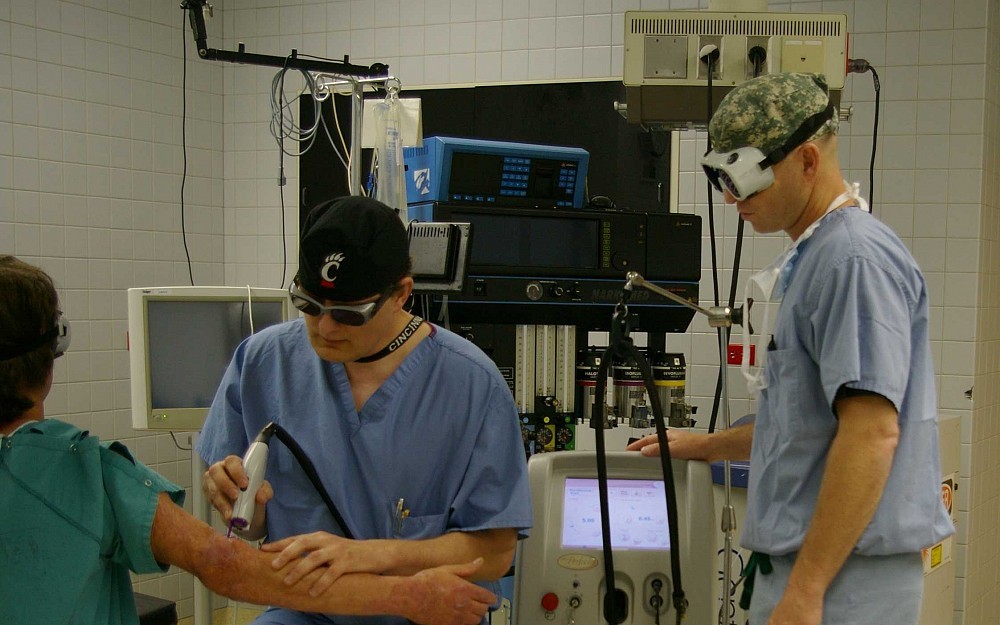
In a new study involving UC's Department of Surgery, James L. Winkle College of Pharmacy and Cincinnati Children's Hospital Medical Center, researchers have quantitatively shown that one treatmenta pulsed-dye-laserimproves burn scars across several measurements of skin condition.
UC burn specialist J. Kevin Bailey, MD, says multiple treatments have been used for scar management with no clearly superior method. Instead, specialists relied on clinical judgment and experience to evaluate treatments, including the pulsed-dye laser.
"Based on subjective judgments, everyone says the laser works. I was not convinced," he says.
So he enlisted a group of burn and skin specialists in a project to objectively measure the lasers results on the appearance, texture and elasticity of burn scars.
Their study, published in the journal Dermatologic Surgery, compared the use of the laser and compression therapy on scars against compression therapy alone for pediatric burn patients. Its the first study to use this kind of objective data to demonstrate the lasers efficacy.
"There were a lot of questions around this laser, says Randal Wickett, PhD, professor of pharmacy and study co-author. "The literature on whether it works was conflicting. Studies have been done, but they werent necessarily systematic.
Wickett has had a long research partnership with Marty Visscher, PhD, co-author and director of the Cincinnati Children's Skin Sciences Program. Since both have had previous careers in the skin industry before coming to UC, theyve worked on integrating the multiple analytic tools used in the private sector to medical research.
"Medicine is very good at imaging inside the body, but we havent applied those tools as much to the external areas, says Wickett. "But just because you can see and feel skin doesnt necessarily tell you everything thats going on and it doesnt give you the best quantitative record if youre trying out new treatment modalities.
In the study, the team decided to measure how the laser affected scars on several common measurements of skin condition, including redness, elasticity and scar thickness.
Participants were pediatric patients undergoing burn scar reconstruction with newly healed skin grafts. While patients had compression therapy across the length of the graft, researchers applied laser treatments to one half of their graft seam at six-week intervals.
Then, the team evaluated the scars using high-resolution digital photography, 3-D laser surface scanning of topography and standardized assessment of biomechanical properties, or measuring the elasticity of the scar.
Using the digital photographs, they counted the percentage of pixels showing redness in the image. With 3-D tomography, they measured the difference in height of the scar at each new treatment.
Each aspect of skin health showed improvement with combined laser and compression therapy.
"We standardized each step of the process," says Bailey. "For each photograph, we could see the average amount of redness in the scar. We can break skin down into numbers.
"This project was actually the first of its kind to look at multiple factors associated with burn scars in a quantitative wayits a great technique that can be used in many different specialties, says co-author Shona Burkes.
Burkes, now a PhD pharmacy student, started work on the project in her first and second years of graduate study. "Its very simple to use a camera or a 3-D scanner. The hope is that other clinicians could adopt these techniques to test other treatment options.
Visscher says the technique can be used not just for patients with severe burns, but also for minor burns or scars.
"For patients with burn scars, their self-esteem and integration into society is a huge factor in their well-being and quality of life," Visscher says. "In this case, we demonstrated a good way to determine if these treatments are working and how well they are working. It creates a framework to see if we can improve reconstruction even more for these patients. At the end of the day, its important to the patients who walk in the doorthats what counts."
Co-authors include: Jennifer Whitestone, Total Contact, Inc.; and Richard Kagan, MD, Kevin Yakuboff, MD, and Petra Warner, MD, UC Department of Surgery and Shriners Hospitals. The study was funded by the International Association of Fire Fighters.

Burn scars before and after laser treatment
Tags
Related Stories
Heavy social media use linked to depression
August 31, 2026

U.S. News and World Report, Yahoo! News, MSN, USA Today and other national media highlight a new study by the University of Cincinnati and Northwestern University that found a correlation between heavy social media use and depression in adults.
On-site training in Speech & Hearing Clinic sets UC’s programs apart
August 27, 2026
At the University of Cincinnati’s Speech & Hearing Clinic, Doctor of Audiology and Speech-Language Pathology graduate students gain real-world experience while providing free speech and hearing services to the community.
Funding expands UC research into weight gain side effects of bipolar medication
August 26, 2026
University of Cincinnati researchers have been approved for funding by the Patient-Centered Outcomes Research Institute (PCORI) to expand the implementation of healthy lifestyle interventions and metformin prescription to help manage weight gain in overweight or obese youth taking second-generation antipsychotic medications.