After Stroke, When and How to Use Assistive Devices?

Difficulty in remembering and using spoken or written words, known as aphasia, can be a painful side effect of stroke. For some patients, that difficulty can last long after their stroke, causing a severe decrease in their quality of life.
With two new National Institutes of Health (NIH) awards, a researcher at UCs College of Allied Health Sciences hopes to learn how augmentative and alternative communication (AAC) devices can help these patients continue to communicate.
Assistant Professor of Communication Sciences and Disorders Aimee Dietz, PhD, says that for many post-stroke patients, aphasia does not completely erase their ability to communicate.
"Aphasia is a language disorder, meaning patients may have a hard time understanding what they read or hear and have difficulty expressing themselves when write or speak but often still have the ability to express themselves using fragmented speech, says Dietz.
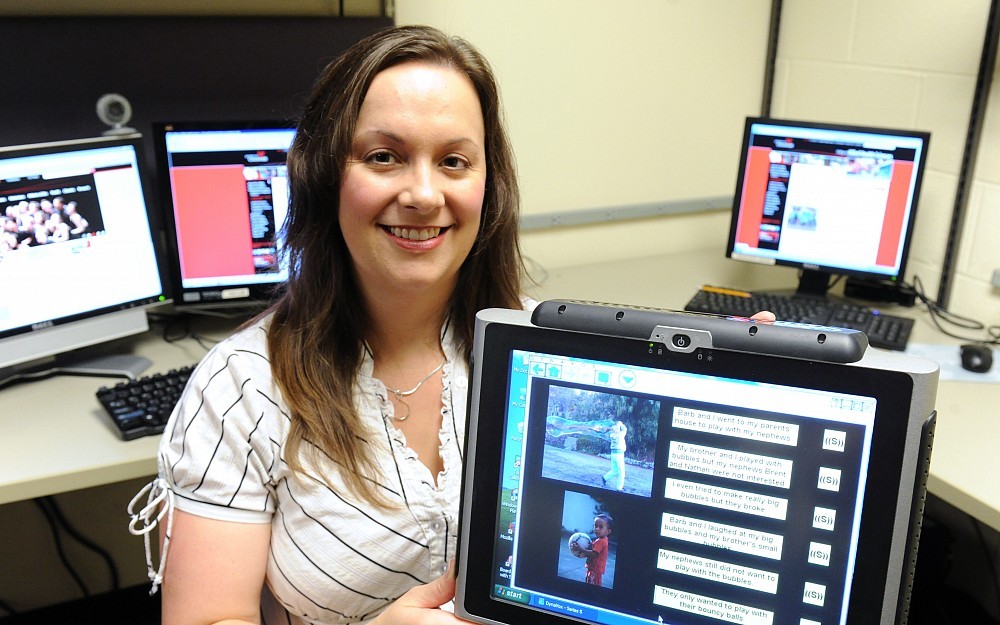
AAC devices allow patients to augment their speech, ranging from a basic board with printed symbols to high-tech devices that incorporate text and photos into an interactive tool. Patents can then point to or play items on the board to help with communication.
More recently, patients and speech-language pathologists have used mobile technology as AAC devices, either through new communication apps or using tablet devices or phones, to hold text or photos. As part of her research, Dietz is studying when to introduce AAC technology into the rehabilitation process and how best to design the devices for patients.
Under a KL2 Research Training Grant awarded by UCs NIH-funded Center for Clinical and Translational Science and Training (CCTST), she will study neuroimaging under the mentorship of imaging research assistant professor Jennifer Vannest, PhD, and professor Scott Holland, PhD, of the Pediatric Neuroimaging Research Consortium at Cincinnati Childrens Hospital Medical Center, as well as associate professor of neurology Jerzy Szaflarski, MD, PhD.
In the research portion of the grant, Dietz will examine the use of an AAC intervention in patients between 3-12 months post-stroke.
Patients in the study will be randomized to receive either standard rehabilitation or a personalized AAC intervention designed by Dietz. The intervention will teach patients how to use their AAC device during recoveryso they can learn how to compensate while working to restore their lost language skills.
Current rehabilitation practices typically do not introduce AAC devices until patients have plateaued in their language recovery, says Dietz, and she hopes to show that restoration therapy does not have to be done to the exclusion of these interventions.
"Until we have a silver bullet for aphasia, we have to find some way for these patients to communicate, she says.
She likens the use of AAC devices to the use of a wheelchair or walker for patients relearning how to walk again: "We dont tell patients, You have to stay in bed until you can walk. What we are doing now is telling them, You cant communicate until you can talk.
In another study, funded by a $25,000 T1 translational science grant, Dietz will study how her personalized AAC device affects patients more than 1 year post-stroke.
For these patients, a generic AAC device can present more struggles than solutions, as they have to relearn the devices symbols and connect them to words.
Personalized devices use a patients own photos and phrases to help them recount stories from their past or convey information about themselves. Dietz says therapists have reported that patients do better when using personalized devices or when recounting personal memories instead of current events.
"When they had their own photos and text, most patients seemed to retrieve the words better, and there were fewer communication breakdowns, she says. "By activating that memory, the device was helping them find the language to talk about it.
Her study, "High-Tech AAC Treatment of Aphasia, will look at patients who are considered to have "chronic aphasia.
By comparing personalized with non-personalized AAC devices, the study could eventually generate enough data to launch a larger study on rehabilitation with personalized AAC devices.
"All apps arent created equal, says Dietz. "Once we learn which work best, we can get the word out to AAC vendors, app developers and speech-language pathologists to have them design interfaces using features that make a positive difference for these patients.
UC's CCTST is supported by an institutional Clinical and Translational Science Award from the National Institutes of Health.
Related Stories
Heavy social media use linked to depression
August 31, 2026

U.S. News and World Report, Yahoo! News, MSN, USA Today and other national media highlight a new study by the University of Cincinnati and Northwestern University that found a correlation between heavy social media use and depression in adults.
On-site training in Speech & Hearing Clinic sets UC’s programs apart
August 27, 2026
At the University of Cincinnati’s Speech & Hearing Clinic, Doctor of Audiology and Speech-Language Pathology graduate students gain real-world experience while providing free speech and hearing services to the community.
UC, NKU renew longstanding partnership supporting Army ROTC cadets
August 26, 2026
The University of Cincinnati Army ROTC and Northern Kentucky University (NKU) have renewed a longstanding partnership that supports students preparing to become Army officers and leaders in their communities. The universities formalized the renewed agreement during a signing event Aug. 11 at NKU.