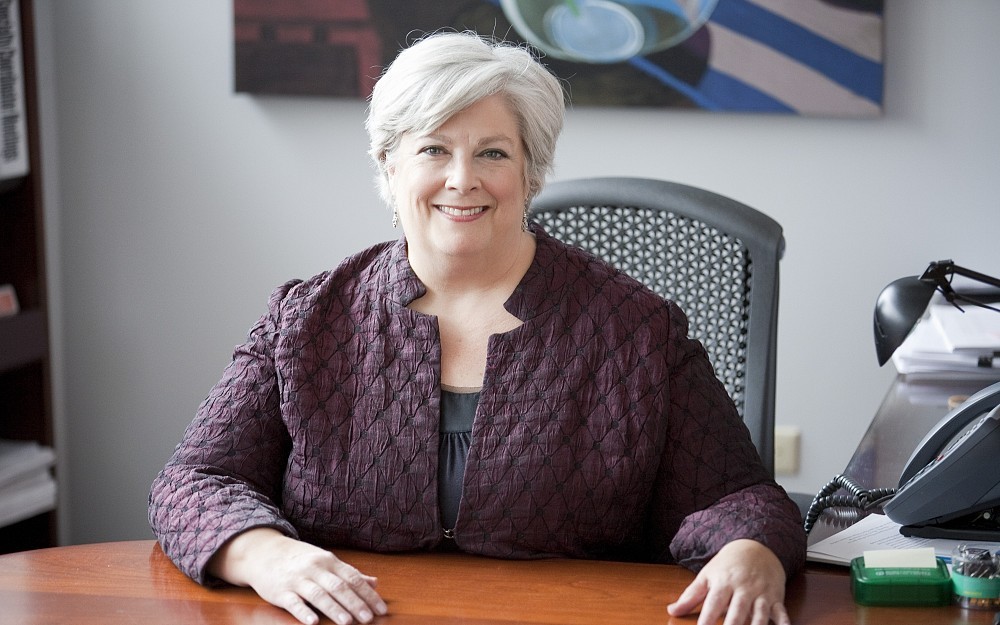
Focus on Administration With College of Nursing's Suzanne Perraud, PhD

The UC College of Nursing has a new senior associate dean for academic affairs: Suzanne Perraud, PhD. Perraud is responsible for the development, implementation and evaluation of all curricula and programs of instruction in the college. Additionally, she provides leadership and guidance of all undergraduate and graduate programs within the context of quality education, practice, research and scholarship. This position is integral in advancing the academic mission of the college and university, UC Health, health care agencies, other schools/colleges of nursing and other disciplines.
Being new to UC, what was the driving factor that brought you here?
"I was fortunate to have spent most of my career in a small but mighty college of nursing in Chicago at , Rush University). I learned so much there and made many friends, one of whom introduced me to Dean Glazer. The dean in turn seeded the idea of a move to Cincinnati and I was intrigued by the promise of what I could learn from applying the skills that I had developed in that small private school to a large and bustling college of nursing set in a public university. Aiding my decision was the fact that I had family in Cincinnati who warmly welcomed this Chicago transplant."
What do you feel are the benefits of working at an academic health center?
'We are so fortunate to be in the midst of this mecca of world-renowned education, patient care and research. Right outside our door are amazing practice partnerships and invaluable opportunities for our students and faculty to contribute to the enormous potential of academic health centers to improve the health and well-being of the global communities they serve. From their earliest clinical experiences, our students further this agenda though participation in collaborative, interprofessional teams engaged in innovative models of practice and research. This poises our graduates to be architects of the changes needed in health care that will enable them to meet the needs of an increasingly complex patient population."
How has nursing changed since your early beginnings?
"Nursing has grown tremendously in the years since I graduated from my BSN program. Driving those changes is a context of care that has become increasingly challenging. The very long inpatient stays that I experienced as a young acute care nurse have been vastly reduced or eliminated altogether by advances in outpatient care and home technology. Nurses have become more diverse than in my day, but still have a long way to go to represent our patients. Nurses have become increasingly specialized and educated, and now do work that was once done only by physicians. Relationships with patients have also changed, with nurses taking on roles as patient advocates and policy change agents. Technology has increased the pace of our work, making it possible to do much more in the same amount of time than could be done in the past. Nursing education has also changed to keep one step ahead of the new realities of the patients and communities in our care. We have seen the advent and the growth of baccalaureate programs, second degree programs, clinical nurse leader programs, advanced practice programs and practice and research doctorates. Infused through all of these programs is an increasing emphasis on the development of the skills needed to prepare nurses at all levels to be leaders."
What makes your role different than with other faculty positions?
"The associate dean position is the ultimate service job. We help the faculty excel at what they do in their positions as teachers, practitioners and researchers by providing them the resources they need. We engage faculty in forming a picture of where we think nursing and nursing education is going and then facilitate their work in getting us there. We are charged with assuring quality in our educational programs and so must put in place the systems and structures that evaluate those programs, and then confront reality and make changes when they are not working as we had hoped. Our practice is largely administrative, though many of us are pulled toward our specialty practice and research."
Have you had mentors in your career? Who, and what did they teach you?
"I have been fortunate to have several wonderful mentors in my career. These mentors were alike in their passion to put patients, students and faculty first. They were also beyond passionate about nursing and the potential of nursing to make a real difference in the lives of patients and society. They helped me become an agent of change and were there for me when I became discouraged or overwhelmed. They led me to the position I am in today, where I am determined to do for others what they did for me."
What do you like to do in your spare time (hobby, interest)?
"I love to read, and I have amassed a large collection of books that I devour when I am on vacation. My children and grandchildren are very important to me so driving or taking the Megabus to Chicago when I can has become something I do in my spare time. I also love to travel, am a fan of music of all kinds and return to an early passion for sketching and painting when I can."
Tags
Related Stories
Heavy social media use linked to depression
August 31, 2026

U.S. News and World Report, Yahoo! News, MSN, USA Today and other national media highlight a new study by the University of Cincinnati and Northwestern University that found a correlation between heavy social media use and depression in adults.
On-site training in Speech & Hearing Clinic sets UC’s programs apart
August 27, 2026
At the University of Cincinnati’s Speech & Hearing Clinic, Doctor of Audiology and Speech-Language Pathology graduate students gain real-world experience while providing free speech and hearing services to the community.
UC, NKU renew longstanding partnership supporting Army ROTC cadets
August 26, 2026
The University of Cincinnati Army ROTC and Northern Kentucky University (NKU) have renewed a longstanding partnership that supports students preparing to become Army officers and leaders in their communities. The universities formalized the renewed agreement during a signing event Aug. 11 at NKU.