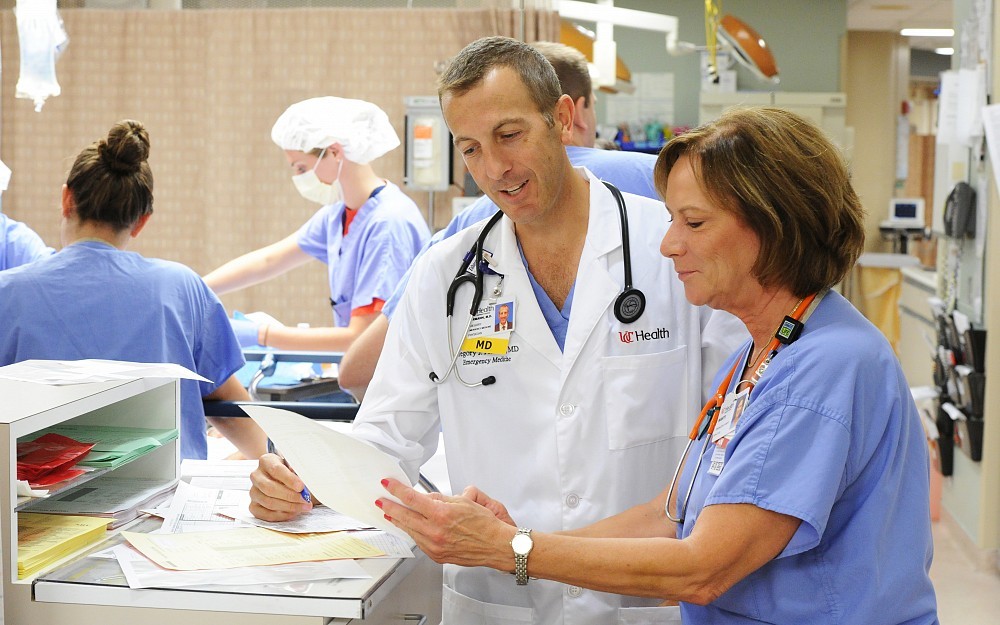
Focus on Faculty with Greg Fermann, MD

Greg Fermann, MD, an associate professor in UCs Department of Emergency Medicine, was recently named the departments executive vice chairman. He also serves as vice chair of strategic planning for the department and directs the departments Center for Clinical Trials.
A graduate of the College of Medicine, Fermann completed his residency at the Maricopa Medical Center in Phoenix and served as chief resident his senior year. In 1996, he returned to his hometown of Cincinnati to join the UC faculty and serve as attending emergency physician at Jewish Hospital and University Hospital.
How has UCs Department of Emergency Medicine changed since youve come to UC?
"Since I joined, weve expanded from a single-ED academic group, where our primary mission was at University Hospital, to our role now where were running several different clinical sites. Our departments physicians practice at Jewish Hospital, West Chester Hospital and University Hospital. For a long period of time we also operated at Christ Hospital and I ran our operation there.
"Ive seen many changes in our academic mission as a whole, and our clinical mission in particular has grown. Weve become very focused on our patient population. Were trying to develop the patient experience at University Hospital and expand its mission as a teaching hospital, a safety-net hospital and a quaternary care hospital. We would like to see the most critically ill and injured patients in the Tristate area come to UH.
"That requires great communication with the administration at University Hospital. We have a great relationship with James Kingsbury, Dr. Brian Gibler, Nancy Barone and Dr. John Deledda, all of whom are determined to create a high quality experience for our patients.
"Were focused on fostering the communication between physiciansthose attending-to-attending conversationsand eliminating confusion and delay. We want our UC Health referring physicians to understand that we are actively involved in their patients care.
How do you see other aspects of the department growing in the future?
"The clinical trials center is a large part of our operation in the ED. We have a group of 23 clinical study associates helping with patient screenings and recruitment, five clinical coordinators and 12 MD investigators.
"Most recently, weve concentrated on expanding our industry relationships. We recruit subjects with diseases and conditions that present acutely to the emergency department: for example, skin infections, acute heart failure syndrome, acute coronary syndrome, angioedema and acute neurologic emergencies.
"Were broadening the scope of our clinical mission. For example, with Brad Evans DO, we direct the Hospitalist program at West Chesterhaving hospitalists in our department helps to coordinate patient care between the emergency department and inpatient units. Also, several of our faculty have additional expertise in critical care specialties.
"The specialty of emergency medicine as a whole has seen a continued evolution. We treat all types of patients, regardless of their ability to pay or what condition they have.
"Its estimated that 50 percent of patients admitted to American hospitals come through the emergency department. That number is closer to 75% if you look at admissions to critical care units. Its the place where most practitioners send their patients and, really, the front door of the health care system.
What do you do outside of your time at UC?
"I live Anderson Township with my wife, Gretchen, who is also a UC COM graduate and currently practices gynecology with Seven Hills Womens Centers.
"We have four children, ages 7 to 15 years old. When Im not working I enjoy running and playing golf, but Im usually following the kidsaround in their activitiescross-country, soccer and gymnastics."

Greg Fermann, MD, is vice chair of strategic planning for the UC Department of Emergency Medicine.
Related Stories
On-site training in Speech & Hearing Clinic sets UC’s programs apart
August 27, 2026
At the University of Cincinnati’s Speech & Hearing Clinic, Doctor of Audiology and Speech-Language Pathology graduate students gain real-world experience while providing free speech and hearing services to the community.
Designing with cancer patients' needs in focus
August 27, 2026
Kristina Shin is designing garments that prioritize the comfort, function and confidence of breast cancer patients, addressing a need often overlooked by traditional fashion.
UC, NKU renew longstanding partnership supporting Army ROTC cadets
August 26, 2026
The University of Cincinnati Army ROTC and Northern Kentucky University (NKU) have renewed a longstanding partnership that supports students preparing to become Army officers and leaders in their communities. The universities formalized the renewed agreement during a signing event Aug. 11 at NKU.