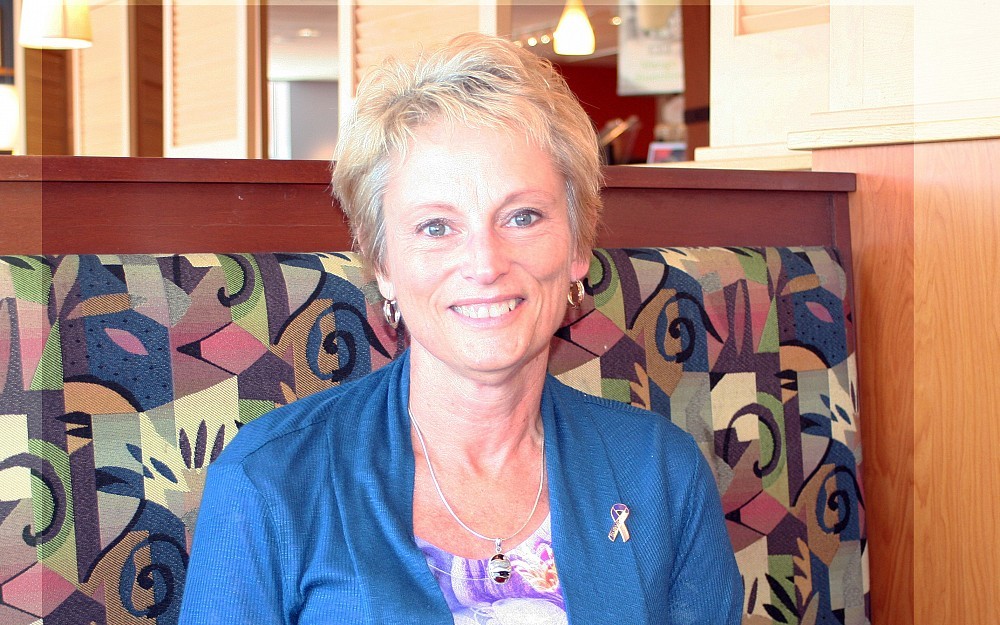
Patient Lives Beyond Pancreatic Cancer With Innovative Care Regimen

West Chester resident Beth Sininger says Dec. 14, 2010, was the worst day of her life. At age 52, she received the shocking news that her lingering stomach pain was actually stage 3 pancreatic cancer.
"I thought maybe I had a bad case of acid reflux. Never in my wildest dreams did I think my diagnosis would be pancreatic cancer, she recalls. "All I could think was: I am going to die. I cant leave my husband and family so soon.
The day after her diagnosis was confirmed, Siningers UC Health primary care physician Sri Murthy, MD, arranged for her to meet with Syed Ahmad, MD, a UC Health surgical oncologist affiliated with the UC Cancer Institute.
Siningers tumor was determined to be inoperable due to its proximity to the major arteries feeding blood to her lower body. Ahmad recommended beginning chemotherapy immediately and arranged for her to see medical oncologist Olugbenga Olowokure, MD, that afternoonotherwise known as "Dr. Benga by his patients.
Although the prognosis seemed dismal at the time, Sininger says the support of her family, friends and "amazing medical team gave her strength to give it her best fight.
"How do you describe Dr. Benga? A force of nature, a huge ray of hope, a spiritual guide, the best doctor anyone could have when fighting pancreatic cancer its really all of the above and more, says Sininger. "With the exception of my husband, he is the most remarkable person I have ever met.
Sininger says from the minute Olowokure met with her and "the chemo gangher husband, step-daughter, mother and best friendhe gave them hope and a path to follow.
"He told us he would do everything possible to make surgery an option, but that I had to believe and keep a positive attitude. I had to keep my boxing gloves on all the time. So, I decided to fight. I kept my boxing gloves onand so did my chemo gangthroughout all of 2011 and still do to this day, she recalls. "Dr. Benga was my constant. He always made time to see me and my family, to answer our questions and walk us through the journey even when it got really hard.
She began an aggressive chemotherapy regimen gemcitabine plus abraxane each cycle of chemotherapy consisting of three weeks on, one week offthat continued for all of 2011. After the second cycle of chemotherapy, she started a series of 31 radiation treatments with Michelle Mierzwa , MD, a UC Health radiation oncologist who is also part of the UC Cancer Institute team. The combination of chemotherapy and radiationalso known as chemoradiationis not typical if there is any suspicion of metastatic disease, but the multidisciplinary pancreatic cancer team agreed it was worth a try. She received gemcitabine-based chemoradiation, then resumed her previous chemotherapy regimen.
"You begin to live your life in months and quarterstumor marker tests happen monthly, imaging tests are quarterly. Its a continual up and down. Sometimes I was so tired I didnt think I could get out of bed, let alone go to treatments. With the help of my chemo gang and an army of medical staffnurses, PAs, doctors, techsI made it through. I had to keep those boxing gloves on and keep fighting. I didnt want to let my family or Dr. Benga down.
By September 2011, Siningers tumor count reached the normal range and remained there for the coming months. Together, Olowokure and Ahmad decided to send her to surgery. Ahmad gathered more than 100 biopsies of the organs and tissues surrounding the pancreas during her procedure to remove part of the pancreas and her spleen. All of the samples came back negative for signs of cancer.
"Friday the 13 turned out to be a lucky day, Sininger says, referring to her surgery date: Friday, Jan. 13, 2012. "I am currently cancer freesome of the best words in the English language. There are no guarantees that my cancer will not return, but Im treating every precious day as a blessing. I owe so much to my medical army. I know I would not have heard these precious words without them and the love and support of my husband, parents, daughters and friends and prayers of so many people.
MORE INFORMATION
To learn more about the multidisciplinary gastrointestinal cancer team at the UC Cancer Institute, visit cancer.uc.edu.
For clinical trials, call 513-584-7698.
For appointment information, click here.
Community Music Event Benefits Pancreatic Cancer Research
A portion of ticket and auction proceeds from the 2012 Rusty Ball will benefit the GIVEHOPE Pancreatic Cancer Research and Awareness Fund, a foundation established in honor of Beth Sininger. Together with BSI Engineering, GIVE HOPE provides funding support for an ongoing pancreatic cancer research pilot grant program at the UC Cancer Institute. The group awarded its first pilot grant in 2012 to Vladimir Bogdanov, PhD, a pancreatic cancer researcher affiliated with the UC Cancer Institute and UC College of Medicine.
The fifth annual Rusty Ball, hosted by the Rusty Griswolds, will be held on November 10, 2012. Last year this event helped 119 local charities. GIVEHOPE was a beneficiary in 2011 and has been selected again for 2012.
The nonprofit will receive a portion of ticket proceeds and certain auction items. GIVEHOPE will be auctioning two autographed guitarsone signed by the Doobie, the other by the band Chicagotwo trips to Chicago and a two-flight glider package from the Caesar Creek Soaring Club. Learn more about the event and purchase tickets at http://tickets.therustyball.com/eventperformances.asp?evt=9. Make sure to designate "GIVEHOPE as your beneficiary.

Olugbenga Olowokure, MD, specializes in gastrointestinal oncology.

Syed Ahmad, MD

Michelle Mierzwa, MD
Related Stories
Cancer Center plays key role in lab research, clinical trials for new pancreatic cancer drug
September 1, 2026

WLWT and WCPO highlighted the contributions of University of Cincinnati Cancer Center researchers that helped lead to the recent FDA approval of daraxonrasib, a new treatment for pancreatic cancer.
Cancer Center physician receives $150,000 New Investigator Research Grant to study treatment-resistant leukemia
September 1, 2026
The University of Cincinnati Cancer Center’s Sarah Skuli, MD, PhD, received a two‑year, $150,000 Leukemia Research Foundation New Investigator Grant to study TP53‑mutated leukemia, a treatment‑resistant subtype with very poor outcomes.
Heavy social media use linked to depression
August 31, 2026

U.S. News and World Report, Yahoo! News, MSN, USA Today and other national media highlight a new study by the University of Cincinnati and Northwestern University that found a correlation between heavy social media use and depression in adults.