Researchers Discover Mechanism That Could Help Cancer Patients With Chemotherapy Recovery

CINCINNATIResearchers at the UC Hoxworth Blood Center and Cincinnati Children's Hospital Medical Center have discovered a potential protein target therapy to improve the outcomes for patients undergoing chemotherapy.
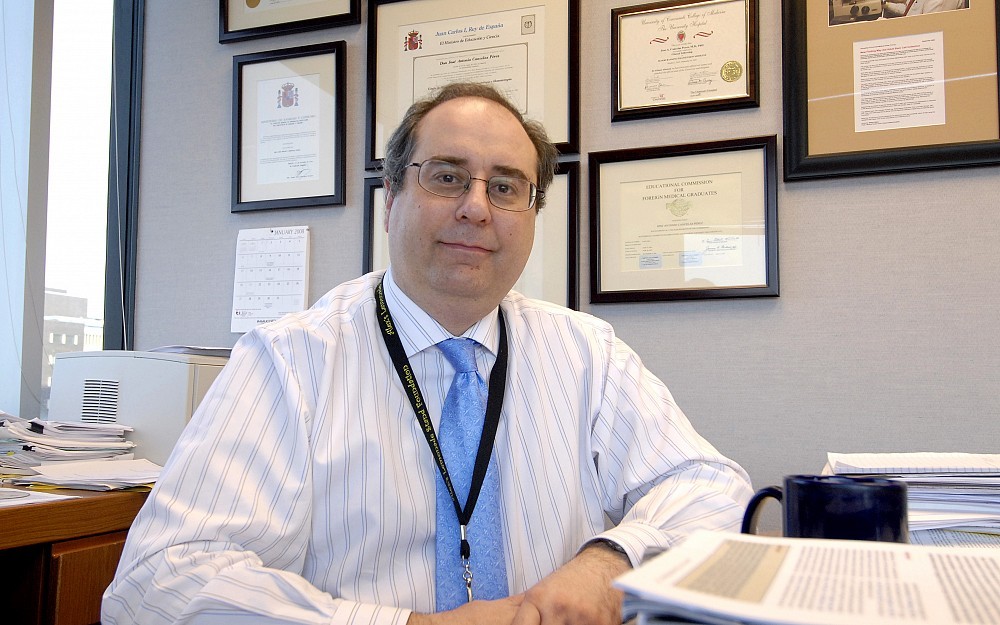
Jose Cancelas, MD, PhD, an associate professor of pediatrics at the UC College of Medicine and director of the research division at Hoxworth Blood Center, and his team have found that Connexin-43a protein expressed in hematopoietic stem cells (stem cells that can take on the role of any cell in the body) that controls oxidation of blood stem cells in the body, opening hope to help patients recover and survive chemotherapy.
These findings were presented this summer in an edition of Proceedings of the National Academy of Sciences (PNAS) journal.
Oxidation is the interaction between oxygen molecules and other substances in cells. Cancelas says oxidation of cells in the body is harmful and causes mutations, leading to more waste in cells and worse outcomes for patients, even death.
"There is significant differentiation in how people respond to chemotherapywhich is essential in some cases for people with cancerand some people recover faster than others, says Cancelas, adding that chemotherapy causes decreased production of blood cells and immunosupression, or a reduced immune system. "Specifically, it takes older people longer to recover because their systemsand cellsare weaker, and chemotherapy weakens the system further.
"Stem cells are equipped with systems to prevent oxidation, pumping wastes into other cells and scavenging from them, depending on them to dispose of waste and prevent damage to the cell. We wanted to see how we could target this mechanism to help patients who have worse outcomes from chemotherapy.
Using animal models, researchers were able to target and increase the amount of Connexin-43 being regulated in the system.
"We found that Connexin-43 exerts a protective role in the cell and regulates the waste being transferred to other cells, so that stem cells can regenerate more quickly even during the stress imposed upon them by chemotherapy, Cancelas says, adding that clinical trials may be the next step in research. "This finding is strictly pre-clinical, but it has the potential to impact patient care greatly. By targeting and activating this protein, chemotherapy waste in older populations can be carried away more quickly, helping them have better outcomes.
This study was funded by grants from the National Heart, Lung and Blood Institute, the Department of Defense, the National Blood Foundation and by a critical gift from the Heimlich Institute of Cincinnati. The project was performed at Hoxworth Blood Center and in the division of experimental hematology and cancer biology at Cincinnati Childrens. Other authors of this paper include Eri Taniguchi-Ishikawa, Susan Dunn, Ashley Ficker, Bhuvana Murali, Malav Madhu; outside collaborators including Daniel Gonzalez-Nieto and Luis Barrio (Universidad Politecnica and Hospital Ramon y Cajal, Madrid, Spain) and David Gutstein and Glenn Fishman (New York University).
Related Stories
Cancer Center plays key role in lab research, clinical trials for new pancreatic cancer drug
September 1, 2026

WLWT and WCPO highlighted the contributions of University of Cincinnati Cancer Center researchers that helped lead to the recent FDA approval of daraxonrasib, a new treatment for pancreatic cancer.
Cancer Center physician receives $150,000 New Investigator Research Grant to study treatment-resistant leukemia
September 1, 2026
The University of Cincinnati Cancer Center’s Sarah Skuli, MD, PhD, received a two‑year, $150,000 Leukemia Research Foundation New Investigator Grant to study TP53‑mutated leukemia, a treatment‑resistant subtype with very poor outcomes.
Heavy social media use linked to depression
August 31, 2026

U.S. News and World Report, Yahoo! News, MSN, USA Today and other national media highlight a new study by the University of Cincinnati and Northwestern University that found a correlation between heavy social media use and depression in adults.