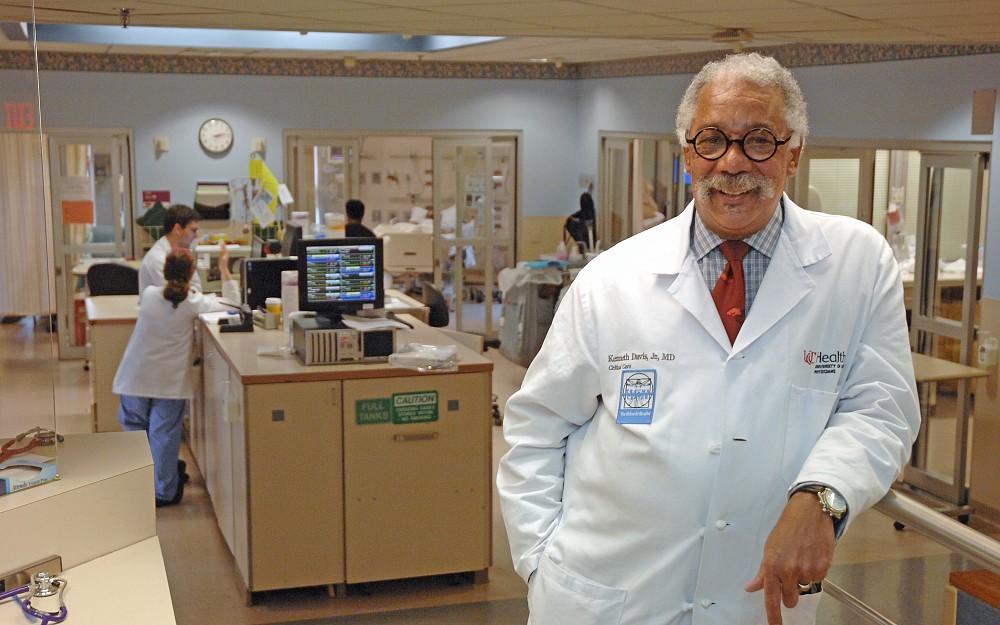
Focus on Faculty with Kenneth Davis, MD

Kenneth Davis, MD, is professor of surgery and clinical anesthesia in the division of trauma and critical care. He also serves as assistant dean for diversity and community affairs. 

Davis was recently named President of the Society of Black Academic Surgeons. The Society, founded in 1989, aims to create a network of African-American surgeons and to stimulate, mentor and inspire surgeons and medical students to pursue academic careers.

In 2008, Davis and his wife, Johnie, created the Lucy Oxley, MD, African American Medical Student Scholarship at the College of Medicine. Lucy Oxley was the first African-American to earn a medical degree at UC (1935).


What does this new role at SBAS mean for you? 
"I’ve been a member of the society for about 20 years now and I’m the 22nd president of the organization. I was the chair of the program committee for three or four years before that.

"For me, it was a tremendous honor to be recognized by people that you know and respect— to feel that they know and respect you well enough that they would want to nominate you to a position like this. It’s a tremendous honor.” 

What does the role of the SBAS president entail?
"A lot of the role involves planning the upcoming annual meeting. I also have to give the presidential address at next year’s meeting. I’ve been thinking about it for well over a year and I still don’t have a clue what I’m going to say.

"Like any academic organization, the bulk of the annual meeting is presentations of abstracts, speakers, posters, etc. But it has a pretty substantial social program and, I think because of the unique membership and the unique relationships, there’s a lot of networking that goes on too.

"Obviously, it’s a small group. But it’s a growing group, and it’s an important one. It’s good for black academic surgeons to see that there are other people out there that are similar to them.

"For example, I can look around here and there aren’t a lot of people who look like me, either as a mentor or role model or anything like that. That’s one of the most important things about the organization, its mentorship role for younger academic surgeons. The society has a leadership institute where they have maybe 12 young faculty members, nominated by their department chairs, and they spend a whole day with leaders in academic surgery talking about how to be a leader.”

What led you and your wife to create the Lucy Oxley scholarship?
"One of the reasons we lose African-American students at the college is that we don’t have the financial aid to be competitive with other schools. We lose two-thirds of the students we accept because we don’t have financial aid. Students are graduating with anywhere from $100,000 to 200,000 in debt. So my wife and I decided that we wanted to do something about that.

"We started this about four years ago and, so far, we’ve been able to raise about $82,000. We were able to give our first partial scholarship award last year.

"My wife’s goal is to raise $2 million—hopefully that’s an attainable goal. If we can get to that goal, we can offer complete, full tuition scholarships for two students just off the interest.”

Related Stories

1

UC students organize free health clinic in community

July 13, 2026

The University of Cincinnati student chapter of Remote Area Medical held its annual free health clinic July 11-12 at St. Xavier High School. Medical, dental and vision care was offered to adults and children, with no income requirements or insurance needed.

2

Is speech-to-text AI really reliable?

July 10, 2026

UC researcher Nelly Elsayed’s study in the International Journal of Medical Informatics reveals key risks in clinical speech-to-text AI and shows why human review is essential.

3

Hoxworth Blood Center CEO advocates on Capitol Hill during National Blood Advocacy Week

July 9, 2026

Hoxworth Blood Center, University of Cincinnati, has announced that David Oh, MD, director and chief executive officer, joined blood center leaders, patient advocates and partner organizations in Washington, D.C., in June as part of Blood Advocacy Week, a national initiative led by America’s Blood Centers to strengthen the nation’s blood supply.
