UC HEALTH LINE: CT Scan Radiation Exposure Not as High as Previously Thought

CINCINNATICardiac computed tomography, or cardiac CT, is a successful technology that allows physicians and imaging specialists to diagnose heart problems in a noninvasive, painless way.
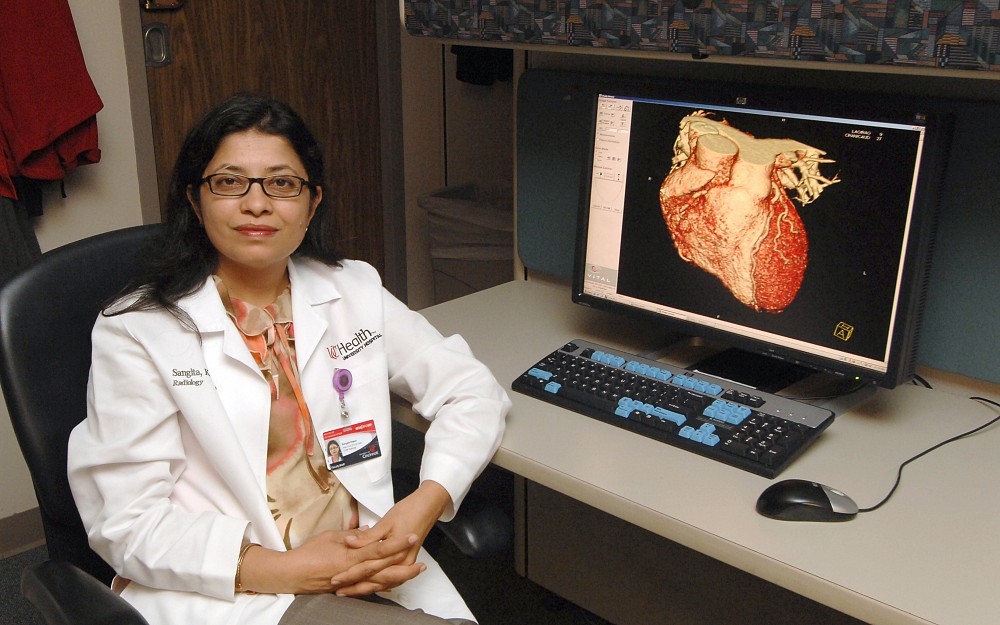
However, Sangita Kapur, MD, UC Health radiologist, says the enthusiasm behind this technique has been tempered by worries from patients about radiation risks.
"I often see patients who are worried about the radiation risks associated with CT, especially women who are worried about breast health, she says.
Cardiac CT is a test that uses an X-ray machine to take clear, detailed pictures of the heart; physicians use this test to look for heart problems.
In the last several years, there have been reports about the harm caused by radiation scans over the life of the patient which could increase his or her chance for cancer.
"The Society of Cardiovascular Computed Tomography has spent a lot of time and resources on research, leading to the development of cardiac CT techniques to lower the radiation doses delivered to patients, Kapur says. "Were using these techniques at UC Health University Hospital, reducing radiation to our patients by 30 to 40 percent.
Kapur says cardiac CT scans at University Hospital are individualized for each patient, based on their body mass index (BMI) and build (including whether the patient is small or large in the chest area). In addition, imaging is targeted to the particular reason the scan is being conducted.
"We no longer take images throughout the entire heart cycle but pinpoint the exact cardiac phase or phases we want to image.These factors alone provide us with a significant reduction in radiation, she says. "Also, we have the advanced Dual Source CT technology which provides better radiation modulation and decreases the duration of scan in some patients while providing improved quality.
"Many imaging modalities give off some sort of radiation, but we are taking steps to deliver the smallest dose possible to lower risks for patients by using an individualized approach.
"Cardiac CT is an important diagnostic tool, especially for people who experience unexplained chest pain, and one should not forgo the test because they are afraid of the radiation risks. It could save or improve your life.
Tags
Related Stories
Cancer Center plays key role in lab research, clinical trials for new pancreatic cancer drug
September 1, 2026

WLWT and WCPO highlighted the contributions of University of Cincinnati Cancer Center researchers that helped lead to the recent FDA approval of daraxonrasib, a new treatment for pancreatic cancer.
Cancer Center physician receives $150,000 New Investigator Research Grant to study treatment-resistant leukemia
September 1, 2026
The University of Cincinnati Cancer Center’s Sarah Skuli, MD, PhD, received a two‑year, $150,000 Leukemia Research Foundation New Investigator Grant to study TP53‑mutated leukemia, a treatment‑resistant subtype with very poor outcomes.
Heavy social media use linked to depression
August 31, 2026

U.S. News and World Report, Yahoo! News, MSN, USA Today and other national media highlight a new study by the University of Cincinnati and Northwestern University that found a correlation between heavy social media use and depression in adults.