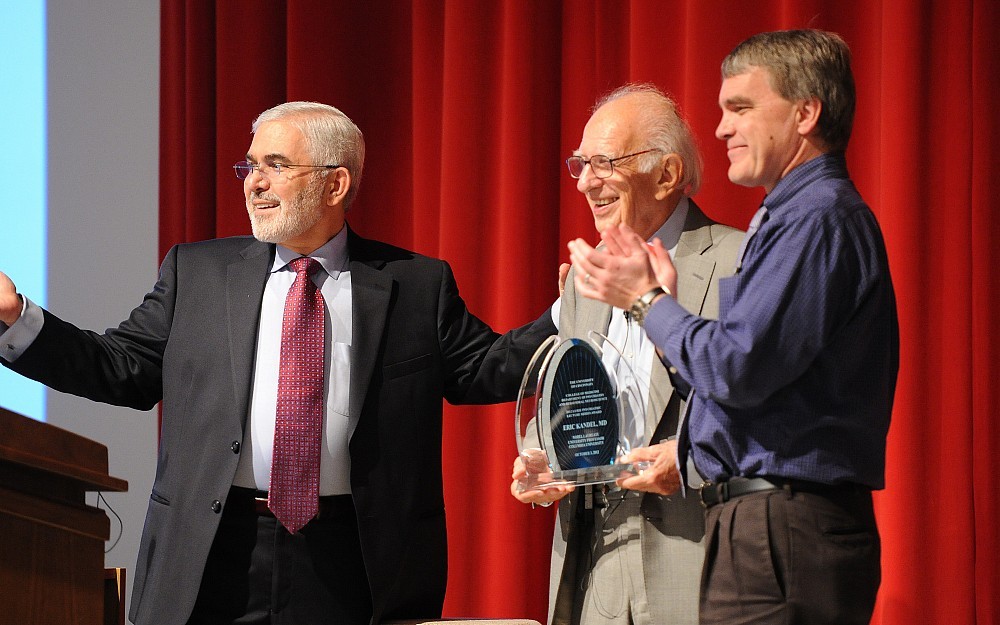
Nobel Laureate Eric Kandel Draws Large Crowd for Talk

Nobel Laureate Eric Kandel, MD, presented the Lurie Family Endowed Psychiatry and Behavioral Neuroscience Lecture and was honored by the UC Department of Psychiatry and Behavioral Neuroscience Wednesday, Oct. 3, in the Medical Sciences Buildings Kresge Auditorium. His topic was, "Mice, Men and Mental Illness.
Kandel is University Professor at Columbia University, Fred Kavli Professor and Director, Kavli Institute for Brain Sciences, and a senior investigator at the Howard Hughes Medical Institute. For his work on learning and memory using the nervous system of a sea slug as an experimental model, Kandel was awarded a share of the 2000 Nobel Prize in Physiology or Medicine.
A large crowd filled the auditorium, including the balcony, to hear Kandel discuss research in his lab focusing on mouse models of schizophrenia. He blended scientific wisdom with wit, drawing laughter early in his talk by saying, "The best way to do good science is to get colleagues who are better than yourself.
Kandel told the audience that mouse models are useful in studying psychological disorders by focusing on specific genes, adding, "New treatments may have to be developed one symptom at a time.
Before his talk, Kandel received a plaque commemorating his visit from Stephen Strakowski (at right in photo), MD, the Dr. Stanley and Mickey Kaplan Professor and Chair of Psychiatry and Behavioral Neuroscience, and Henry Nasrallah (at left), MD, vice chair for education and training. The Lurie Family Endowed Psychiatry and Behavioral Neuroscience Lecture is part of the department of psychiatry and behavioral neurosciences continuing education program.
Tags
Related Stories
On-site training in Speech & Hearing Clinic sets UC’s programs apart
August 27, 2026
At the University of Cincinnati’s Speech & Hearing Clinic, Doctor of Audiology and Speech-Language Pathology graduate students gain real-world experience while providing free speech and hearing services to the community.
Funding expands UC research into weight gain side effects of bipolar medication
August 26, 2026
University of Cincinnati researchers have been approved for funding by the Patient-Centered Outcomes Research Institute (PCORI) to expand the implementation of healthy lifestyle interventions and metformin prescription to help manage weight gain in overweight or obese youth taking second-generation antipsychotic medications.
One in four NFL players had CTE at death
August 25, 2026

Forbes cites research on concussions and football helmets by the University of Cincinnati in a report that found one in four NFL players had brain damage at death.