Institute for Military Medicine Welcomes New Altitude Chamber

Starting this month, researchers at UCs Institute for Military Medicine (IMM) will need to travel a significantly shorter distance to study the environment of aeromedical evacuationinstead of flying hundreds of miles, theyll just drive a few minutes up the highway.
The IMM just finished installing its new research altitude chamber at UCs Reading Campus. Previously, researchers traveled to San Antonio to conduct Air Force-funded projects in the altitude chamber at the Brooks-City Air Force Base.
"This new altitude chamber is a tremendous asset to our research team, says Alex Lentsch, PhD, director of the IMM and vice chair for research in the department of surgery. "This will allow us to not only conduct our Air Force studies more quickly and efficiently, but also expand collaborations across the university in a manner that benefits our partners at Wright-Patterson Air Force Base.
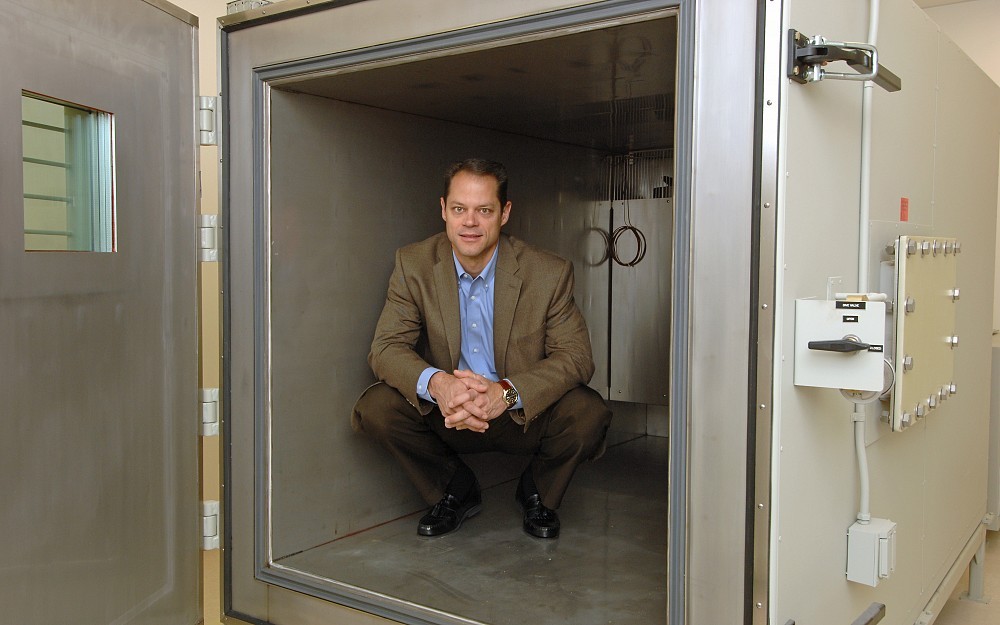
The new chamber is constructed of steel, weighs more than 5,000 pounds and, on the inside, measures 4 feet wide by 4 feet high by 6 feet long. It can simulate conditions up to 25,000 feet above sea level, though Lentsch says most of the work will be done at lower simulated altitudes.
The chamber will be used to study the effects of hypobaric hypoxia, or conditions of low air pressure and low oxygen content, the unique environment of aeromedical evacuation at high altitudes. Lentsch says its main purpose will be to test the effects of simulated altitude on serious injuries and infections as well as on proper functioning of medical devices.
In 2010, the Air Force signed a cooperative agreement with UC funding $24 million of IMM research. Recent research has included studies on the bacterial colonization of complex musculoskeletal wounds at altitude and studies on the amount of oxygen required when using an oxygen concentrator at altitude.
IMM researcher and surgery resident Sung Yang, MD, will use the chamber as part of his research on the effects of altitude on traumatic brain injury. Yangs studies have identified specific therapeutic targets that can reduce altitude-associated worsening of traumatic brain injury.
"The altitude chamber will allow us to simulate flight and better understand the effects of brain injury after flight, says Yang.
Other projects expected to utilize the chamber include studies on the effects of altitude on pneumonia and pulmonary infections in transport patients.
Lentsch says some Institute research has been on hold because teams were not able to travel to the Brooks-City Base in recent months.

Alex Lentsch, PhD, director of the UC Institute for Military Medicine by the new research altitude chamber at UC Reading Campus.
Tags
Related Stories
Cancer Center plays key role in lab research, clinical trials for new pancreatic cancer drug
September 1, 2026

WLWT and WCPO highlighted the contributions of University of Cincinnati Cancer Center researchers that helped lead to the recent FDA approval of daraxonrasib, a new treatment for pancreatic cancer.
Cancer Center physician receives $150,000 New Investigator Research Grant to study treatment-resistant leukemia
September 1, 2026
The University of Cincinnati Cancer Center’s Sarah Skuli, MD, PhD, received a two‑year, $150,000 Leukemia Research Foundation New Investigator Grant to study TP53‑mutated leukemia, a treatment‑resistant subtype with very poor outcomes.
Heavy social media use linked to depression
August 31, 2026

U.S. News and World Report, Yahoo! News, MSN, USA Today and other national media highlight a new study by the University of Cincinnati and Northwestern University that found a correlation between heavy social media use and depression in adults.