Researchers Use Computer Simulations to Find True Cost of HIV Screenings

CINCINNATIIntroducing HIV screenings into the nations emergency departments (EDs) leaves some doctors worrying about longer wait times, disrupted operations, and possible interference with necessary emergency services. Are their concerns unfounded? New research at the University of Cincinnati will use computer-based simulation modeling to determine how screening for HIV in the emergency department will affect how those emergency departments operate.
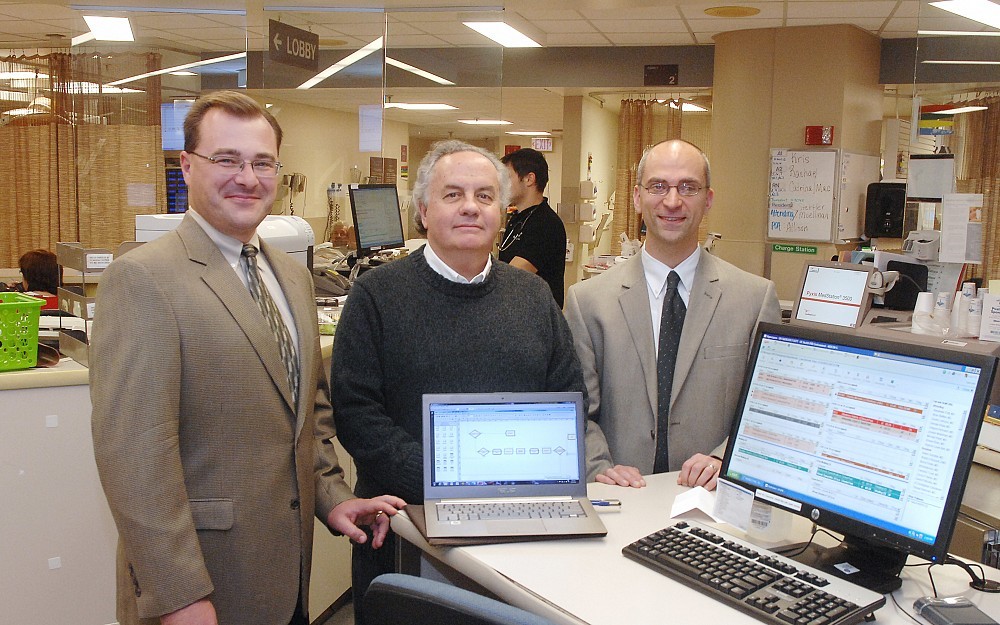
UC emergency medicine researchers Michael Lyons, MD, MPH and Michael Ward, MD, MBA, are partnering with David Kelton, PhD, of UCs Carl H. Lindner College of Business on a five-year, $1.25 million grant from the Agency for Healthcare Research and Quality to find out the costs, in terms of operational disruption and lost opportunity to provide other services, of introducing HIV testing into EDs.
"EDs are already overcrowded and in crisis, so physicians fear that time and resources spent on HIV testing will detract from their core mission, says Lyons, an assistant professor of emergency medicine at UC and medical director of UCs HIV Early Intervention Program. "But we dont know the true opportunity cost of instituting HIV screening in departments. Knowing which methods are least disruptive could provide valuable guidance and help promote adoption of this important public health practice.
If hospitals and physicians were able to quantify the true costs of conducting HIV screening programs, Lyons says they can then either look at options to minimize or avoid those costs, or work with policy makers and hospital administration to secure additional resources to compensate for those costs. Or, if the costs associated with the testing are found to be less than believed, Lyons hopes that providing that clarified information will encourage more hospitals to introduce such programs.
Lyons, who has spent more than a decade researching ED HIV screening, will work with Ward, assistant professor of emergency medicine and operations research fellow, to model the possible disruptions to an ED. In computer simulation modeling, researchers can use existing data to predict how adding something like HIV testing can affect a complex system like an emergency department.
Ward has used this type of research to study the disruptions of implementing electronic health records in an ED, cost-effectiveness and accuracy of different tests to diagnose pulmonary embolisms and admission strategies for chest pain patients.
"This approach to healthcare research is helping us to answer complex what if? questions that would normally take years and much more money to answer, he says. "This approach is particularly advantageous because there are multiple methods for ED HIV screening and multiple types of EDs. Testing all the combinations in real-time research studies would be prohibitively costly and time consuming. Simulation promises to provide the answers much more rapidly. Our study will provide doctors with a tool that helps them decide how to include an HIV screening test into their care without having a negative impact on the emergency care they are providing to all their patients.
In order to create realistic simulations, Ward and Lyons will work with the national ED HIV Testing Consortium to create ten different computer models of ED HIV testing, as well as visit hospitals across the country to measure the real time and resource requirements of the different methods.
Lyons says simulation modeling can have a broad effect on the future of medical and organizational research: "Theres a lot of interest in what new things healthcare should be doing, but the real question is: How do we change the things were already doing? How do you make healthcare do new things and do them better?
He says they are able to do this particular type of multi-disciplinary research because of Wards unique background in both medicine and business, and the involvement of Kelton, professor of operations, business analytics, and information systems and an international expert in simulation modeling.
Kelton, who has spent decades studying simulation modeling in areas like manufacturing, logistics, and military operations, says: "Its exciting to have this opportunity to help expand the power of computer-simulation modeling and analysis into the clearly critical realm of ED operations under HIV screening.
Tags
Related Stories
Cancer Center plays key role in lab research, clinical trials for new pancreatic cancer drug
September 1, 2026

WLWT and WCPO highlighted the contributions of University of Cincinnati Cancer Center researchers that helped lead to the recent FDA approval of daraxonrasib, a new treatment for pancreatic cancer.
Cancer Center physician receives $150,000 New Investigator Research Grant to study treatment-resistant leukemia
September 1, 2026
The University of Cincinnati Cancer Center’s Sarah Skuli, MD, PhD, received a two‑year, $150,000 Leukemia Research Foundation New Investigator Grant to study TP53‑mutated leukemia, a treatment‑resistant subtype with very poor outcomes.
Heavy social media use linked to depression
August 31, 2026

U.S. News and World Report, Yahoo! News, MSN, USA Today and other national media highlight a new study by the University of Cincinnati and Northwestern University that found a correlation between heavy social media use and depression in adults.