Allied Health Wants Students to Consider Culture in Health Care

As health care providers in hospitals, outpatient offices, clinics and at home, allied health sciences students will encounter many different patients in their careers. To help prepare these students for positive interactions with patients of all different backgrounds, the College of Allied Health Sciences has launched a new diversity and cultural awareness campaign.
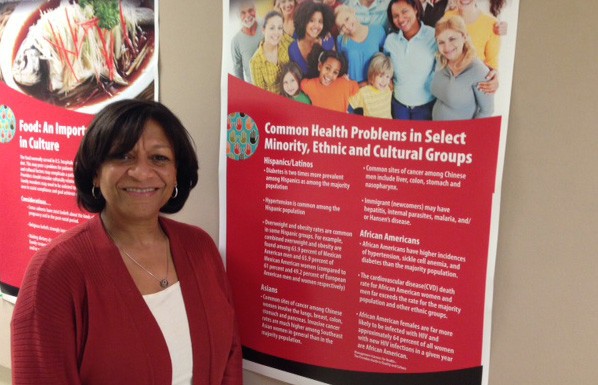
Led by director of diversity initiatives Monica Wilkins, the campaign launched with a speaker series in February on health promotion/disparities and cultural stereotypes. The campaign included a poster series which was on display throughout French East for three weeks.
Posters focused on a variety of cultural traditions that can affect health and interactions between health care providers and patients, involving everything from cultural foods to attitudes toward touching and expressing emotion among different cultures.
"The whole idea is to tweak students awareness of how to interact with patients and how cultural influences have an impact on what we do as health care providers, says Wilkins. "Some cultures have religiously based views on health and alternative remedies, or some may express pain differently or focus differently on nonverbal communication. Cultural misunderstandings can happen very innocently, but they can and do lead to health disparities and even result in negative outcomes.
Wilkins came to the college in 2011 to focus on diversity programs, recruitment and mentorship. She hopes this latest campaign will expand the colleges diversity efforts to bring non-minority students into the conversation about diversity.
"We want to make an impact with all the students in our college, she says, "for them to better understand the importance of diversity and the issues surrounding it.
Third-year dietetics student Jalisa Holifield attended the program as part of her involvement with the Connections Mentoring program for minority students in Allied Health. She is also a member of RAPP, UCs Racial Awareness Program.
Holifield believes that UC, as a predominantly white university, can benefit from more diversity campaigns.
"Chances are most of the incoming students do not have experience with cultures that are different from theirs and college is really the best place to experience that, she says. "Being in a safe space and having programs such as RAPP and workshops really helps a student grow into a more socially responsible person.
She thinks next steps could include recruiting minority men to come to the college and speak about their experiences in health care fields.
Wilkins is formulating a CAHS diversity council with the intent to do more broad-based programs: "We didnt want people to think of the campaign as one day for diversitythat we go to this one event and were done.

Monica Wilkins, director of diversity initiatives for the College of Allied Health Sciences
Related Stories
Cancer Center plays key role in lab research, clinical trials for new pancreatic cancer drug
September 1, 2026

WLWT and WCPO highlighted the contributions of University of Cincinnati Cancer Center researchers that helped lead to the recent FDA approval of daraxonrasib, a new treatment for pancreatic cancer.
Cancer Center physician receives $150,000 New Investigator Research Grant to study treatment-resistant leukemia
September 1, 2026
The University of Cincinnati Cancer Center’s Sarah Skuli, MD, PhD, received a two‑year, $150,000 Leukemia Research Foundation New Investigator Grant to study TP53‑mutated leukemia, a treatment‑resistant subtype with very poor outcomes.
Heavy social media use linked to depression
August 31, 2026

U.S. News and World Report, Yahoo! News, MSN, USA Today and other national media highlight a new study by the University of Cincinnati and Northwestern University that found a correlation between heavy social media use and depression in adults.