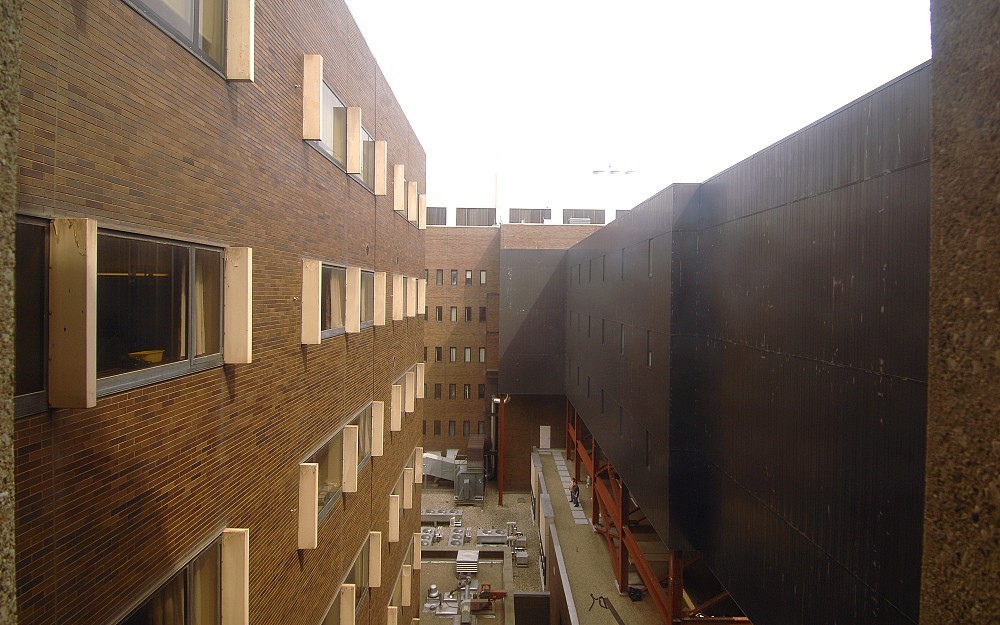
Cooperation Needed for Final MSB Rehab Phase

Begun almost nine years ago, the Medical Sciences Building (MSB) Rehabilitation Project is about to launch its final phase of activity. But first, planners need cooperation from the buildings current occupants.
With work on Phase IV scheduled to begin June 1, the affected area in the south half of the MSB Levels 3-7 in the west quadrant and Levels E-7 in the eastmust be vacated by May 1, 2013. Failure to do so could have serious consequences, planners warn.
"In addition to putting the project behind schedule, there will be major financial consequences for UC and the College of Medicine if the Phase IV area isnt available to the contractor by June 1, says Lejla Zejnilovic, a planner in the Office of Planning, Design and Construction.
"If people wait too long to clear their areas, we will have to hire movers to clear their labs and charge the individual departments for these extra services.
Shutting down labsboth wet and dry involves strict procedures, Zejnilovic notes, including an exit checklist and inspections by the UC offices of Environmental Health and Safety, Biosafety and Radiation Safety, which verify the lab space for occupancy and give a list of approved labs to construction officials.
Clearing out office space also takes time, Zejnilovic says, because of requests that must be processed through the Asset Management and Grounds & Moving departments. Anyone with questions about that process should call 513-556-5654.
As the most ambitious phase since Phase I (construction of the CARE/Crawley Building), Phase IV will have a noticeable impact for many faculty, staff and students in the MSB. Repercussions of Phase IV workexpected to last through the end of 2014include:
- Closing of the bridges connecting the MSB and UC Medical Center on Levels 5, 6 and 7 while work is being done. The bridges will reopen when work is completed, but will no longer house offices and lockers.
- Closing of the MSB loading dock for most users while work is being done. The dock will be under control of the contractor, Messer Construction. Zejnilovic says MSB occupants should contact their vendors now and advise them that starting June 1, deliveries should be made by using Kresge Circle.
Faculty offices and conference rooms on the bridges have been vacated, but numerous lockers remainmany of them locked with padlocks or combination locks. Zejnilovic says that these lockers will be hauled away April 15. The current users of these lockers must remove all of their belongings by April 15 and leave the emptied lockers unlocked; the lockers will be forcibly entered for removal of contents if necessary. Anyone currently using a locker on the bridges is asked to call 513-556-2357 with any questions.
Once Phase IV work is complete, move-in will tentatively begin in January 2015 and last through July 2015. Because of major reconfigurations to the space involved, not everyone who moves out will move back in to the Phase IV area when work is complete. Planning for the MSB after Phase IV completion is underway in conjunction with a master plan for the medical campus.
Related Stories
UC study shows lack of awareness for lung cancer screenings across country
August 21, 2026
University of Cincinnati Cancer Center researchers have published a study in the American Journal of Surgery that found only 15% of eligible American adults have discussed lung cancer screening with their doctors.This research emphasizes the need to spread awareness and better educate the public about screening through low-dose computed tomography.
UC radiation oncologist speaks with Local 12 news about clinical trial for head and neck cancer treatment
August 10, 2026

Dr. Sara Medek, a UC radiation oncology professor, speaks with Local 12 news about a new clinical trial aimed at reducing radiation in certain areas while still treating cancer effectively but with fewer painful side effects.
Cancer Center director charts future based on collaboration, AI
August 10, 2026

David Gius, MD, PhD, was featured in a Cincinnati Business Courier article and The Cancer Letter’s “The Directors" podcast discussing his priorities and goals as he recently took the helm as director of the University of Cincinnati Cancer Center.