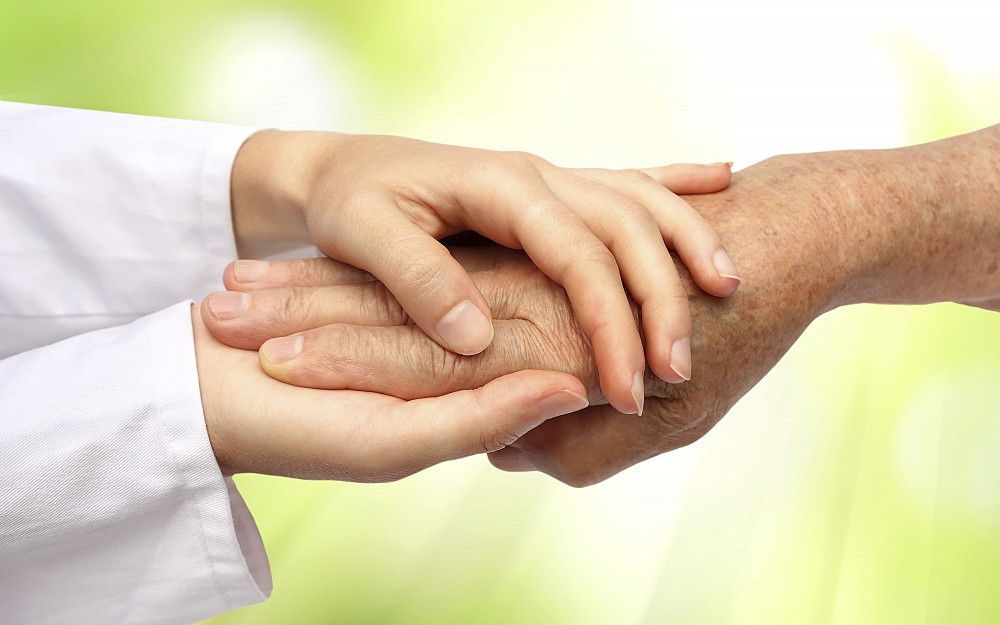
Outpatient Oncology Social Work Expands to Meet Patient Needs

As the University of Cincinnati Cancer Institute continues to grow, the health system is changing the way it delivers supportive services to ensure patients holistic needs are met.
UC Medical Center recently launched a dedicated outpatient social work service to support various units across the medical center, with a strong focus on oncology. Georgia Anderson, a masters trained oncology social worker, was appointed to lead the newly created unit as well as existing palliative care services. Anderson spent the past five years as the oncology social worker for patients receiving care at the Barrett Center, the primary adult outpatient cancer care facility of the UC Cancer Institute. She now leads a team of 12 outpatient social workers assigned to various service lines across the medical center.
As part of this expansion, three social workers have joined the team to serve oncology: Claire Bifro (malignant hematology and bone marrow transplant); Kristin Jordan (head/neck cancer, lung cancer, brain tumors); and Anne Shibilski (genitourinary, gastrointestinal, gynecologic, breast and melanoma). Debra Brundidge has joined the palliative care team, along with nurse practitioner Tracey Adams. The team served 1,078 patients in the first quarter of 2013.
Commission on Cancer Changes Fuel Expansion
By 2015, the American College of Surgeons Commission on Cancer will require that all accredited cancer care facilities like the Barrett Center demonstrate that they screen patients diagnosed with cancer and identify the issues that can negatively impact treatment and outcome.
The Commission on Cancer is a nationally recognized consortium of professional organizations dedicated to improving survival and quality of life for cancer patients through standard-setting, prevention, research, education and the monitoring of comprehensive quality care.
Andersons team is in the pilot phase of integrating a distress screening tool at the UC Cancer Institute. She expects it to be fully implemented in oncology services by early summer.
"Cancer is the great equalizer. It doesnt matter if you have money or notthe disease changes the way your family operates and causes tremendous strain. Thats where social work can really help, says Anderson. "Too often, patients and their families turn to us after their personal lives are starting to fall apart. Our goal is to use this distress screening tool to identify patients who need help earlier so patients receive the maximum benefit of social work services.
Patient Navigator Services
Although many people think of social work as helping patients with material needssuch as transportation or housing assistanceAnderson stresses that the UC Cancer Institute oncology social work model is shifting to allow social workers to focus on what they do best: counseling.
This includes empowering patients with information about their specific diagnoses, personal health rights and health insurance/benefits coverage; connecting to support and educational programs; and helping the patient understand how to best communicate with their medical team.
"Our goal is to reduce stress for patients and families throughout all phases of cancer. That means something different to every patient we encounter, adds Anderson.
"We become the interpreters between the medical team and the patient. We are not medically trained, but we are medically savvy so we can help families and patients understand what types of questions they should be asking so they are able to make more informed treatment decisions.
UC Medical Center has partnered with the American Cancer Society to offer position a patient resource navigatorJulie Behanat the Barrett Center. Nearly 200 patients have taken advantage of this resource since it launched in January.
More Information
Learn more about oncology social work and palliative care at uccancer.com. To reach the oncology social work team, call 513-584-3200. Palliative care can be reached at 513-584-8181.
Tags
Related Stories
Heavy social media use linked to depression
August 31, 2026

U.S. News and World Report, Yahoo! News, MSN, USA Today and other national media highlight a new study by the University of Cincinnati and Northwestern University that found a correlation between heavy social media use and depression in adults.
On-site training in Speech & Hearing Clinic sets UC’s programs apart
August 27, 2026
At the University of Cincinnati’s Speech & Hearing Clinic, Doctor of Audiology and Speech-Language Pathology graduate students gain real-world experience while providing free speech and hearing services to the community.
Funding expands UC research into weight gain side effects of bipolar medication
August 26, 2026
University of Cincinnati researchers have been approved for funding by the Patient-Centered Outcomes Research Institute (PCORI) to expand the implementation of healthy lifestyle interventions and metformin prescription to help manage weight gain in overweight or obese youth taking second-generation antipsychotic medications.