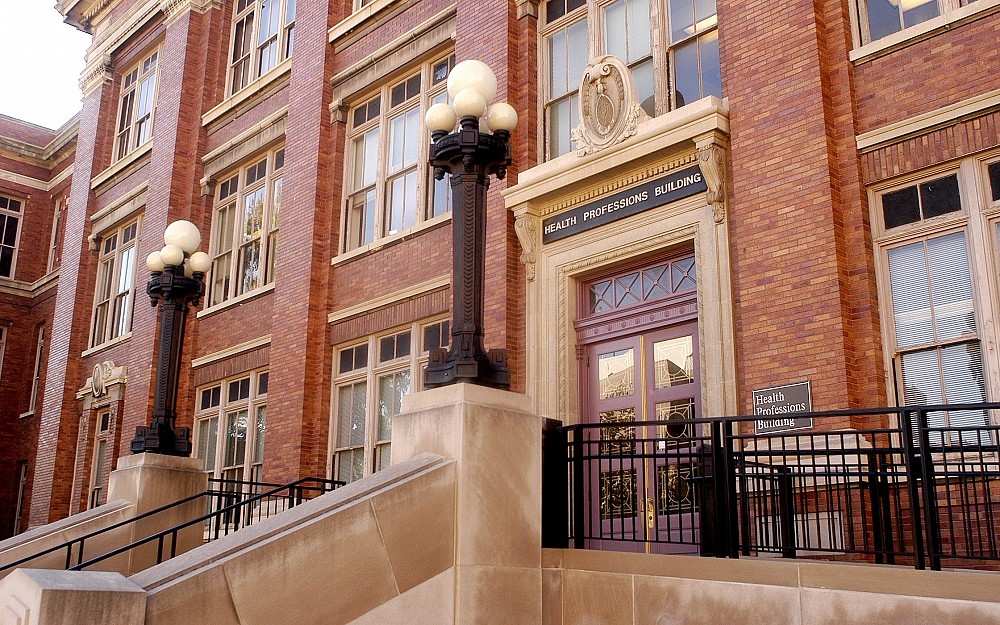
Work Begins on HPB Roof Replacement Project

Work is underway on a roof replacement project for the Health Professions Building (HPB). This project also includes repair of the masonry parapets, minor modifications to an existing mechanical equipment platform and painting of exposed metal trim.
The majority of this work will be conducted from 6 a.m. until 3 p.m. Monday through Friday and is expected to take four months to complete, weather permitting. By starting at 6 a.m., crews will try to get all loud work done by 8 in an effort to minimize interruption of buildings operations.
Work began this week at the south end of the HPB, where it abuts Wherry Hall, and will proceed northward (toward the Holmes Hospital parking lot). Each of the two courtyards in the rear of the building will be used for construction staging, but not both at the same time. These areas will be fenced off, and parking will not be available in them when the fencing is in place. Handicap parking spaces will be temporarily relocated to adjacent areas.
No impact to climate control inside the building is anticipated.
If you have questions, please contact Dewey Enderle, construction manager with the Office of Planning, Design and Construction, at 513-556-3499.

Scaffolding is put in place at the Health Professions Building as a roof replacement project gets underway.
Tags
Related Stories
On-site training in Speech & Hearing Clinic sets UC’s programs apart
August 27, 2026
At the University of Cincinnati’s Speech & Hearing Clinic, Doctor of Audiology and Speech-Language Pathology graduate students gain real-world experience while providing free speech and hearing services to the community.
Funding expands UC research into weight gain side effects of bipolar medication
August 26, 2026
University of Cincinnati researchers have been approved for funding by the Patient-Centered Outcomes Research Institute (PCORI) to expand the implementation of healthy lifestyle interventions and metformin prescription to help manage weight gain in overweight or obese youth taking second-generation antipsychotic medications.
One in four NFL players had CTE at death
August 25, 2026

Forbes cites research on concussions and football helmets by the University of Cincinnati in a report that found one in four NFL players had brain damage at death.