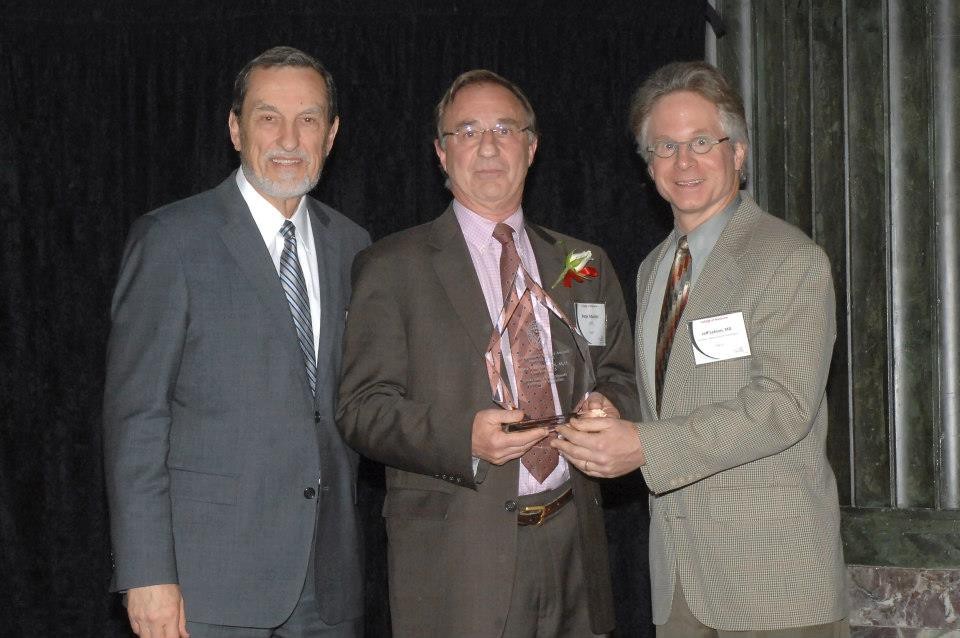
College of Medicine Distinguished Alumni Award Winner: Peter Raff Mueller, MD

Each year the College of Medicine Alumni Association recognizes outstanding alumni though the Distinguished Alumni Awards. The award recognizes MD graduates of the College of Medicine for achievements in the areas of basic research, education, clinical care, health service administration, and public and/or civic duties.
This year's winners, Peter Mueller, MD, and Robert Eckel, MD, were recognized at the 2013 Reunion, held April 11-13.
An innovator in interventional radiology and leader at Harvard Medical School, Dr. Peter Mueller has shaped his academic discipline with 35 years of scholarship and patient care.
Born in Boston, Mueller received a Bachelors Degree from Harvard University before coming to Cincinnati to study at the College of Medicine. He earned his Medical Degree from UC in 1973 and stayed to complete his medical internship at the University of Cincinnati Medical Center, then Cincinnati General Hospital, before returning to Boston. At Massachusetts General Hospital, Mueller completed both a residency in radiology and a clinical fellowship in abdominal imaging and interventional radiology.
He began serving on the Harvard Medical School faculty in 1977 as an instructor in radiology, rising through the departments ranks to become full professor in 1999. He also served as Division Head of Abdominal Imaging and Interventional Radiology at Massachusetts General for almost 25 years.
It was at Massachusetts General that Mueller and his colleagues introduced many percutaneous interventional procedures such as drainage of fluid collections and abscesses, drainage procedures of the pleural space,percutaneous gastrostomy,percutaneous cholecystostomy ,percutaneous biliary drainage and others techniques that are now standards of care worldwide. Most recently, Mueller has been a leader in the use of alcohol injection and radiofrequency ablation to treat liver tumors and kidney tumors
Through his career, Muellers main focus has been on the evaluation and development of non-vascular interventional techniques. A prolific researcher, he has published 360 papers, contributed 54 textbook chapters and co-written three medical textbooks.
Through his weekly research meetings, hes worked with medical students, residents and fellows to guide them through the process of academic research. Under his leadership, many of Muellers fellows have gone on to hold prestigious positions in academic radiology.
In 2005, he received The Society of Interventional Radiology's - Dr. Charles T. Dotter Award, recognizing Mueller for his accomplishments in introducing and refining interventional procedures that help to improve the quality and variety of techniques offered to patients. More recently he received the Gold Medal from CIRSE ( Cardiovascular and Interventional Radiology Society of Europe)
Dr. Mueller has served as president of multiple medical societies, including the Society for Minimally Invasive Therapy, the New England Roentgen Ray Society the Interventional Society of Biliary Radiology and, from 2009-2010, the Society of Gastrointestinal Radiologists.
Related Stories
Cancer Center plays key role in lab research, clinical trials for new pancreatic cancer drug
September 1, 2026

WLWT and WCPO highlighted the contributions of University of Cincinnati Cancer Center researchers that helped lead to the recent FDA approval of daraxonrasib, a new treatment for pancreatic cancer.
Cancer Center physician receives $150,000 New Investigator Research Grant to study treatment-resistant leukemia
September 1, 2026
The University of Cincinnati Cancer Center’s Sarah Skuli, MD, PhD, received a two‑year, $150,000 Leukemia Research Foundation New Investigator Grant to study TP53‑mutated leukemia, a treatment‑resistant subtype with very poor outcomes.
Heavy social media use linked to depression
August 31, 2026

U.S. News and World Report, Yahoo! News, MSN, USA Today and other national media highlight a new study by the University of Cincinnati and Northwestern University that found a correlation between heavy social media use and depression in adults.