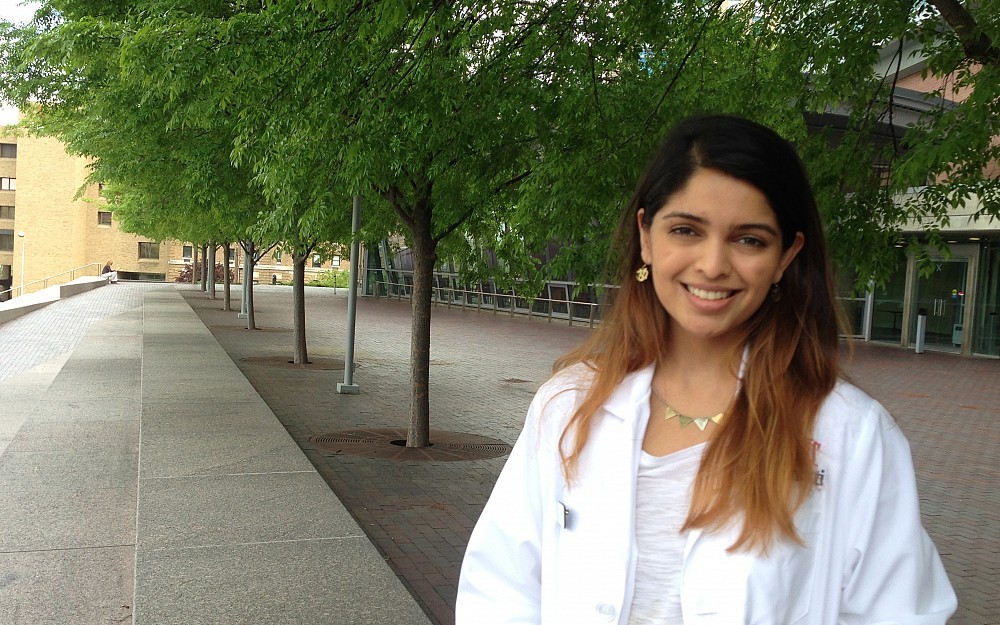
Focus on Students with Priya Srivastava

College of Medicine student Priya Srivastava is in the last weeks of her first year of medical school at UC. Originally from Brunswick, Ohio, Srivastava came to Cincinnati through UCs dual-admission program, where she completed her undergraduate degree in biology and neuroscience at McMicken College of Arts & Sciences before coming to the College of Medicine.
As part of the College of Medicines new curriculum, Srivastava received EMT and first responder training in her first week of classes. This spring, on the night of March 7, she came upon an automobile accident on the highway and put her training into use at the scene.
Did you know anything about first responder training when you started medical school?
"No, but it was really enjoyable and really interactive. Actually, it was the first thing that opened my mind up to emergency medicine in general. Ive known since I was little that I wanted to be a doctor, as far back as I can remember. I came into the college wanting to do pediatrics or dermatology, but I had so much fun with the ER residents that I changed my mind.
What happened on the night of the automobile accident?
"I was going home to surprise my parents for the weekend. It was a Thursday night and I was driving up I-71N. I saw a bunch of trucks and cars pulling over on the other side of the highway, and then I saw a car completely flipped over with no paramedics on scene. I turned around in the next median and raced up to the side of the road. I always keep a first aid kit on me and I grabbed it and ran over.
"There was a man lying in the snow on a piece of cardboard. I started assessing what was going on and checking for the ABCs of EMT training: airway, breathing and circulation.
"He was a Spanish speaker, so that added a more challenging aspect. But it was OK because I took five years of Spanish starting in high school and, during the fall semester, I took a course on Medical Terminology in Spanish. It was almost like I had to be thereno one else knew Spanish or had EMT training.
"His head was bleeding, so I had some bystanders hold gauze to it while I picked out pieces of glass from his forehead. Finally, one of the Highway Patrol officers arrived and helped me continue the assessment while I held his C-spine. About five minutes later, the paramedics showed up. Since I was on C-spine, I had to lead them in putting him on a backboard.
Were you nervous? Did you have any hesitation at first?
"I had to do it. It didnt even cross my mind to keep driving. It only hit me when I was pulling out my first aid kit and running overthen, I thought, What am I doing? That was the only time I had a bit of hesitation, but after that I was on autopilot.
"At the scene, all the EMT training made sense: First you assess the scene, then get your gloves, assess the patient. It all came back.
Whats your perspective on it now?
"Medical school is really difficult and it wears on your confidence and your belief in yourself. Theres been so many times this year when Ive wondered, Can I do this? Am I good enough for this?
"During the whole incident, this bystander gave me the biggest compliment Ive ever gotten. He was panicking at first, but he told me, You made everyone calm down. You knew what to do and you calmed everyone around you.
"I remembered that, while shadowing in the ED, Dr. Pancioli, the chair of emergency medicine, said that one quality of an ER doc is to remain calm. That renewed my confidence in myself and convinced me that I really want to pursue emergency medicine.
"I want to thank the ER residents and Dr. Pancioli and everyone who set up the first responder training program. Had I just been a regular medical student going to a different medical school, I would have literally been the most useless person at the scene. I would have been reciting facts about ribosomes. The credit goes to them, that they helped prepare meits because of them that I could do that.
Related Stories
On-site training in Speech & Hearing Clinic sets UC’s programs apart
August 27, 2026
At the University of Cincinnati’s Speech & Hearing Clinic, Doctor of Audiology and Speech-Language Pathology graduate students gain real-world experience while providing free speech and hearing services to the community.
Designing with cancer patients' needs in focus
August 27, 2026
Kristina Shin is designing garments that prioritize the comfort, function and confidence of breast cancer patients, addressing a need often overlooked by traditional fashion.
UC, NKU renew longstanding partnership supporting Army ROTC cadets
August 26, 2026
The University of Cincinnati Army ROTC and Northern Kentucky University (NKU) have renewed a longstanding partnership that supports students preparing to become Army officers and leaders in their communities. The universities formalized the renewed agreement during a signing event Aug. 11 at NKU.