UC Cancer Institute Announces Program Leaders, Core Disease-Based Centers

The University of Cincinnati Cancer Institute is moving forward, with a strategic plan built around comprehensive, disease-based centers of excellence and an appointed leadership team to guide the overall institutes efforts.
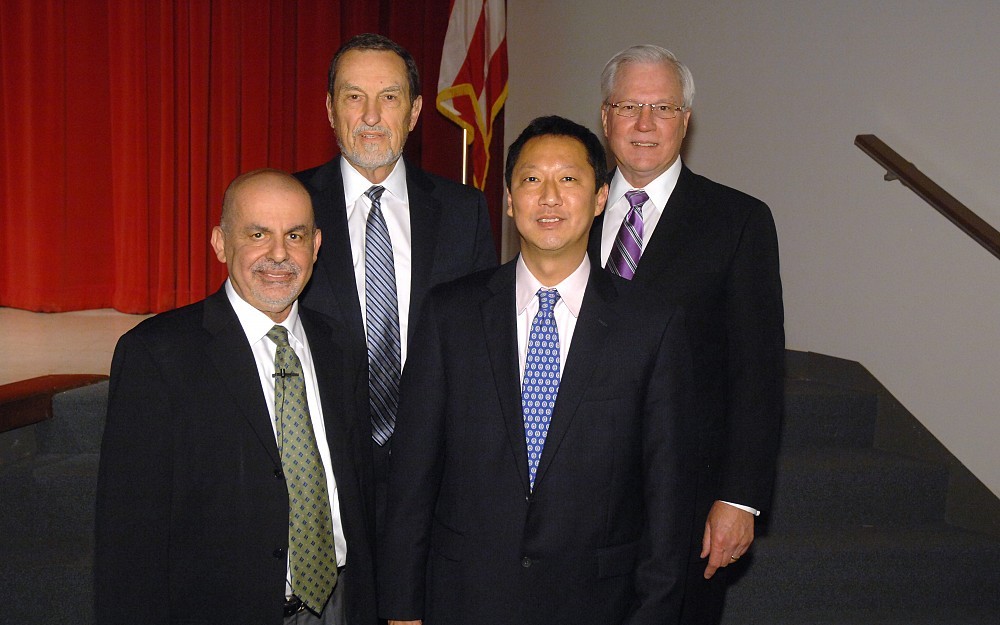
UC President Santa Ono, PhD, UC Health President and CEO Jim Kingsbury and College of Medicine Dean Thomas Boat, MD, joined UC Cancer Institute Director George Atweh, MD, at an internal update and reception event held May 2, 2013, to share their commitment and vision for making the UC Cancer Institute a success.
"As the regions only academic health center, we have a responsibility to develop a world-class academic cancer center for our community, said Atweh in his presentation to a crowd of nearly 200, noting that the UC Cancer Institute is a system-level entity that integrates programs and people from the UC Colleges of Medicine, Pharmacy, Nursing and others as well as the UC Medical Center, Barrett Center, UC Physicians, Hoxworth Blood Center and West Chester Hospital.
"Our vision is to become the Midwest destination for adult cancer care, research and education, Atweh said. "We can achieve this by coordinating and integrating cancer research, clinical services and education to set and practice the highest standards for adult cancer care in the Midwest and advancing cancer research on a regional, national and international level.
Comprehensive Cancer Centers
The UC Cancer Institute is one of four institutes supported by both the UC College of Medicine and UC Health. The institute model is built on disease-based "centers, bringing together teams of clinicians, translational scientists and other disease-specific specialists to work collaboratively on transformational science projects.
Through a strategic planning process, the UC Cancer Institute identified five comprehensive cancer centers to serve as the initial focus of its efforts: breast, brain, gastrointestinal, head and neck, and lung. Each center includes multidisciplinary clinicians as well as scientists working in basic, clinical and population sciences. The institute is working to integrate faculty from the UC College of Nursing and James L. Winkle College of Pharmacy and other UC colleges into the disease-based centers.
"The term comprehensive is an important distinctionboth in the way we think about ourselves and how we measure ourselves against our competitors, added Atweh.
To become a true center of excellence, the UC Cancer Institute comprehensive centers must show excellence at all stops on what Atweh called the "discovery engine wheel of discovery science, translational research, clinical research, clinical care and population impact.
"We have accepted the challenge and now must deliver the promise of transformational cancer research at the UC Cancer Institute, working together toward the common goal of building a comprehensive cancer center for Greater Cincinnati, added Atweh. "We must focus on changing the culture of our academic health center to keep patients needs first, while remaining committed to integrity, collegiality, collaboration and excellence among ourselves."
Administrative Oversight
The UC Cancer Institute is guided by an executive committee made up of cancer clinicians and scientists as well as leadership from the UC colleges of pharmacy and nursing. Additional oversight comes from a Stakeholder Advisory Group led by Michael Edwards, MD, chair of UCs surgery department.
Cincinnati Cancer Center Collaboration
The UC Cancer Institute infrastructure was designed to complement efforts of the Cincinnati Cancer Center, a collaborative initiative of the UC College of Medicine, UC Health and Cincinnati Childrens Hospital Medical Center.
The UC Cancer Institute and Cancer and Blood Diseases Institute at Cincinnati Childrens focus on disease-specific problems in cancer while the Cincinnati Cancer Centers teams focus on broad research themes applicable to many cancers. The efforts were strategically designed to complement one another and will ultimately position the organizations to apply for National Cancer Institute designation.
Executive Committee
George Atweh, MD, Director
Vijaya Gandhi, PhD, Associate Director for Administration & Strategic Planning
Frank Smith, MD, Clinical Director
Jerry Lingrel, PhD, Associate Director for Basic Science
John Morris, MD, Associate Director for Translational Science
Syed Ahmad, MD, Associate Director for Clinical Research
Shuk-mei Ho, PhD, Associate Director for Population Sciences
Kenneth Greis, PhD, Associate Director for Education; Associate Director for Shared Resources
William Barrett, MD, Associate Director for Community Outreach
Ex-Officio Members
William Fant, PharmD, Dean, James L. Winkle College of Pharmacy
Greer Glazer, RN, PhD, Dean, UC College of Nursing
Carrie Hayden
Chair, UC Cancer Institute Community Advisory Council
Laureen McCorkle
Director of Development
Amanda Harper
Senior Public Information Officer
Disease-Based Center Leaders
Lung Cancer: John Morris, MD, and Sandra Starnes, MD
Head and Neck Cancer: Keith Casper, MD, and Peter Stambrook, PhD
Brain Tumors: Jon Breneman, MD, and Ronald Warnick, MD
Breast Cancer: Elyse Lower, MD
Gastrointestinal Cancer: Syed Ahmad, MD

George Atweh, MD
Related Stories
On-site training in Speech & Hearing Clinic sets UC’s programs apart
August 27, 2026
At the University of Cincinnati’s Speech & Hearing Clinic, Doctor of Audiology and Speech-Language Pathology graduate students gain real-world experience while providing free speech and hearing services to the community.
Designing with cancer patients' needs in focus
August 27, 2026
Kristina Shin is designing garments that prioritize the comfort, function and confidence of breast cancer patients, addressing a need often overlooked by traditional fashion.
UC, NKU renew longstanding partnership supporting Army ROTC cadets
August 26, 2026
The University of Cincinnati Army ROTC and Northern Kentucky University (NKU) have renewed a longstanding partnership that supports students preparing to become Army officers and leaders in their communities. The universities formalized the renewed agreement during a signing event Aug. 11 at NKU.