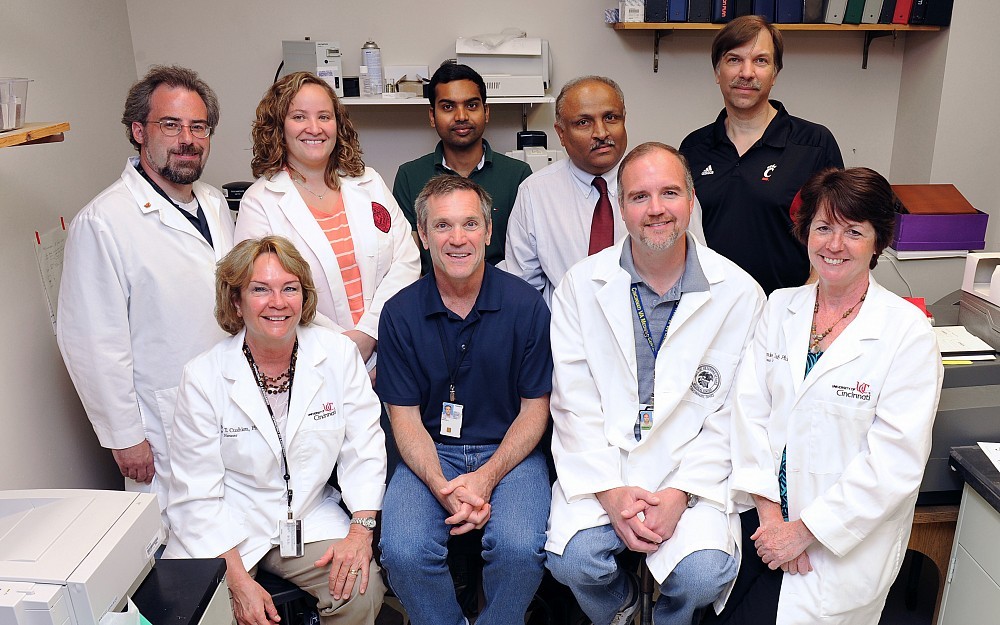
Researchers Use IDIQ to Partner With Industry, Support Translational Science

Regardless of how promising basic research can be, it cant help patients without first being tested (and retested) in a number of different ways, including in animal models.
Additionally, many small drug companies dont have the money or resources to invest in a larger research operation to find out if the treatments can eventually move into human populations.
This is where an arrangement known as an indefinite delivery/indefinite quantity (IDIQ) can be very helpful. Researchers at the University of Cincinnati (UC) are using this mechanism to partner with industry, helping advance research that may have otherwise been stuck in the lab.
IDIQ is a type of contract that provides supplies or services during a fixed amount of time; these contracts are most often used for services in the engineering and science field.
Melanie Cushion, PhD, professor in the division of infectious diseases, and Michael Linke, PhD, a researcher with the Cincinnati Department of Veterans Affairs, along with researchers in the James L. Winkle College of Pharmacy (Pankaj Desai, PhD) and the McMicken College of Arts and Sciences (Larry Sallans, PhD), were just awarded two National Institute of Allergy and Infectious Diseases task orders as part of an IDIQ: the first ($789,328) to evaluate experimental drugs in a mouse model of pneumocystis pneumonia (fungal pneumonia) and the second ($64,904) to screen experimental drugs against pneumocystis in an in vitro screening system.
As part of these studies, investigators will research dosing of the medication in question as well as toxicity and how long it stays active within the models being analyzedall data necessary to move the therapies into clinical trials.
"An IDIQ is a funding mechanism used by governmental agencies including the NIH (National Institutes of Health) that many people at UC are not aware of, Cushion says. "Its a way to support the translational research pipeline which is important to the university and the field of medicine as a whole. This helps researchers form connections with industry on a contractual basis, assisting with the advancement of science in many areas and eventually helping bring products to market.
Cushion says that because of the resources and special expertise available in labs at UC, researchers involved with IDIQs can facilitate drug discoveries for a number of infectious diseases, including viral, fungal and bacterial.
As with many contractual agreements, research teams involved in IDIQ agreements bid upon contracts (task orders) that are solicited by companies, with NIH sponsorship, hoping to secure funding in exchange for data provided. Researchers only get money once their services are deliveredand they must prove beforehand that they can deliver on their promises. These contractual mechanisms help small businesses bring their candidate drugs to the next phase of development as potential therapeutics.
Linke says research teams are held to a strict timeline and must present their findings to the companies and NIH representatives several times throughout the process.
"It helps to keep researchers on task and really helps teams think through the process, which is more efficient and productive in the long run, he says.
The IDIQ can last for up to seven years; task orders usually take a year but can be longer if necessary.
"This is something new and exciting to us, but it is really using the multidisciplinary strengths present at UC to facilitate the next steps in research, Cushion says, adding that in addition to these orders, there are several more in the works. "Were helping small businesses get their promising therapies out there and, in turn, may be able to impact patient care.
Related Stories
These teeny spiders are social media stars
August 28, 2026

The New York Times turned to a University of Cincinnati professor to explain the appeal of jumping spiders on social media.
On-site training in Speech & Hearing Clinic sets UC’s programs apart
August 27, 2026
At the University of Cincinnati’s Speech & Hearing Clinic, Doctor of Audiology and Speech-Language Pathology graduate students gain real-world experience while providing free speech and hearing services to the community.
UC, NKU renew longstanding partnership supporting Army ROTC cadets
August 26, 2026
The University of Cincinnati Army ROTC and Northern Kentucky University (NKU) have renewed a longstanding partnership that supports students preparing to become Army officers and leaders in their communities. The universities formalized the renewed agreement during a signing event Aug. 11 at NKU.