Clinical Trial Examines Use of Valve for Treating Severe Emphysema

CINCINNATIResearchers at UC are conducting the local arm of a clinical trial that could provide less invasive, effective treatment for patients with severe emphysema.
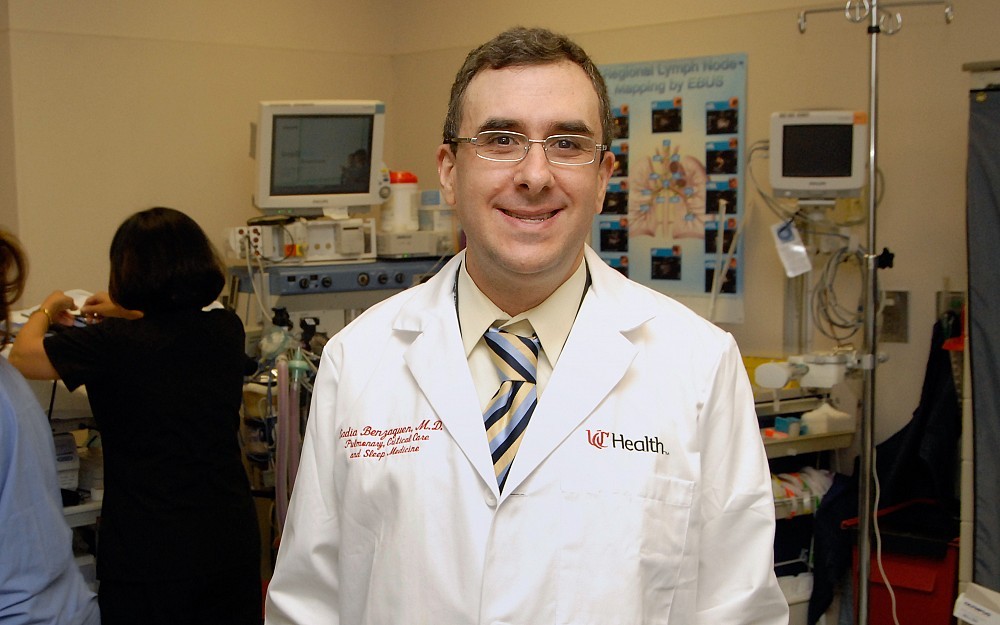
Sadia Benzaquen, MD, assistant professor in the division of pulmonary, critical care and sleep medicine and a UC Health director of interventional pulmonology, is leading the trialcalled EMPROVEwhich will specifically evaluate the safety and efficacy of endobronchial valves for patients with severe emphysema. Currently, these patients are treated with lung transplant or volume reduction surgery which removes part of the poorly functioning areas of the lung space occupying tissue from each lung.
For patients that cannot undergo transplant for lung reduction surgery, there are currently no effective treatment options; this trial could change the standard of care for patients with severe emphysema complications.
"Emphysema is a long-term lung disease in which the tissues necessary to support the shape and function of the lungs are destroyed, Benzaquen says. "In emphysema, the destruction of lung tissue around smaller sacs, called alveoli, makes these air sacs unable to hold their functional shape upon exhalation.
Endobronchial valves are small, one-way valves which are implanted in an airway of the lung. The valve is typically implanted so that when a patient exhales, air is able to flow through the valve and out of the lung compartment that is fed by that airway, but when the patient inhales, the valve closes and blocks air from entering that lung compartment, helping the compartment empty itself of air.
"One previous study showed that these valves may be beneficial in treating emphysema, where lungs cannot contract sufficiently to exhale air, leading to air trapping and hyperaeration (hyperinflation), Benzaquen says. "In the EMPROVE Trial, we are attempting to confirm this data and see if the endobronchial valves may be another treatment option for patients, specifically those who are too ill to undergo lung transplant or volume reduction surgery.
This study is randomized, meaning participants will either receive the valve or medical management for their condition. Those assigned to receive the valve will undergo complete blocking of one lobe of the lung using the valves. The lobe will be selected based on imaging with computed tomography (CT) scan and, if necessary, a lung perfusion scan.
"All study participants will be followed for one, three and six months and then annually for five years if in the valve treatment group or two years if in medical management group, Benzaquen adds. "Were very excited to be involved with this trial which could bypass and improve the current standard of care for patients with emphysema. Our hope is that we can improve outcomes for these patient groups.
Tags
Related Stories
Cancer Center plays key role in lab research, clinical trials for new pancreatic cancer drug
September 1, 2026

WLWT and WCPO highlighted the contributions of University of Cincinnati Cancer Center researchers that helped lead to the recent FDA approval of daraxonrasib, a new treatment for pancreatic cancer.
Cancer Center physician receives $150,000 New Investigator Research Grant to study treatment-resistant leukemia
September 1, 2026
The University of Cincinnati Cancer Center’s Sarah Skuli, MD, PhD, received a two‑year, $150,000 Leukemia Research Foundation New Investigator Grant to study TP53‑mutated leukemia, a treatment‑resistant subtype with very poor outcomes.
Heavy social media use linked to depression
August 31, 2026

U.S. News and World Report, Yahoo! News, MSN, USA Today and other national media highlight a new study by the University of Cincinnati and Northwestern University that found a correlation between heavy social media use and depression in adults.