Metastatic Pancreatic and Primary Breast Cancer Have Common Growth Mechanisms, Study Suggests

CINCINNATIA recently discovered form of the protein that triggers blood clotting plays a critical role in promoting the growth of metastatic pancreatic cancer and primary breast cancer, according to the cumulative findings from two new scientific manuscripts published online ahead of print this week in the International Journal of Cancer and PNAS (Proceedings of the National Academy of Sciences).
The protein, called "Tissue Factor, is present in various tissuesfor example, walls of blood vessels. Earlier studies suggested that alternatively spliced Tissue Factor (asTF) may contribute to cancer growth, but the molecular events leading to this were previously unknown.
New research conducted through an international collaboration between the labs of Vladimir Bogdanov, PhD, of the University of Cincinnati Cancer Institute, and Henri Versteeg, PhD, of the Einthoven Laboratory for Experimental Vascular Medicine at the Leiden University Medical Center in Leiden, the Netherlands, articulates how asTF fuels growth and metastasis of solid cancers.
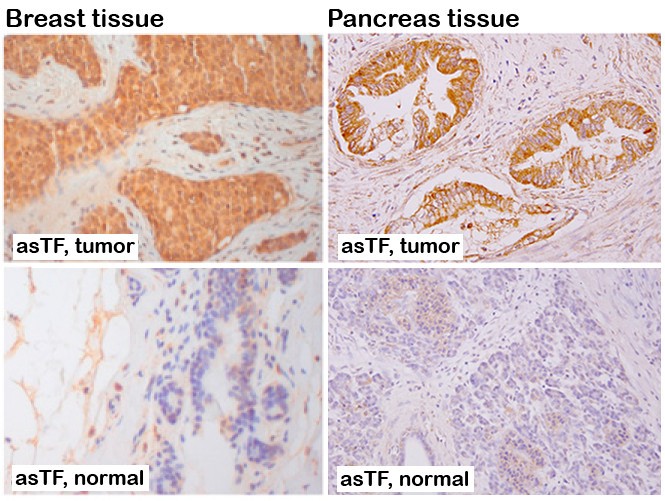
Using preclinical animal models, Bogdanov and Versteegs teams obtained the first scientifically validated evidence that asTF promotes the spread of pancreatic cancer and promotes primary growth of breast cancer tumors.
"We have demonstrated that targeting asTF with a novel monoclonal antibodydeveloped based on our 10 years of studying asTFalso stops the growth of breast cancer in an animal model, giving us a promising new target to fight certain forms of breast cancer, says Bogdanov, who originally described asTF in 2003. UC filed a patent for this technology in January 2013.
Bogdanov and Versteeg will present their findings at the XXIV Congress of the International Society on Thrombosis and Haemostasis in Amsterdam, the Netherlands (held June 29-July 4, 2013).
"Many molecules on the surface of cellsincluding integrinsare important for the function of both normal and cancerous cells, so targeting integrins for stopping the growth of cancer is not a promising strategy. What is unique about asTF is that it binds to integrins on vessel-forming cells, activating them. Weve shown that certain cancer cells share those same qualities, so if you target asTFwhich is elevated in cancerthere is significant potential to spare the good parts of the cellular system while removing the bad cancer-specific protein from the game, explains Bogdanov.
"Many routine therapies such as chemotherapy or radiation may not always be efficient. Targeting asTF in tumors using our monoclonal antibody may form a potent additional anticancer strategy in combination with conventional avenues, says Versteeg.
This work was funded by National Institutes of Health/National Cancer Institute grant 1R21CA160293-01A1 and the Netherlands Organization for Scientific Research VIDI grant 91710329. Authors on both manuscripts have no conflicts of interest to report.
Collaborators in the International Journal of Cancer study include UCs Dusten Unruh, Kevin Turner, DO, Ramprasad Srinivasan, PhD, Xiaoyang Qi, PhD, Zhengtao Chu, , David Plas, PhD, Catherine Gallo, Syed Ahmad, MD, and Fred Lucas, MD; Begum Kocatürk, PhD, of Einthoven Laboratory for Experimental Vascular Medicine; Bruce Aronow, PhD, of Cincinnati Childrens Hospital Medical Center; Holger Kalthoff, PhD, of the Institute of Experimental Cancer Research (Germany); Daniel Krichhofer, PhD of Genentech (California); and Wolfram Ruf, MD, of the Scripps Research Institute (California).
Collaborators in the PNAS study include Begüm Kocatürk, PhD, and Yascha Van den Berg, MD, PhD, Martijn van der Ent, PhD, Pieter Reitsma, PhD and Susanne Osanto, PhD, of Einthoven Laboratory for Experimental Vascular Medicine; Chris Tieken, PhD, J. Sven D. Mieog, PhD, Charla Engels, PhD, Peter Kuppen, PhD, Cornelis Van de Velde, PhD, and Gerrit-Jan Liefers, PhD, of Leiden University Medical Center; and Dr Ruf of the Scripps Research Institute.

Vladimir Bogdanov, PhD, is an assistant professor of medicine and director of the hemostasis research program at the UC College of Medicine.
Tags
Related Stories
Cancer Center plays key role in lab research, clinical trials for new pancreatic cancer drug
September 1, 2026

WLWT and WCPO highlighted the contributions of University of Cincinnati Cancer Center researchers that helped lead to the recent FDA approval of daraxonrasib, a new treatment for pancreatic cancer.
Cancer Center physician receives $150,000 New Investigator Research Grant to study treatment-resistant leukemia
September 1, 2026
The University of Cincinnati Cancer Center’s Sarah Skuli, MD, PhD, received a two‑year, $150,000 Leukemia Research Foundation New Investigator Grant to study TP53‑mutated leukemia, a treatment‑resistant subtype with very poor outcomes.
Heavy social media use linked to depression
August 31, 2026

U.S. News and World Report, Yahoo! News, MSN, USA Today and other national media highlight a new study by the University of Cincinnati and Northwestern University that found a correlation between heavy social media use and depression in adults.