HEALTH LINE: A Cautionary Tale About Diving in Residential Pools

CINCINNATIDiving accidents can happen in the blink of an eye, which is why pool safety is paramount for both children and adults.
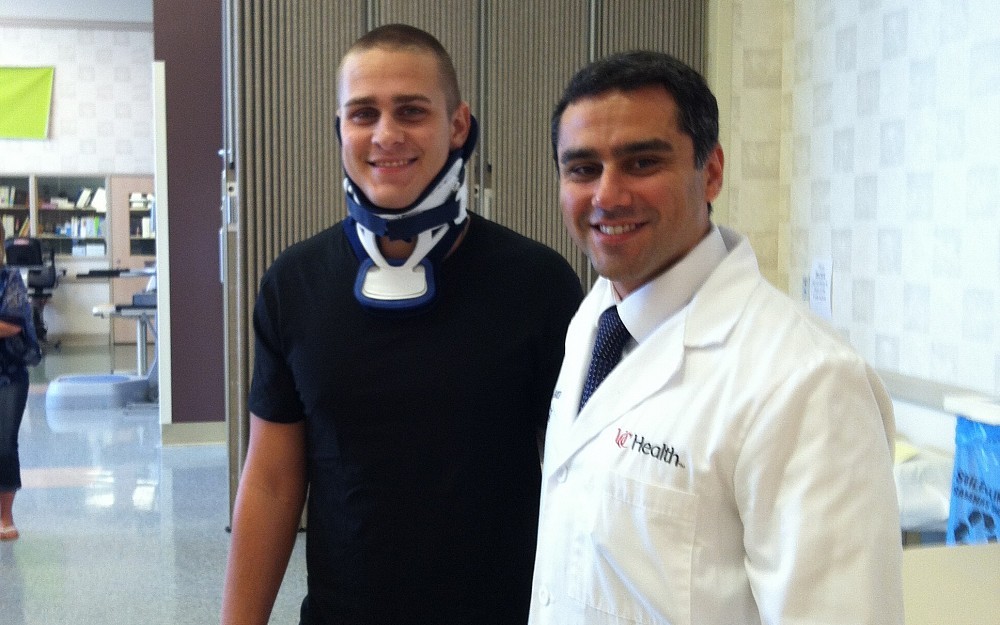
Consider 21-year-old Nick Wehby of Mason, Ohio, who was enjoying himself poolside with his parents at a graduation party one minute and floating face down the next, unable to move his arms or legs.
Although Wehby is walking again, he still has restricted mobility in his arms and a lot of rehabilitation ahead of him; because, unfortunately, what happened to him happens in residential pools all too frequently: he accidentally dove into the shallow end of the pool.
"I remember floating and wondering is this the last thought Im going to have? Wehby recalls of the accident that sent him to the emergency department at University of Cincinnati Medical Center (UCMC) on June 23, 2013, where he arrived a quadriplegic. The impact had dislocated Nicks C3 and C4 vertebrae.
Nick and his family attribute the mistake to the pool being the exact reverse of their own residential pool with Nick thinking the deep end was to his left like it is at home, and poor lighting. The accident happened at about 11:30 p.m.
"It was such a normal thing to do. He just got up out of his chair and said Im going to jump in and cool off, and dove in head first, says his father, Fred Wehby.
"Its very rare for patients to have Nicks degree of recovery, says Steven Agabegi, MD, the UC Health spine surgeon and assistant professor of orthopedic surgery at the University of Cincinnati College of Medicine, who rushed Nick into surgery after seeing a twinge of movement in one of Nicks legs.
Agabegi was able to relocate and fuse Nicks spine, but both the surgeon and Nicks family are hoping that the story of his miraculous recovery can be directed to help save someone else from what could have been a more devastating outcome. "Feet first, says Nick, who was attending the University of Indianapolis on a football scholarship but will be now be restricted from all contact sports.
It could have been so much worse, says Agabegi, who says that in the summer months its common to see at least a dozen head and spine trauma patients whose injuries resulted from diving, and those similar to Nicks injuries have resulted in the patient either being a paraplegic or a quadriplegic.
Agabegi cautions that although many residential pools have diving areas and diving boards, the majority of residential pools are not safe for diving, regardless of how deep the water is in the "deep end. Recreational diving, he says, should be restricted to large public pools, where there are clear markers and lifeguards on duty
Its not just about the depth; its the length and slope of the pool, says Agabegi.
"The recommended depth for diving is 9 feet, but even if you have a 9-foot deep end, there is still a slope between the deep and shallow ends. We have seen spinal trauma from hitting that slope.
Agabegi also warns of diving or jumping into natural bodies of water, where you cant see the bottom and dont know what youll hit under the waters surface.
According to the United States Consume Products Safety Division, which oversees pool manufacturers, most diving injuries take place in water 5 feet deep or shallower.
Other risk factors can include being a first-time visitor to a particular pool, the lack of depth markers, inadequate lighting, diving into another person in the pool, horseplay and alcohol.
Related Stories
Cancer Center plays key role in lab research, clinical trials for new pancreatic cancer drug
September 1, 2026

WLWT and WCPO highlighted the contributions of University of Cincinnati Cancer Center researchers that helped lead to the recent FDA approval of daraxonrasib, a new treatment for pancreatic cancer.
Cancer Center physician receives $150,000 New Investigator Research Grant to study treatment-resistant leukemia
September 1, 2026
The University of Cincinnati Cancer Center’s Sarah Skuli, MD, PhD, received a two‑year, $150,000 Leukemia Research Foundation New Investigator Grant to study TP53‑mutated leukemia, a treatment‑resistant subtype with very poor outcomes.
Heavy social media use linked to depression
August 31, 2026

U.S. News and World Report, Yahoo! News, MSN, USA Today and other national media highlight a new study by the University of Cincinnati and Northwestern University that found a correlation between heavy social media use and depression in adults.