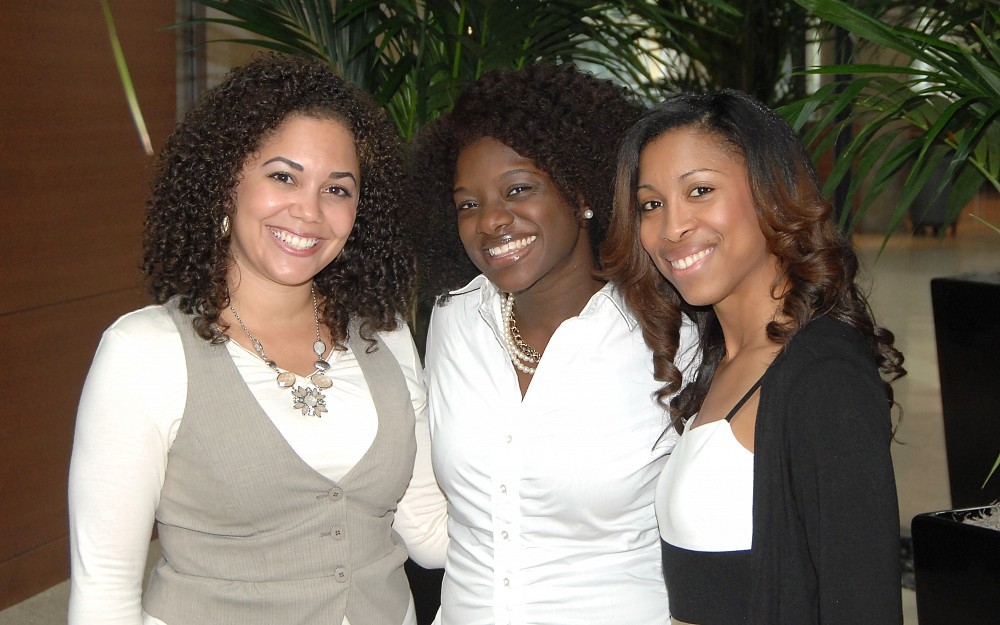
Together, Students Pave Their Own Path to Medical School

Today, Sara Stigler, Nicolette Barbour and Ashley Sutherland are three first-year medical students in the College of Medicines Class of 2017.
But two years ago, they were researchers, graduate students and a U.S. Air Force captainall trying to figure out how to apply to medical school while working 40-hour weeks, handling their responsibilities and getting any amount of sleep they could manage.
In order to do all that, Stigler, Sutherland and Barbour formed a unique partnership to help them study for the MCAT exam, apply for medical school and support and guide each other along the way.
Sutherland and Barbour had first met as young girls in a tight-knit elementary and high school in Cleveland, but went their separate ways during college.
At UC for her undergraduate degree, Barbour met Stigler in her pre-med program. Together, along with a small group, they launched UCs chapter of Minority Association of Pre-Med Students, or MAPs. Years later, they crossed paths again, when both Barbour and Stigler were working at Cincinnati Childrens Hospital Medical Center as clinical research coordinators.
They both still wanted to go to medical school, but with full-time jobs and, in Stiglers case, beginning a masters program, they were unsure of how to start the intensive studying regimen needed for the Medical College Admission Test (MCAT).
At the same time, Barbour and Sutherland, now stationed at Wright Patterson Air Force Base, were discussing methods for studying, when they all three found the answer: their own study group, dubbed "the MCAT Slayers.
Since the traditional MCAT study courses didnt work, they found a sample exam schedule online and shaped it to fit their schedule. Occasionally, they had to rework the study plan.
"We originally thought we can work for eight hours and then come home, do a few hours of homework, and then study for MCAT for five more hours, remembers Sutherland. "We really cant. Its not feasible.
Sutherland started to drive down for weekend study sessions, but most of their work was done through video chats, study binders and shared websites. During lunch breaks at work, they would gather with their books and laptops.
"We put our computers on silent and opened up Skype to study with each other, says Stigler. "The idea was that if I see you on your phone texting, it doesnt count as a study hour.
Around the fall of 2011, they fell into a regular schedule. They had a texted "question of the day, daily study breaks and weekly tests. They also fell into roles with in the group: Stigler was the long-term planner and motivator, Barbour organized the curriculum and Sutherland kept everyone on time and on task. After the MCAT, the three stuck together and completed their applications and interview preparation as a group.
"I think it was the best thing to ever happen to me, honestly, says Sutherland. "Being able to study with them and have that accountability, but also to understand our different strengths and weaknesses
we all learned a lot about ourselves.
When it came time to apply, they scheduled an informational meeting with Office of Diversity Affairs Coordinator William Harris as a groupwith Sutherland Skyped in from the base.
Theyre also discussing plans to use their skills out in the broader community. In addition to working towards increased health care access as physicians, they want to work on getting more minority students like themselves into medical school now.
"Looking at the numbers of people who are matriculating, especially underrepresented minorities, from UC into the College of Medicineits very small, says Stigler. "We want to help to be a liaison between the area high schools and colleges into the College of Medicine.
"Weve started to have conversations about how we can do that, adds Barbour. "Maybe we do a business, maybe we can do a foundation we can take this all the way.
Related Stories
Heavy social media use linked to depression
August 31, 2026

U.S. News and World Report, Yahoo! News, MSN, USA Today and other national media highlight a new study by the University of Cincinnati and Northwestern University that found a correlation between heavy social media use and depression in adults.
On-site training in Speech & Hearing Clinic sets UC’s programs apart
August 27, 2026
At the University of Cincinnati’s Speech & Hearing Clinic, Doctor of Audiology and Speech-Language Pathology graduate students gain real-world experience while providing free speech and hearing services to the community.
Designing with cancer patients' needs in focus
August 27, 2026
Kristina Shin is designing garments that prioritize the comfort, function and confidence of breast cancer patients, addressing a need often overlooked by traditional fashion.