Health Line: Coach's Seizures Prompt Discussion on Epilepsy and Stress

CINCINNATIFew jobs are more high-profile than head football coach at a state university. So when University of Minnesota Coach Jerry Kill experienced his fourth documented game-day epileptic seizure in 22 games at the school, a national discussion that spilled beyond the sports pages and websites ensued.
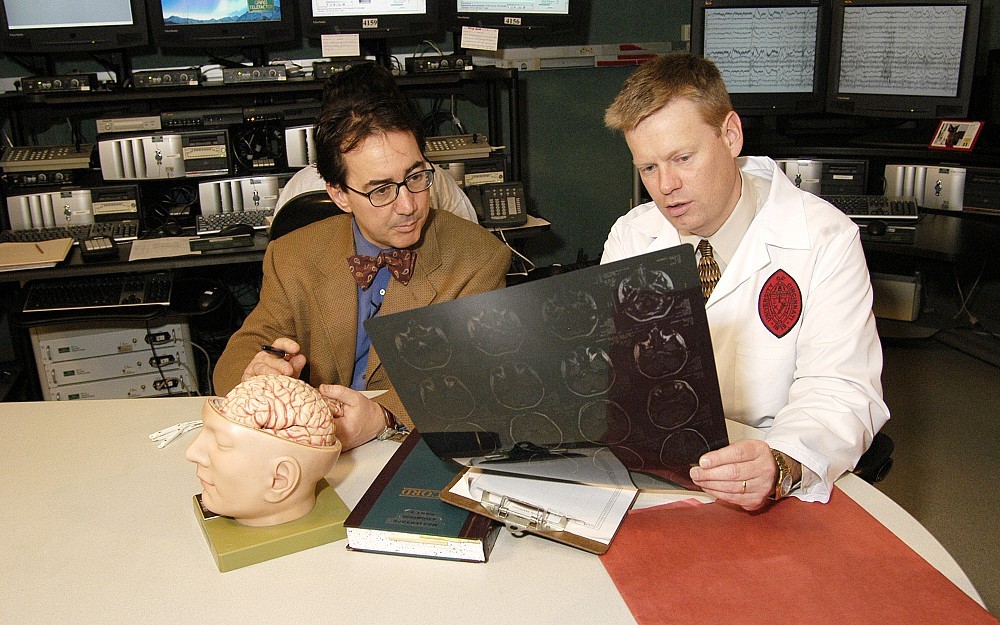
For Michael Privitera, MD, professor of neurology and rehabilitation at the University of Cincinnati (UC) College of Medicine and director of the UC Epilepsy Center, its a familiar dialogueand one he welcomes it as an opportunity for education.
"We try to educate people about what epilepsy is and what it is not, says Privitera. "People with epilepsy suffer from stigmatization and this has been true for centuries where people with seizures were thought to be possessed.
"Epilepsy has also had inappropriate stigma about mental illness and cognitive impairment. People with epilepsy are more likely than the general population to suffer from depression, but once identified, depression can be treated just as in the case of someone without epilepsy.
According to the Epilepsy Foundation, epilepsy is a medical condition that produces seizures affecting a variety of mental and physical functions. A seizure happens when a brief, strong surge of electrical activity affects part or all of the brain.
An estimated 2.2 million Americans have epilepsy, the foundation says. When a person has two or more unprovoked seizures, he or she considered to have epilepsy.
Kill has been a head coach at the college level since 1994, steadily moving up the ladder to the position he now occupies at Minnesota, a member of the prestigious Big Ten conference. Now in his third season with the Gophers, he has been rushed to a hospital after having a seizure and collapsing on the sidelines and, most recently, suffering a seizure during a game last month and missing the second half.
After last months seizure, at least one national columnist, Gregg Doyel of CBSSports.com, raised the alarming specter of Kill dying on the sidelines and wrote: " What about whats best for everyone else? Who gets to make that decision?
Seizures should not mean exclusion from a high-profileand often stressful job such as Kills, Privitera says. However, if job stress is a seizure trigger, then the person with epilepsy in consultation with his or her physician should evaluate the risk benefit of stressful activities.
"There is a difference between having seizures exclude you from a certain job or activity compared to avoiding certain activities that are seizure triggers, Privitera says. "About half of people with epilepsy report that stress can make seizures more likely.
Privitera says people with epilepsy should not participate in activities where a brief loss of awareness would be dangerous to the person or others, such as driving, operating heavy machinery or working from heights.
Privitera and his colleagues at the UC Epilepsy Center, one of 12 centers and programs at the UC Neuroscience Institute, an institute of the UC College of Medicine and UC Health, have done extensive research on stress as a seizure trigger. Theyve identified some risk factors but much work needs to be done, Privitera says, adding that the Cincinnati-based Charles L. Shor Foundation for Epilepsy Research funds research on understanding and blocking the effects of stress on seizures.
David Ficker, MD, an associate professor of neurology and rehabilitation medicine and associate director of the UC Epilepsy Center, says that by continuing to coach, Kill is setting an important example for others who face the uncertainty of seizures and the stigma that some people will inevitably impose.
"I think he is a great role model for individuals with epilepsy who want to continue working, and who should try to continue working, Ficker says.
The Epilepsy Foundation provides guidance for first aid in the event of a seizure, noting that the goal is to keep the person safe until the seizure stops naturally. Emergency assistance should be called if a seizure lasts longer than five minutes, if the individual has more than one seizure without returning to normal or if an injury occurs as a result of the seizure.
For ongoing care, Privitera points out that the UC Epilepsy Center has a Level 4 designation from the National Association of Epilepsy Centers, the most advanced certification an epilepsy center can obtain.
Work-related issues for people with epilepsy will be among the topics at an Oct. 19 patient symposium, "Strategies for Managing Epilepsy: Ask the Experts, a free event for patients and families at UC Health West Chester Hospital. Ficker is the program director; topics will include treatments, coping with stress and driving with epilepsy. For more additional information or for assistance registering, call 513-558-5438.
Related Stories
Why can it get so hot at times?
September 3, 2026

Cincinnati is experiencing more days of extreme heat this summer than in previous decades, due in large part to warmer global temperatures. But explanations for these higher temperatures also relate to regional factors, including the city's location in a river valley and large proportion of built environment.
UC invests in the next generation of graduate leaders through fellowships focused on mentorship and research
September 3, 2026
The Next Lives Here Presidential Fellowship supports the recruitment of top doctoral students through competitive funding, mentorship and professional development.
Cancer Center plays key role in lab research, clinical trials for new pancreatic cancer drug
September 1, 2026

WLWT and WCPO highlighted the contributions of University of Cincinnati Cancer Center researchers that helped lead to the recent FDA approval of daraxonrasib, a new treatment for pancreatic cancer.